Custom Software Development for Scaleups: Scale Smarter Today
.png)

.svg)
[ key takeways ]
- Custom software helps scaleups handle growth without being limited by generic tools or rigid systems.
- As businesses expand, tailored solutions improve efficiency by aligning with real workflows and operations.
- Scalable architecture, cloud infrastructure, and automation are essential for long-term performance.
- Choosing the right development partner plays a major role in building reliable and future-ready systems.
- Investing early in the right software foundation makes growth smoother, faster, and more sustainable.
.svg)
Growth changes everything. The tools that once helped your business move fast can suddenly start slowing you down. This is where custom software development for scaleups comes in.
It means building software that fits your business as it grows, your workflows, your users, and your goals.
Scaleups need this because off-the-shelf tools often cannot handle increasing complexity, data, and demand. Without the right systems, growth can turn messy and inefficient.
Understanding custom software is important because it directly affects how smoothly you scale and compete. The right solution can save time, reduce costs, and improve performance.
Let’s explore how it works and why it matters for your growth.
What Is Custom Software Development for Scaleups?
Custom software development for scaleups means building software that is designed specifically for a growing business. Instead of using general tools, companies create systems that match their exact needs, workflows, and growth plans.
This becomes important because scaleups grow fast and standard tools often cannot keep up.
What Defines a Scaleup Company
A scaleup company is a business that has moved beyond the startup stage and is now growing quickly in users, revenue, and operations.
These companies are often backed by venture capital, which helps them expand faster, hire talent, and enter new markets. Many of them operate as SaaS platforms, which serve a large number of users online.
Scaleups are often described as high-growth companies or venture-backed startups because their main focus is rapid expansion.
As they grow, operations become more complex, with larger teams, more customers, and heavier data usage. These are also known as scaling startups, where efficiency and system stability become critical.
Custom Software vs Off-the-Shelf Solutions
The key difference between custom software and off-the-shelf tools is flexibility. Off-the-shelf software is ready-made and designed for general use. It is quick to start but limited in customization. As a result, businesses often need to adjust their processes to fit the tool.
On the other hand, enterprise software built as custom or bespoke software is designed around the company’s specific needs. This supports better flexibility, smoother integration with other systems, and stronger scalability.
This is where the build vs buy software decision becomes important. While SaaS tools work well for early stages, scaleups often shift toward custom solutions when they need better control, deeper integration, and long-term growth support.
Key Features of Scalable Custom Software
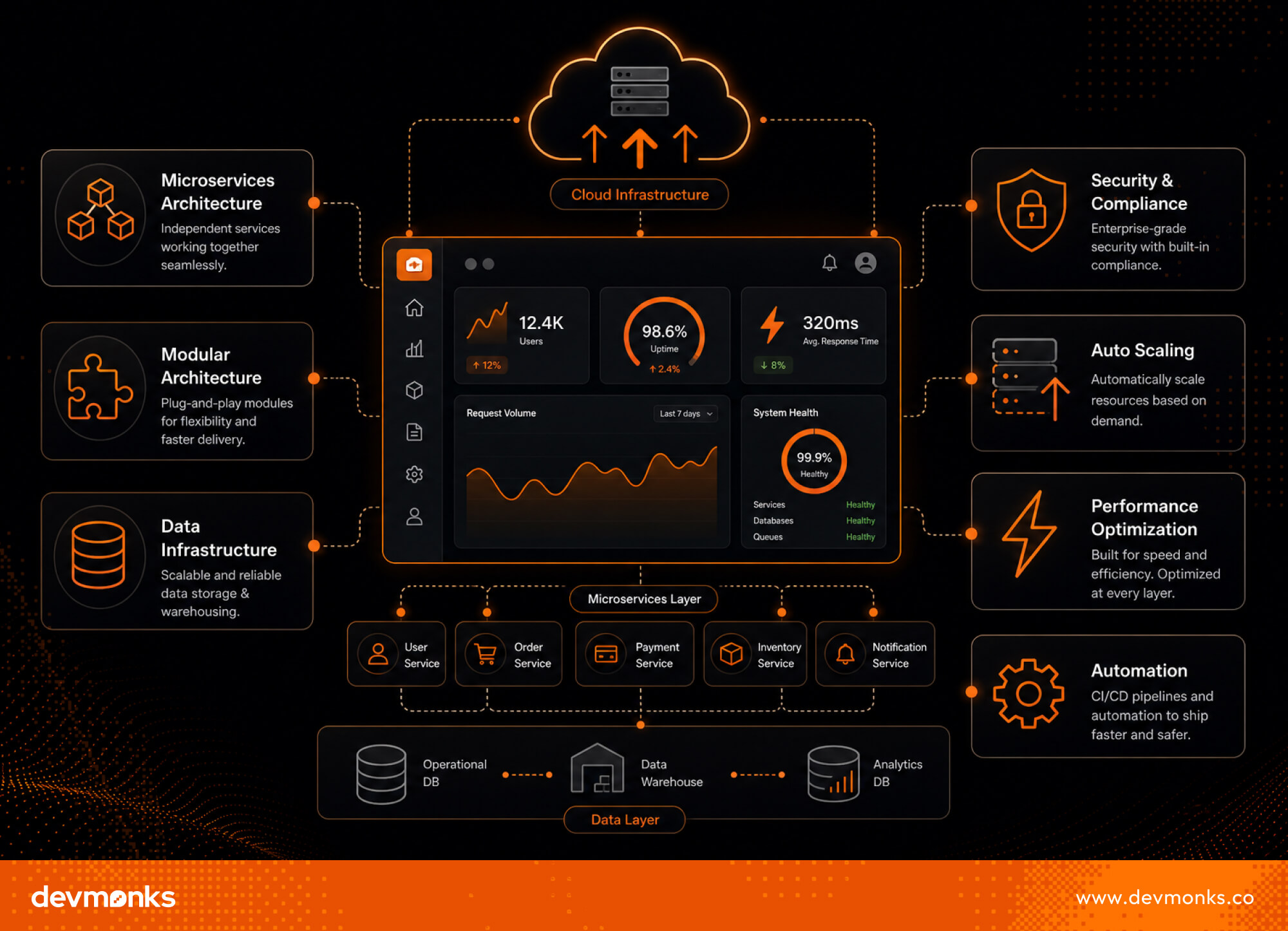
Scalable custom software is designed to grow with a business without slowing down or breaking under pressure. Here are the major features of scalable custom software.
Scalable Software Architecture
Scalable systems often use a microservices architecture, where each function of the software works as a separate module. This makes updates easier and allows individual parts to scale independently without affecting the whole system.
These systems also run on Cloud infrastructure, which supports horizontal scaling by adding more servers when demand increases. In distributed systems, multiple services work together across different servers, which improves speed and reliability.
Security and Compliance
As companies grow, protecting data becomes more important. Strong security systems help prevent breaches and ensure safe access to sensitive information.
Compliance standards like GDPR and SOC 2 ensure that companies follow global rules for privacy and security. These are essential when scaleups expand into international markets or handle large user data.
Data Infrastructure for Growth
A data warehouse helps store large amounts of structured data in one place for easy access and reporting. It supports smooth data management across departments.
Big data analytics turns this data into insights, which helps businesses make data-driven decisions that improve strategy and performance.
Architecture Flexibility
Flexible systems use a modular design, where parts can be updated independently. Loose coupling reduces dependency between components, which makes the system easier to maintain.
Statelessness improves scalability by allowing each request to run independently.
Elastic Cloud Infrastructure
Cloud systems offer auto scaling, which adjusts resources based on demand. Containerization and orchestration help run applications efficiently across environments, which improves deployment speed and reliability.
High Performance and Automation
Load balancing, database sharding, and caching strategies ensure fast system performance even with high traffic.
Meanwhile, CI/CD pipelines and asynchronous processing automate development and background tasks, which keep systems fast and efficient.
Custom Software Development Process for Scaleups
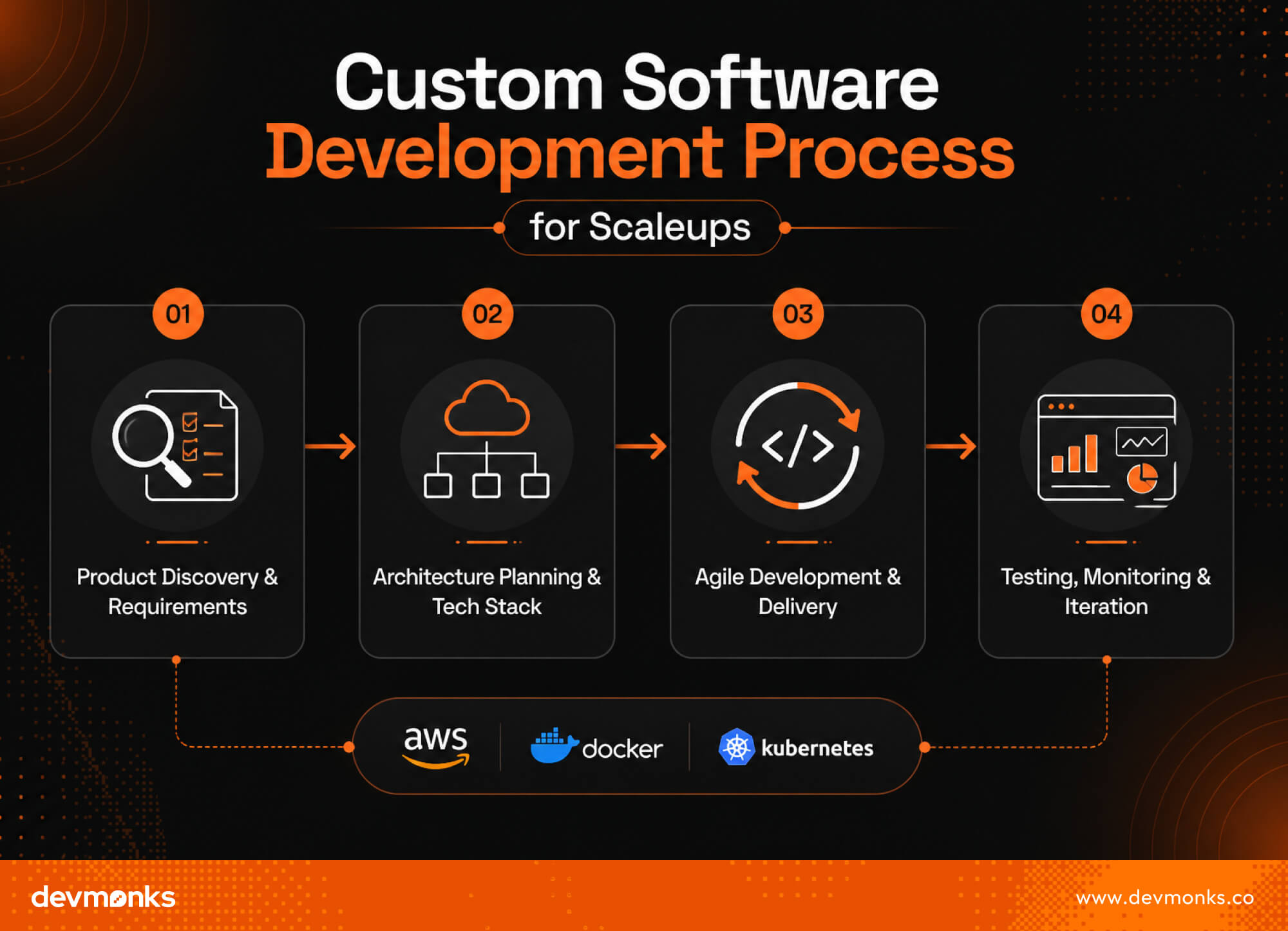
Building custom software for scaleups follows a structured process. This ensures the system is not only functional but also scalable, stable, and ready for long-term growth.
Each stage that plays a key role in turning business needs into a reliable digital product is given below.
Step 1: Product Discovery and Requirements Mapping
The process starts with understanding what the business truly needs. Teams run discovery sessions to define goals, user problems, and growth expectations. This phase helps shape a clear product roadmap, which guides the entire development journey.
A key outcome here is defining the MVP (Minimum Viable Product). This is the simplest version of the product that still delivers value. It helps scaleups test ideas quickly while keeping scalability requirements in mind from the beginning.
Step 2: Architecture Planning and Tech Stack Selection
Once requirements are clear, teams design the system architecture. This includes deciding how the software will be structured and which technologies will be used. The goal is to ensure the system can grow without performance issues.
Popular tools and platforms like AWS, Kubernetes, and Docker are often chosen for scalability and reliability. This stage defines the overall technology stack, which includes frameworks, programming languages, and cloud setup that best fit the product needs.
Step 3: Agile Development and Continuous Delivery
Development usually follows Agile methodology, where work is divided into small, manageable cycles called sprints. This allows teams to build features step by step and adapt quickly to changes.
With DevOps practices and continuous deployment, new updates are tested and released frequently. CI/CD pipelines automate this process, which makes development faster, more reliable, and less error-prone.
Step 4: Testing, Monitoring, and Iteration
Before and after release, the system goes through continuous testing. Automated testing ensures that new changes do not break existing features and that the software remains stable.
After deployment, monitoring systems track performance, errors, and user behavior in real time. This feedback helps teams improve the product through continuous iteration, which ensures the system stays scalable and efficient as it grows.
How to Choose the Right Custom Software Development Partner
Choosing the right development partner is critical for scaleups because the quality of your software directly impacts your growth. The right team should understand not just coding, but also how fast-growing businesses operate.
Here are the ways to choose the right custom software development partner.
Experience with High-Growth Companies
Look for a partner with proven experience in building products for high-growth companies. Their portfolio should show work with scaleups or venture-backed startups, where scalability and speed were important.
This ensures they understand real-world growth challenges, not just basic development.
Technical Expertise and Architecture Capability
Strong engineering leadership is essential. The partner should be skilled in system design, scalable architecture, and modern tools. They must know how to build systems that handle long-term growth, not just short-term delivery.
Collaboration and Agile Practices
Good communication and teamwork matter as much as technical skills. A strong partner follows Agile methodology and works closely with your team to adapt quickly.
For example, agencies like Dev Monks focus on collaborative development, scalable architecture, and Agile delivery, which makes them a strong fit for scaleups that want both speed and stability in their product growth.
Technologies Used in Custom Software for Scaleups
Modern scaleups rely on powerful technologies to build software that can handle rapid growth, high traffic, and complex operations. The right tech stack ensures performance, flexibility, and long-term scalability.
Cloud Infrastructure Platforms
Most scalable systems are built on cloud platforms that provide flexible computing power and storage. Leading providers include AWS, Google Cloud, and Microsoft Azure.
These platforms support automatic scaling, high availability, and global deployment, which makes them ideal for fast-growing businesses.
Backend Technologies for Scalability
The backend is the core of any system. Popular choices include Node.js for fast, event-driven applications, Python for flexibility and data-heavy systems, Java for enterprise-level stability, and Go for high-performance microservices.
These technologies help manage complex operations efficiently.
Frontend Technologies for High-Growth Products
For user interfaces, scaleups often use React, Vue, and Next.js. These frameworks help build fast, responsive, and interactive web applications, ensuring smooth user experiences even as traffic grows.
Challenges in Custom Software Development for Scaleups
Custom software development brings many benefits, but scaleups also face several challenges while building and scaling their systems.
Managing Technical Debt
Fast development can lead to technical debt, where quick fixes create long-term complexity. Over time, this makes the system harder to maintain and slows down new feature development.
Maintaining Performance During Growth
As user numbers increase, systems must scale databases, APIs, and infrastructure. Without proper planning, performance issues like slow response times and downtime can occur.
Hiring and Managing Engineering Talent
Scaleups often struggle to balance internal teams and outsourced developers. While in-house teams offer control, external partners can provide speed and expertise.
Scope Creep and Feature Prioritization
Projects often expand beyond the original plan, which makes it difficult to prioritize features and stay focused on the product roadmap.
Scalability Bottlenecks
Poor architectural decisions can create bottlenecks that limit growth and system performance.
Resource and Budget Constraints
Limited time and budget can restrict technology choices, which makes it harder to build fully optimized, scalable systems.
Cost of Custom Software Development for Scaleups
The cost of custom software development for scaleups can range from $30,000 to $1M+, depending on several key factors. A larger development scope increases the overall development cost, especially when more features and integrations are required.
The size of the team also affects the software budget, as more developers, designers, and engineers mean higher expenses.
In addition, infrastructure costs like cloud services and tools, along with ongoing maintenance and updates, add to long-term spending. Proper planning helps scaleups balance quality and budget effectively.
Future Trends in Custom Software for Scaleups
Here are some of the emerging future trends in custom software for scaleups.
- AI-driven development: AI is increasingly used to speed up coding, testing, and debugging. It helps teams build software faster and make better decisions during development.
- Low-code platforms: These tools allow faster application building with minimal coding, which helps scaleups launch and iterate products quickly without heavy engineering effort.
- Serverless architecture: This model lets companies run applications without managing servers directly. It improves scalability and reduces infrastructure costs because you only pay for actual usage.
- Platform engineering: Focuses on building internal developer platforms that simplify workflows, improve productivity, and support large engineering teams as the company grows.
FAQs
Why Generic Software Becomes a Limitation for Scale-Ups?
Generic software often works well in the early stages of a business because it is quick and easy to use. However, as scaleups grow, these tools start to limit flexibility. They are built for mass use, not specific workflows, so businesses face missing features, weak integration, and extra manual work. Over time, this creates inefficiencies. Teams must rely on multiple disconnected tools, which slows down operations and reduces productivity.
Why Scaleups Choose Custom Software?
Scaleups choose custom software because it is built around their exact business needs. Instead of adjusting their processes to fit a tool, they build a system that supports their workflow, goals, and growth plans. This improves efficiency, flexibility, and integration across teams. Custom software also scales with the business. New features, departments, and users can be added without disrupting the system.
How Custom Software Helps Startups Automate Operations?
Custom software helps startups automate repetitive tasks such as data entry, reporting, customer onboarding, and order processing. This reduces manual work and allows teams to focus on higher-value activities like strategy and growth. It also connects different business functions into one system. Instead of switching between tools, data flows automatically across departments. This improves accuracy, reduces errors, and speeds up decision-making, which helps startups operate more efficiently as they scale.
When to build custom software?
Build custom software when off-the-shelf solutions limit your growth, workflows are too complex, or integration needs are unique. It’s ideal when scalability, data control, or competitive advantage matters, and when long-term efficiency outweighs upfront development costs and time investment for your business.
End note
Scaling a business is not just about growing faster, it is about growing smarter. Custom software gives scaleups the structure and flexibility they need to manage complexity, improve efficiency, and deliver better customer experiences.
Instead of relying on tools that limit growth, businesses should focus on building systems that align with their long-term goals. The right custom solution can streamline operations, support innovation, and create a strong foundation for future expansion.
If you are planning to scale, now is the time to evaluate your current systems. Investing in the right software today can make growth smoother, faster, and more sustainable tomorrow.
.png)
.svg)
Frequently Asked Questions
How can I discuss an AI MVP with Dev Monks?

Book a strategy call with your use case, existing systems, and project priorities. The team can help define an initial scope and the dependencies that need to be addressed.
Does using AI replace engineering review?
Dev Monks uses AI-assisted workflows with human-guided decisions. Product requirements, engineering choices, and testing remain part of the development process.
What AI development services does Dev Monks offer?
Dev Monks offers agentic AI solutions, custom language-model solutions, workflow automation, and RAG development. Its broader services include SaaS engineering, MVP development, backend integrations, and web and mobile applications.
Is Dev Monks an official OpenAI Select Partner?
Yes. Dev Monks is now an official OpenAI Select Partner within the OpenAI Partner Network.
How long does it usually take to complete a project?
We combine AI-driven workflows with product-first engineering to provide MVP development services for startups and enterprises. Our approach balances speed, reliability, and usability while keeping teams involved. We deliver production-ready, scalable solutions, not just prototypes or demos.
What makes Dev Monks different from other development companies?
We combine AI-driven workflows with product-first engineering to provide MVP development services for startups and enterprises. Our approach balances speed, reliability, and usability while keeping teams involved. We deliver production-ready, scalable solutions, not just prototypes or demos.
How Involved Will My Team be During Development?
We combine AI-driven workflows with product-first engineering to provide MVP development services for startups and enterprises. Our approach balances speed, reliability, and usability while keeping teams involved. We deliver production-ready, scalable solutions, not just prototypes or demos.
How involved will my team be during development?
We combine AI-driven workflows with product-first engineering to provide MVP development services for startups and enterprises. Our approach balances speed, reliability, and usability while keeping teams involved. We deliver production-ready, scalable solutions, not just prototypes or demos.
Do you develop both web and mobile applications?
We combine AI-driven workflows with product-first engineering to provide MVP development services for startups and enterprises. Our approach balances speed, reliability, and usability while keeping teams involved. We deliver production-ready, scalable solutions, not just prototypes or demos.
How can Dev Monks help my startup launch faster
We combine AI-driven workflows with product-first engineering to provide MVP development services for startups and enterprises. Our approach balances speed, reliability, and usability while keeping teams involved. We deliver production-ready, scalable solutions, not just prototypes or demos.
%20vs%20new%20Date().jpg)