SaaS platforms differ from traditional software in one critical way: They are shared systems. Instead of one application per customer, SaaS platforms serve multiple tenants through a single scalable infrastructure.
This introduces architectural challenges:
Data isolation
Tenant-based configuration
Resource allocation
Horizontal scaling
Security segmentation
Feature toggling per tenant
Security & Isolation
SaaS platforms differ from traditional software in one critical way: They are shared systems. Instead of one application per customer, SaaS platforms serve multiple tenants through a single scalable infrastructure. SaaS platforms differ from traditional software in one critical way: They are shared systems. Instead of one application per customer, SaaS platforms serve multiple tenants through a single scalable infrastructure.
Performance Engineering & Performance challenges in SaaS
SaaS platforms differ from traditional software in one critical way: They are shared systems. Instead of one application per customer, SaaS platforms serve multiple tenants through a single scalable infrastructure. SaaS platforms differ from traditional software in one critical way: They are shared systems. Instead of one application per customer, SaaS platforms serve multiple tenants through a single scalable infrastructure.
SaaS platforms differ from traditional software in one critical way: They are shared systems. Instead of one application per customer, SaaS platforms serve multiple tenants through a single scalable infrastructure. SaaS platforms differ from traditional software in one critical way: They are shared systems. Instead of one application per customer, SaaS platforms serve multiple tenants through a single scalable infrastructure.
Scaling Strategy
SaaS platforms must scale horizontally.
This includes:
Stateless application servers
Load balancing
Auto-scaling groups
Distributed caching
Read replicas
Queue-based processing
Observability & Reliability: You cannot scale what you cannot measure.
SaaS platforms differ from traditional software in one critical way: They are shared systems. Instead of one application per customer, SaaS platforms serve multiple tenants through a single scalable infrastructure. SaaS platforms differ from traditional software in one critical way: They are shared systems. Instead of one application per customer, SaaS platforms serve multiple tenants through a single scalable infrastructure.
Conclusion
SaaS platforms differ from traditional software in one critical way: They are shared systems. Instead of one application per customer, SaaS platforms serve multiple tenants through a single scalable infrastructure. SaaS platforms differ from traditional software in one critical way: They are shared systems. Instead of one application per customer, SaaS platforms serve multiple tenants through a single scalable infrastructure.
Atiqur Rahman
CEO & Co-founder
In seven years, he revamped Toffee for 10M users, blending feedback. Co-founder of Design Monks, creating impactful experiences.
How long does it usually take to complete a project?
We combine AI-driven workflows with product-first engineering to provide MVP development services for startups and enterprises. Our approach balances speed, reliability, and usability while keeping teams involved. We deliver production-ready, scalable solutions, not just prototypes or demos.
What makes Dev Monks different from other development companies?
We combine AI-driven workflows with product-first engineering to provide MVP development services for startups and enterprises. Our approach balances speed, reliability, and usability while keeping teams involved. We deliver production-ready, scalable solutions, not just prototypes or demos.
How Involved Will My Team be During Development?
We combine AI-driven workflows with product-first engineering to provide MVP development services for startups and enterprises. Our approach balances speed, reliability, and usability while keeping teams involved. We deliver production-ready, scalable solutions, not just prototypes or demos.
How involved will my team be during development?
We combine AI-driven workflows with product-first engineering to provide MVP development services for startups and enterprises. Our approach balances speed, reliability, and usability while keeping teams involved. We deliver production-ready, scalable solutions, not just prototypes or demos.
Do you develop both web and mobile applications?
We combine AI-driven workflows with product-first engineering to provide MVP development services for startups and enterprises. Our approach balances speed, reliability, and usability while keeping teams involved. We deliver production-ready, scalable solutions, not just prototypes or demos.
How can Dev Monks help my startup launch faster
We combine AI-driven workflows with product-first engineering to provide MVP development services for startups and enterprises. Our approach balances speed, reliability, and usability while keeping teams involved. We deliver production-ready, scalable solutions, not just prototypes or demos.
The best free AI for Python coding depends on your goals. ChatGPT excels at code generation and learning, Claude is outstanding for debugging, Gemini handles large codebases well, while GitHub Copilot and Windsurf shine inside VS Code with powerful autocomplete features.
No single AI is perfect for every task. An AI that works well for Django development may not be the best for competitive programming or data science.
Knowing which tool is best for writing code, fixing bugs, or learning Python can save time and improve productivity. Read on to compare the top free Python AI tools and find the right one for your workflow.
What Is the Best Free AI for Python Coding?
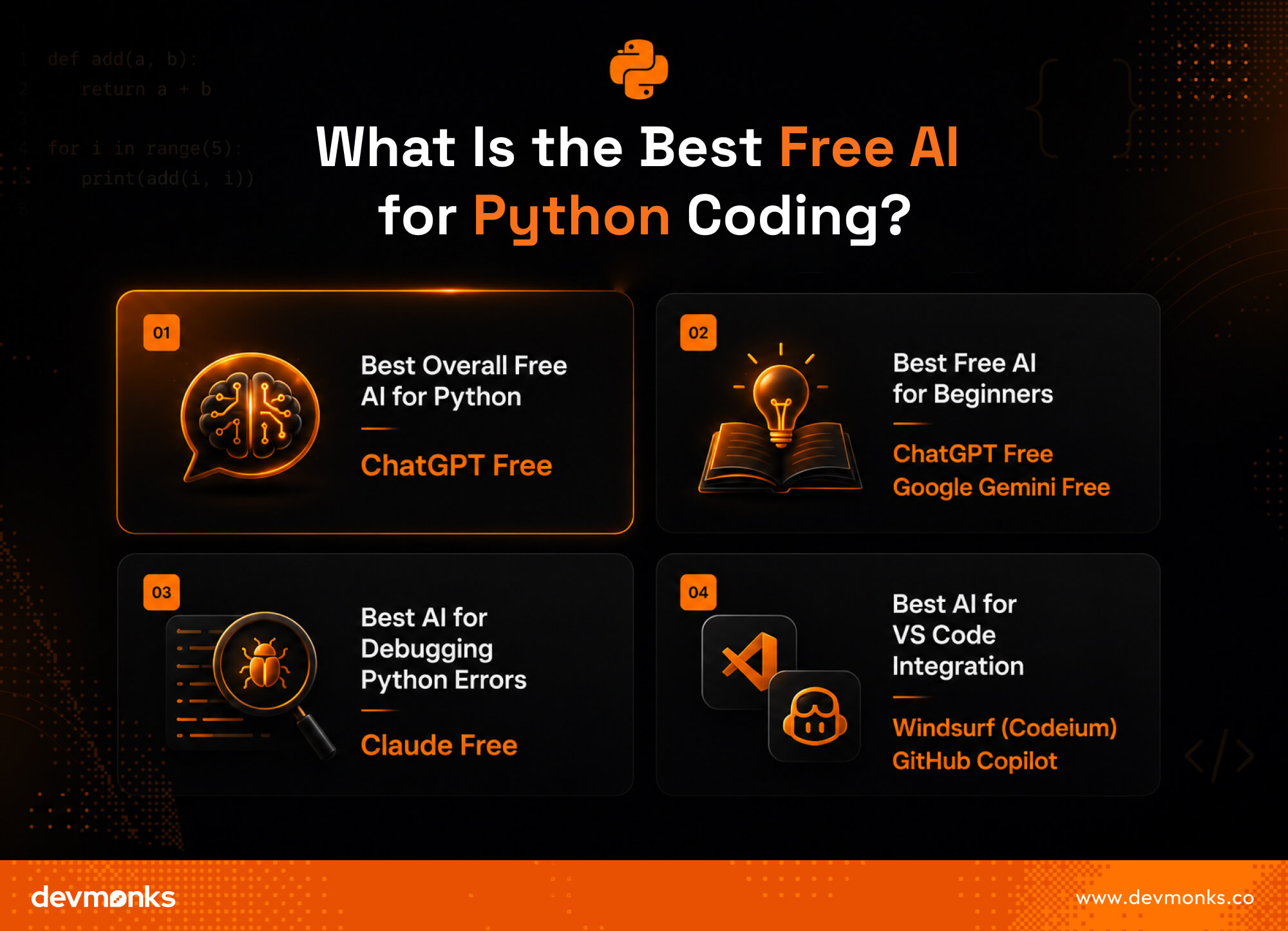
The best free AI for Python coding depends on your needs, but ChatGPT Free offers the best overall balance for most users. It combines code generation, explanations, debugging help, and learning support in a simple interface.
Whether you are writing your first Python script or building a larger project, it works as a reliable AI coding assistant. Learning web development takes a lot of time, especially if you're starting with Python. But if you have ChatGPT, it's way easier.
Best Overall Free AI for Python
ChatGPT Free is the top choice for most developers. It supports code generation, explains concepts clearly, and helps fix errors. Its ease of use makes it suitable for both beginners and experienced programmers.
Best Free AI for Beginners
For beginners, ChatGPT Free and Google Gemini Free are excellent Python AI tools. They explain code in simple language, answer follow-up questions, and help users learn Python step by step. Their conversational style makes coding less intimidating.
Best AI for Debugging Python Errors
When it comes to debugging, Claude Free stands out. Its strong reasoning abilities allow it to analyze complex code and identify the root cause of errors. Instead of only suggesting fixes, it often explains why the problem occurred.
Best AI for VS Code Integration
If you work in VS Code, Windsurf (Codeium), and GitHub Copilot are excellent options. They provide autocomplete, smart code completion, and in-editor AI assistance, which helps developers write Python code faster without leaving their IDE.
While AI tools can help developers write code faster, businesses often require expert implementation and custom solutions.
Agencies like Dev Monks use AI-assisted development practices to build high-quality websites and applications tailored to specific business needs.
Top Free AI Tools for Python Coding Compared
If you are searching for the best free AI for coding Python, you have plenty of great options today. Some tools work as chat assistants, while others integrate directly into your code editor.
The right choice depends on whether you need code completion, debugging, or full project support. Here is a detailed look at the top free AI coding tools for Python developers.
ChatGPT Free
ChatGPT Free is one of the most popular AI tools for Python coding. It helps users write scripts, explain concepts, generate functions, and debug errors.
Beginners especially enjoy its conversational style because they can ask follow-up questions and receive detailed explanations.
The tool is excellent for learning Python syntax, understanding algorithms, and fixing common bugs. It can also generate code snippets quickly and explain why a certain approach works.
However, the free version has usage limits and may not always provide editor-based autocomplete or code completion features. You usually need to copy and paste code into the chat interface.
Claude Free
Claude Free stands out for its strong reasoning abilities. It performs especially well when analyzing complex Python code and identifying logical errors.
Many developers use it for debugging because it explains problems clearly and suggests practical fixes.
This AI coding tool is useful for reviewing large code blocks and improving code quality. It often provides thoughtful responses that help developers understand the root cause of bugs rather than simply offering quick fixes.
The free version may have message limits depending on usage.
Google Gemini Free
Google Gemini Free is another powerful option for Python developers. It offers generous free usage and supports long conversations, which makes it useful for larger coding projects.
One of its biggest strengths is handling long context windows. This helps developers to work with larger files and maintain continuity across multiple coding tasks.
Gemini can assist with code generation, debugging, and explanations while integrating with Google's ecosystem.
Windsurf (Codeium)
Windsurf, powered by Codeium, is a strong free AI coding tool designed for developers who prefer working directly inside their editor. It provides fast autocomplete and code completion features that speed up Python development.
The tool supports popular editors such as VS Code, which makes it convenient for daily coding. Developers can generate functions, receive suggestions, and improve productivity without constantly switching tabs.
GitHub Copilot Free
GitHub Copilot Free gives developers access to AI-powered coding assistance within the GitHub ecosystem. It offers a free quota that allows users to experience AI-driven code completion and autocomplete features.
For Python developers already using GitHub repositories, Copilot integrates smoothly into their workflow. It can generate repetitive code, suggest functions, and help reduce development time. However, advanced usage may require a paid subscription.
Cursor Free
Cursor is an AI-powered code editor built specifically for developers. Unlike chat-based tools, Cursor brings AI directly into the coding environment.
This editor-based workflow helps users write, edit, and debug Python code without leaving the workspace.
Cursor supports intelligent code completion, project understanding, and quick debugging. Developers who prefer an integrated coding experience often find Cursor highly efficient.
Replit AI
Replit AI is ideal for users who want browser-based coding without installing software. It combines an online IDE with AI assistance, which makes Python development accessible from almost any device.
The AI features help with code generation, debugging, and explanations directly inside the browser. This makes Replit especially useful for students, beginners, and developers who need a portable coding environment.
Feature Comparison Table of Free Python AI Tools
Choosing the best AI for coding Python for free can be difficult because each tool shines in different areas. Some focus on debugging, while others excel at code completion or editor integration.
The table below compares the most important features to help you pick the right AI coding assistant for your needs.
AI Tool
Free Plan
Python Support
Debugging Quality
VS Code Support
Context Window
Best For
ChatGPT Free
Yes
Excellent
Very Good
Limited (via extensions)
Medium
Learning Python, explanations, and debugging
Claude Free
Yes
Excellent
Excellent
Limited
Very Large
Bug fixing and code reasoning
Google Gemini Free
Yes
Excellent
Very Good
Limited
Large
Working with long code files
Windsurf (Codeium)
Yes
Excellent
Good
Native support in VS Code
Medium
Autocomplete and code completion
GitHub Copilot Free
Yes (with quota)
Excellent
Good
Native support in VS Code
Medium
Developers using GitHub workflows
Cursor Free
Yes
Excellent
Very Good
Built-in editor
Medium to Large
AI-powered editor experience
Replit AI
Yes (limited)
Excellent
Good
Browser-based
Medium
Online Python coding
JetBrains AI
Limited free access
Excellent
Very Good
No
Medium
Developers using JetBrains IDEs
Which Free AI Is Best for Different Python Tasks?
Not all Python AI tools are built for the same job. Some are better at code generation, while others excel at Python debugging or code explanation. Choosing the right AI can save time and improve your coding experience.
Best AI for Writing Python Scripts
For writing Python scripts, ChatGPT Free and Google Gemini Free are excellent choices. They can generate code quickly, explain syntax, and suggest better ways to solve problems.
Whether you need a simple calculator or a web scraper, these tools can help.
Best AI for Debugging Errors
If your code keeps throwing errors, Claude Free is one of the best options. Its strong reasoning skills make it excellent for Python debugging and code refactoring. It often identifies not only the bug but also why it happened.
Best AI for Django Development
Developers working with Django can benefit from ChatGPT and GitHub Copilot. These tools understand common Django patterns, such as models, views, and templates. They can generate boilerplate code and speed up development.
Best AI for Data Science and Pandas
For data science tasks, ChatGPT and Gemini perform very well. They can help with libraries like NumPy, Pandas, and Matplotlib. From cleaning datasets to creating charts, these AI assistants simplify complex tasks.
Best AI for Learning Python
Beginners often prefer ChatGPT Free because of its teaching style. It provides step-by-step explanations, answers questions, and breaks down difficult concepts into easy language.
Best AI for Competitive Programming
For logic-heavy problems and algorithms, Claude Free and Gemini Free are strong choices. They can explain time complexity, suggest efficient solutions, and help developers improve their problem-solving skills.
Can AI Generate Entire Python Projects?
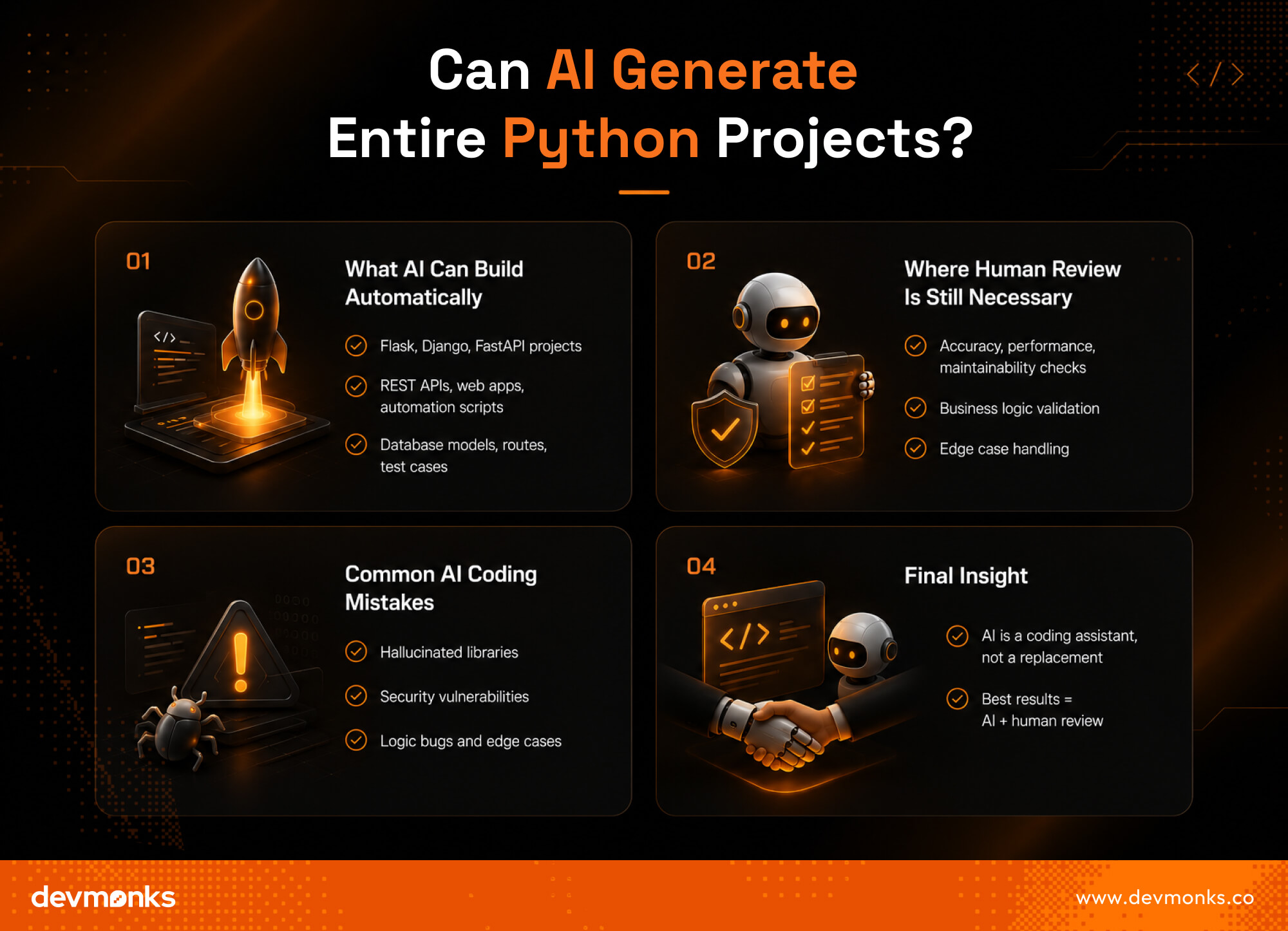
Yes, AI can generate entire Python projects, but it is not fully autonomous. Modern AI tools can create project structures, write code, and even generate documentation.
They are especially useful for building small to medium-sized applications quickly. For enterprise web development, it's better to take human assistance.
What AI Can Build Automatically
AI can create Python applications using frameworks like Flask, Django, and FastAPI. For example, it can generate REST APIs, web applications, data analysis scripts, and automation tools.
AI can also write database models, create routes, and suggest test cases. This greatly speeds up development and reduces repetitive work.
Where Human Review Is Still Necessary
Even though AI is powerful, human review remains essential. Developers should always check the generated code for accuracy, performance, and maintainability.
AI may not fully understand business requirements or edge cases. Human oversight ensures that the application works as intended and follows best practices.
This is where experienced developers and reliable agencies come in. Agencies like Dev Monks combine AI-assisted development with expert review to ensure applications are secure, scalable, and aligned with business goals.
Human oversight ensures that the final product works as intended and follows industry best practices.
Common AI Coding Mistakes
AI-generated code is not perfect. Common mistakes include:
Hallucinated libraries: The AI may reference packages, APIs, or functions that do not actually exist.
Security issues: Generated code can contain vulnerabilities such as insecure authentication, poor input validation, or unsafe database queries.
Logic bugs: The code may work incorrectly in certain scenarios due to flawed reasoning or missed edge cases.
AI is an excellent coding assistant, but it should be treated as a helper rather than a replacement for developers. The best results come from combining AI-generated code with careful human review.
How to Use AI Effectively for Python Coding
AI can save hours of work, but the quality of its output depends on how you use it. With the right approach, AI can become a powerful Python coding assistant rather than just a code generator.
Writing Better Prompts
Good prompts lead to better results. This is known as prompt engineering. Instead of saying, "Write Python code," be specific. For example, ask: "Write a Python script that reads a CSV file and calculates average sales."
Clear instructions help AI generate more accurate code.
Providing Error Messages and Context
When asking AI to fix bugs, include the error message and relevant code. Context matters. For example:
"I'm getting KeyError: 'name' in this Pandas code. How can I fix it?"
Sharing details helps the AI identify the issue faster and provide better debugging suggestions.
Asking AI to Explain Code
AI is not only for writing code. You can ask it to explain functions, algorithms, or syntax in simple terms. This makes learning Python easier and helps developers understand why the code works.
Using AI With VS Code
Many AI tools work directly inside VS Code through extensions. Tools like GitHub Copilot and Windsurf provide autocomplete, code completion, and debugging support within the editor.
This creates a smoother workflow and lets developers code faster without switching between apps.
ChatGPT vs Claude vs Gemini vs Copilot for Python
Choosing the best AI for Python depends on what you value most. Some tools excel at coding accuracy, while others are better for debugging or editor integration. Here's how they compare.
Accuracy
ChatGPT and Claude are known for producing accurate Python code and clear explanations. Gemini performs well on larger codebases due to its long context window.
GitHub Copilot is highly effective for generating code inside an IDE, but may occasionally suggest outdated patterns.
Debugging Ability
When it comes to debugging, Claude often stands out because of its strong reasoning skills. It explains why an error occurs instead of simply providing a fix.
ChatGPT also performs very well for debugging and code explanations. Gemini is useful when working with long scripts or multiple files.
Free Usage Limits
All four tools offer free access, but with limitations. ChatGPT Free and Claude Free have message limits.
Gemini Free generally provides generous usage and larger context windows. GitHub Copilot Free includes a monthly quota for code suggestions.
IDE Integration
For IDE support, GitHub Copilot is the clear winner. It integrates seamlessly with editors like VS Code and works directly in your coding environment. ChatGPT, Claude, and Gemini are primarily chat-based, though extensions are available.
Which One Should You Choose?
Choose ChatGPT if you want the best all-around AI assistant. Pick Claude for debugging Python errors. Use Gemini for large projects and long conversations. Select GitHub Copilot if you prefer AI built directly into your editor.
Limitations of Free AI Coding Assistants
Free AI coding assistants can boost productivity, but understanding their limitations helps you use them more effectively.
Usage caps: Most free plans limit the number of messages, code generations, or requests you can make each day or month.
Context limitations: AI tools may struggle with large codebases, multiple files, or long conversations due to context window restrictions.
Privacy concerns: Avoid sharing sensitive information such as passwords, API keys, or confidential business data with AI tools.
Hallucinations: AI can sometimes generate incorrect code, suggest nonexistent libraries, or provide inaccurate explanations.
Dependency on prompts: The quality of AI output depends heavily on the prompt. Clear and detailed instructions usually produce better results.
FAQs
Which AI is completely free for Python coding?
Several AI tools offer free plans for Python coding, including ChatGPT Free, Claude Free, Gemini Free, and Windsurf (Codeium). While many have usage limits, Windsurf provides generous free code completion features, which makes it one of the best free AI coding tools.
What AI works inside VS Code?
Many AI coding assistants integrate directly with VS Code. Popular options include GitHub Copilot, Windsurf (Codeium), and Cursor. These tools provide autocomplete, code completion, debugging assistance, and AI-powered suggestions without requiring developers to leave the editor.
Can AI write Django applications?
Yes, AI can generate Django applications by creating models, views, templates, and API endpoints. Tools like ChatGPT and GitHub Copilot can build project structures and write boilerplate code, though developers should always review the output for accuracy and security.
End Notes
Chat-based tools like ChatGPT, Claude, and Gemini are ideal for learning and debugging. Meanwhile, editor-based tools such as Cursor, Windsurf, and GitHub Copilot provide seamless AI assistance directly inside coding environments.
Your best choice depends on whether you prioritize debugging, autocomplete, or an integrated development workflow.
When comparing Bootstrap vs Flexbox, many developers assume they are direct competitors. In reality, they serve different purposes.
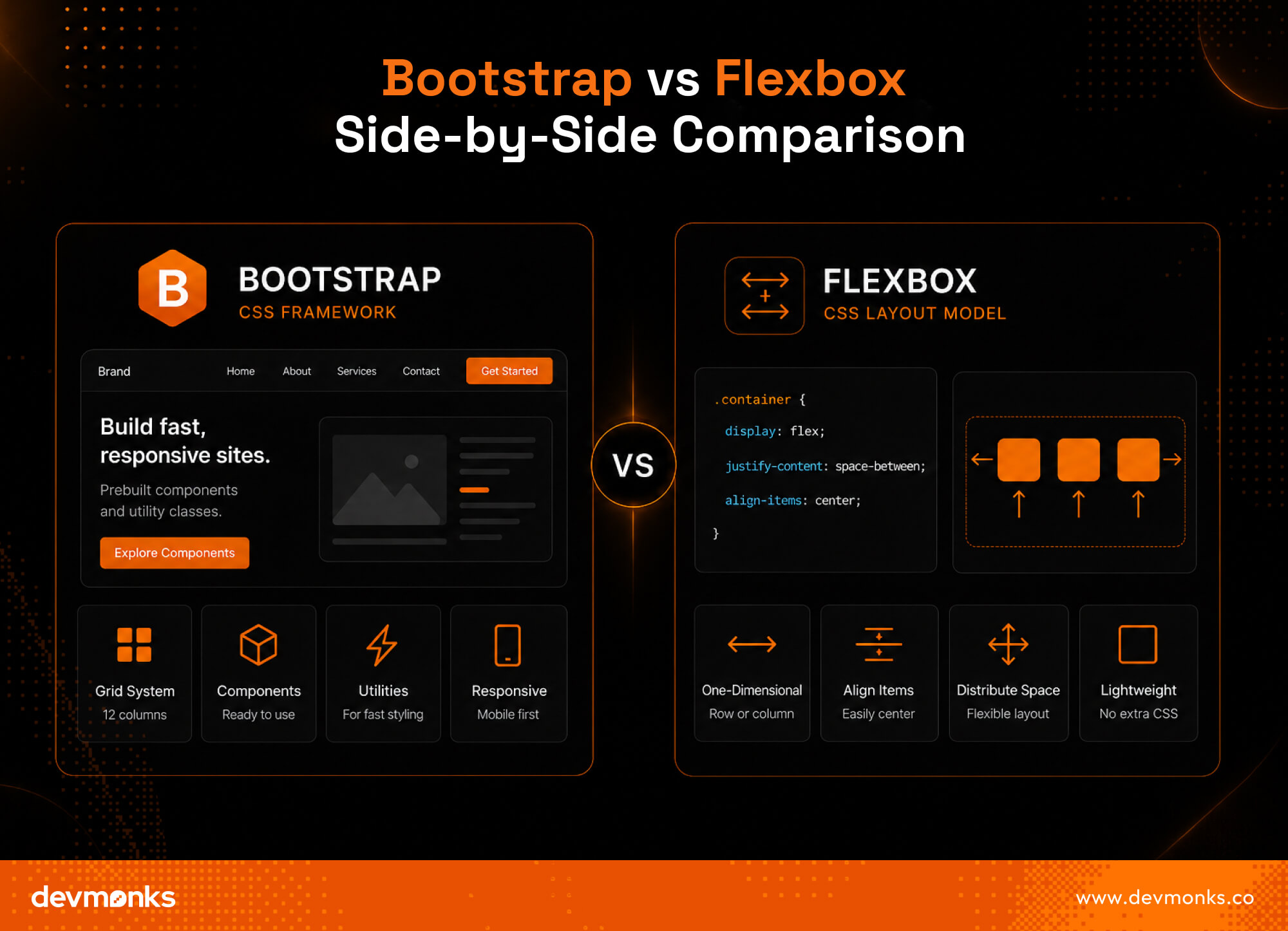
Bootstrap is a CSS framework that provides a responsive grid system, prebuilt components, and utility classes, while Flexbox is a CSS layout model used to arrange elements efficiently. Bootstrap is a framework, whereas Flexbox is a layout tool.
Understanding this difference is important for choosing the right approach to responsive web design and building maintainable websites.
In this guide, we'll compare their features, strengths, limitations, and use cases to help you decide when to use each one.
What Is Bootstrap?
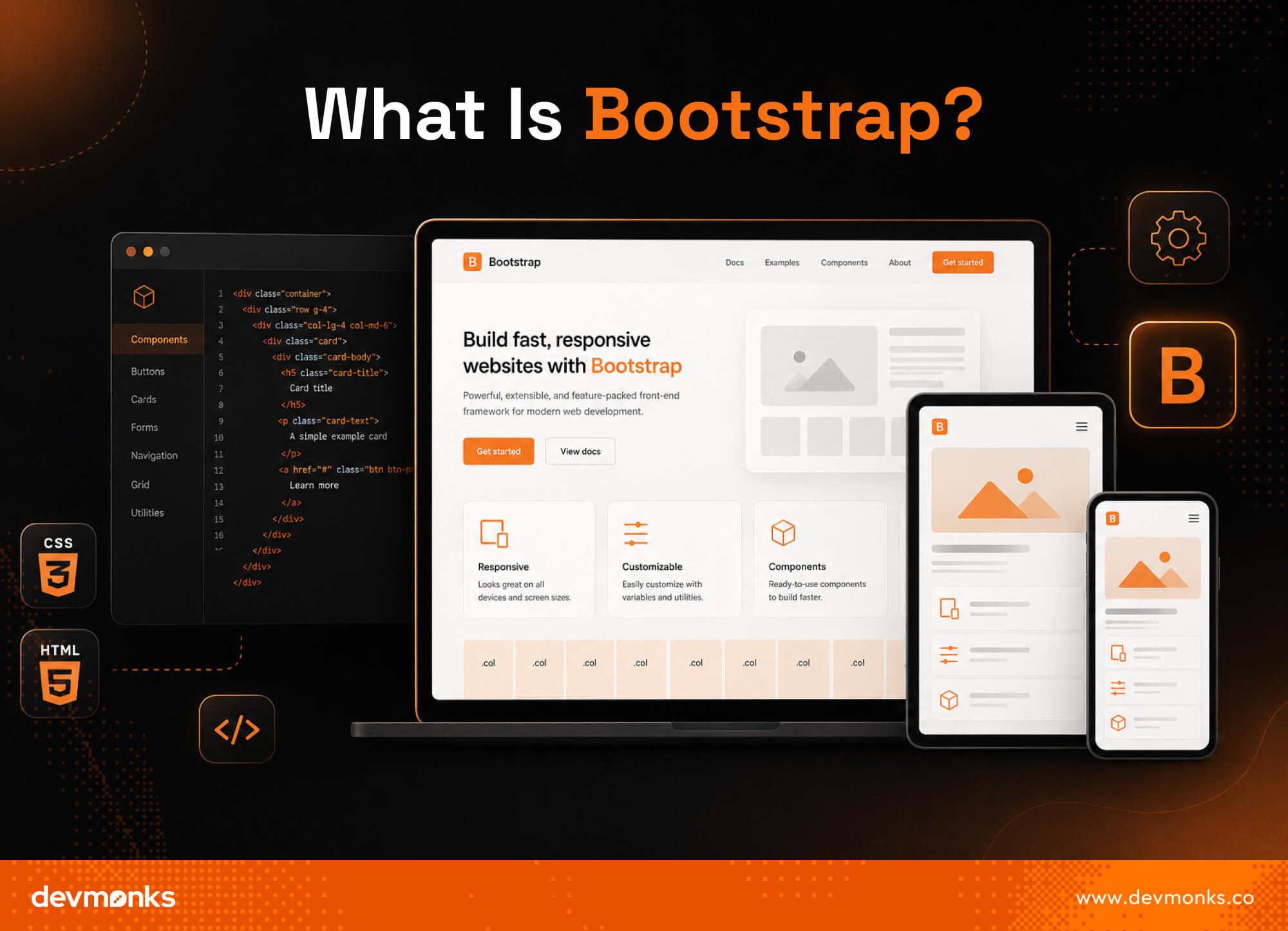
Bootstrap is a popular front-end framework used to build responsive and mobile-friendly websites. It provides prebuilt components, CSS classes, and a responsive grid system that help developers create layouts faster.
Instead of coding every element from scratch, developers can use Bootstrap's ready-made tools to streamline development.
Key Features of Bootstrap
Bootstrap includes a flexible grid system for organizing content into rows and columns. It also offers UI components such as Navbars, buttons, forms, and Card components.
Utility classes make it easy to control spacing, colors, alignment, and other styling needs. Responsive breakpoints ensure layouts adapt smoothly across different screen sizes.
Advantages of Bootstrap
Bootstrap speeds up development with reusable components and predefined styles. It helps maintain design consistency and offers a large ecosystem of themes, templates, plugins, and community resources.
Bootstrap speeds up development with reusable components and predefined styles.
This is one reason why development agencies such as Dev Monks often use Bootstrap when building responsive websites and web applications under tight timelines.
Limitations of Bootstrap
Websites built with Bootstrap can sometimes have a similar appearance because of its default styling.
The framework also adds extra CSS code, which can increase file size. While customization is possible, creating a completely unique design may require additional effort and style overrides.
What Is Flexbox?
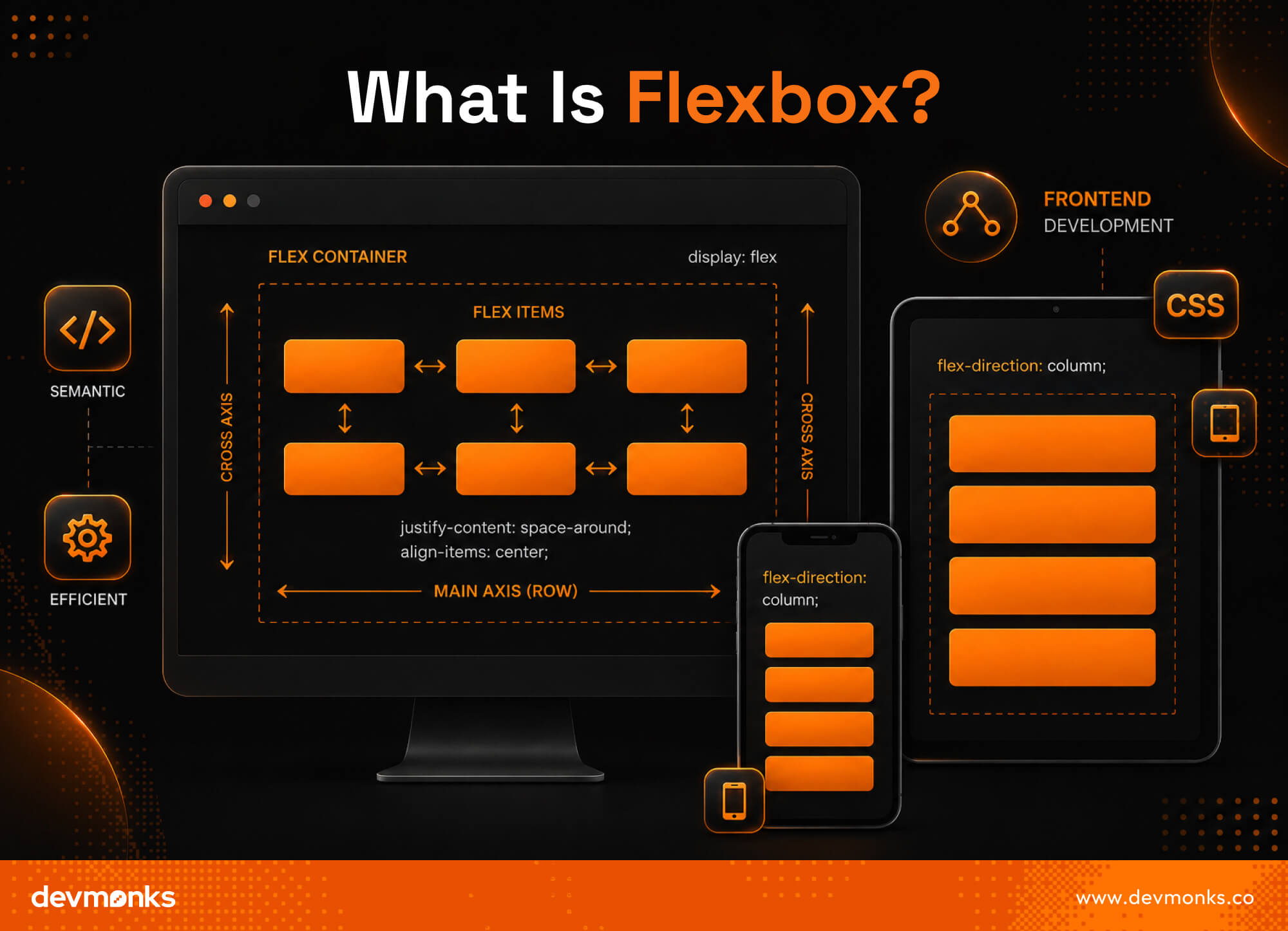
Flexbox, short for Flexible Box Layout, is a CSS layout module designed for one-dimensional layouts. It helps developers arrange elements in a row or a column without relying on complex positioning methods.
Flexbox is built directly into CSS, which makes it a simple and powerful tool for creating flexible layouts.
How Flexbox Works
Flexbox works through a Flex container that holds one or more Flex items. The layout is controlled along two directions, the Main axis and the Cross axis.
The main axis defines the primary direction in which items are placed, while the cross axis runs perpendicular to it. This structure makes it easier to align, distribute, and reorder elements.
Common Flexbox Properties
Developers activate Flexbox using display:flex. Properties like justify-content control item placement along the main axis, while align-items manages alignment on the cross axis.
Other useful properties include flex-direction for changing layout direction and flex-wrap for controlling item wrapping.
Advantages of Flexbox
Flexbox offers greater layout control, cleaner code, and native CSS support without external frameworks.
Limitations of Flexbox
Flexbox has a steeper learning curve for beginners and does not include prebuilt components or UI elements.
Bootstrap vs Flexbox: Side-by-Side Comparison
Both Bootstrap and Flexbox help developers build modern website layouts, but they serve different purposes.
Bootstrap is a complete CSS framework with ready-made UI components, while Flexbox is a CSS layout model focused on arranging elements efficiently. The table below highlights the main differences.
Feature
Bootstrap
Flexbox
Purpose
Complete CSS framework
CSS layout model
Learning Curve
Easier for beginners
Requires learning layout concepts
Customization
Moderate flexibility
High flexibility and control
Responsiveness
Built-in responsive system
Manual responsive design
Performance
Larger CSS bundle
Lightweight and efficient
Components
Includes ready-made UI components
Layout tools only
Purpose
Bootstrap is a full CSS framework that includes styling, layouts, and UI components. Flexbox is a layout model built into CSS and is mainly used to control the positioning and alignment of elements.
Learning Curve
Bootstrap is generally easier for beginners because many features are ready to use. Flexbox requires developers to understand concepts such as alignment, direction, and spacing before using it effectively.
Customization
Flexbox offers greater control over layouts and element positioning. Bootstrap can be customized, but developers often need to override existing styles to achieve unique designs.
Responsiveness
Bootstrap includes a responsive grid system and predefined breakpoints. Flexbox can also create responsive layouts, but developers must define the behavior themselves using CSS rules and media queries.
Performance
Bootstrap adds extra CSS files and features that may not always be needed. Flexbox is part of native CSS, which makes it lighter and reduces unnecessary overhead.
Components
Bootstrap comes with ready-made UI components such as Navbars, buttons, modals, forms, and cards. Flexbox does not provide components. It only offers layout tools that developers can use to build custom interfaces from scratch.
How Bootstrap Uses Flexbox Internally?
Many developers compare Bootstrap and Flexbox, but Bootstrap actually relies heavily on Flexbox behind the scenes. Since Bootstrap 4, much of its layout system has been built using Flexbox.
This means the Bootstrap grid vs Flexbox debate is not always a direct comparison, as the framework uses the layout model to power many of its features.
Bootstrap Grid and Flex Utilities
Bootstrap includes several flex utilities that make working with layouts easier. For example, d-flex turns an element into a flex container.
The justify-content-center class centers items along the main axis, while align-items-center aligns them along the cross axis. These Bootstrap flex utilities allow developers to create flexible layouts without writing custom CSS.
Why They Are Not Competitors
Bootstrap and Flexbox are best viewed as complementary tools rather than competitors. Flexbox provides the layout foundation, while Bootstrap builds on top of it with a grid system, responsive features, and ready-made components.
In many projects, developers use both together to create responsive and visually consistent websites more efficiently.
Bootstrap Grid vs Flexbox
Although Bootstrap's grid system is built using Flexbox, the two are often used differently when creating a responsive layout. Understanding their layout approach helps developers choose the right tool for each situation.
One-Dimensional vs Two-Dimensional Layouts
Flexbox is designed for one-dimensional layouts. It controls elements in a single direction, either a row or a column. Bootstrap's grid system, on the other hand, organizes content into rows and columns, creating a more structured layout.
This makes it easier to manage multiple sections across a page.
When Grid Works Better
A grid-based approach works best for complex page structures where content must align across both rows and columns.
Examples include dashboards, admin panels, landing pages, and multi-section website layouts. For these cases, a grid system provides better organization and consistency.
When Flexbox Works Better
Flexbox is ideal for smaller interface elements that require precise alignment. It works especially well for navigation bars, card layouts, menus, toolbars, and groups of buttons.
When you need to control spacing, alignment, or item order within a single row or column, Flexbox is usually the better choice than CSS Grid or a full grid system.
Code Example: Bootstrap vs Flexbox Layout
Both Bootstrap and Flexbox can create the same responsive layout. The main difference is how the layout is structured and managed.
Bootstrap Example
Bootstrap uses rows and columns to organize content.
<div class="container">
<div class="row">
<div class="col-md-6">Column 1</div>
<div class="col-md-6">Column 2</div>
</div>
</div>
In this example, the row creates a horizontal section, while the col-md-6 classes split the space into two equal columns. Bootstrap handles responsiveness automatically through its grid system.
Pure Flexbox Example
Flexbox uses a flex container to control item placement.
<div class="flex-container">
<div>Column 1</div>
<div>Column 2</div>
</div>
.flex-container {
display: flex;
}
.flex-container div {
flex: 1;
}
Here, the flex container places both items in a row and gives them equal width. Alignment and spacing can be adjusted using Flexbox properties.
Code Complexity Comparison
Bootstrap requires less custom CSS and speeds up development. Flexbox offers more control but often needs additional styling.
For simple responsive layouts, Bootstrap is usually faster. For highly customized CSS layout techniques, Flexbox provides greater flexibility and maintainability.
Bootstrap vs Flexbox for Responsive Design
Both Bootstrap and Flexbox support responsive design, but they approach it differently. Bootstrap provides built-in responsive tools, while Flexbox relies on custom CSS and media queries to adapt layouts across devices.
Mobile-First Design
Modern websites are usually built using a mobile-first approach. Bootstrap follows this philosophy by including predefined breakpoints for different screen sizes.
Similar mobile-first principles are also found in popular mobile app development tools used to create cross-platform applications.
Flexbox also supports mobile-first design, but developers must create their own media queries to control layout changes.
Responsive Utilities in Bootstrap
Bootstrap makes responsive design easier with utility classes and grid breakpoints. Classes such as col-md and col-lg adjust column widths based on screen size.
The d-none utility can hide elements on specific devices. These features reduce the need for custom CSS and speed up development.
Flexbox and Media Queries
Flexbox provides complete control over responsive layouts. Developers can combine Flexbox properties with media queries to change direction, spacing, alignment, and item order at different screen sizes.
While this requires more code, it allows highly customized responsive design solutions that match specific project needs.
Bootstrap vs Flexbox Performance Comparison
Performance is an important factor when choosing between Bootstrap and Flexbox. While both can create efficient layouts, they differ in file size, overhead, and long-term maintainability.
CSS File Size
Bootstrap includes a large collection of components, utilities, and responsive features. As a result, it adds more CSS code to a project, even if many features are not used.
Flexbox is built into CSS, so it does not require loading an additional framework.
Rendering Performance
Flexbox relies on native browser CSS capabilities, which makes it lightweight and efficient. Bootstrap layouts also perform well, but the extra framework code can increase page size and resource usage.
For small projects, pure CSS often provides a leaner solution.
Maintainability
Flexbox can lead to cleaner and more organized code because developers write only the styles they need.
Bootstrap simplifies development but may introduce unused classes and framework dependencies over time. For highly customized projects, Flexbox often offers a more maintainable architecture.
When Should You Use Bootstrap?
Bootstrap is a great choice when speed and consistency are more important than deep customization. Its ready-made components and responsive features help teams launch projects faster.
Rapid Prototyping
Bootstrap is ideal for rapid prototyping because developers can quickly build layouts and interface elements without writing large amounts of custom CSS.
Small Teams
Small teams often benefit from Bootstrap's standardized structure. It helps maintain a consistent design and reduces the time spent creating common UI elements.
MVP Development
When building an MVP (Minimum Viable Product), speed is critical. Bootstrap allows teams to focus on functionality while using prebuilt components for the interface.
Admin Dashboards
Bootstrap works particularly well for admin dashboards. Its grid system, forms, tables, cards, and navigation components make it easy to create organized and responsive dashboard layouts with minimal effort.
When Should You Use Flexbox?
Flexbox is a strong choice when you need complete control over layouts and want to create a unique user interface. It is especially useful for projects that prioritize flexibility and clean CSS.
Custom UI Design
Flexbox works well for custom UI design because it gives developers precise control over alignment, spacing, and element positioning without relying on framework defaults.
Lightweight Websites
For lightweight websites, Flexbox helps reduce unnecessary code. Since it is built into CSS, there is no need to load a separate framework.
Component-Based Systems
Flexbox is commonly used in component architecture, where individual interface elements need flexible and reusable layouts. It makes it easier to manage the structure of independent components.
Design Systems
Many modern design systems use Flexbox to create consistent and adaptable layouts. Its flexibility helps developers build scalable interfaces that remain easy to maintain as projects grow.
Can You Use Bootstrap and Flexbox Together?
Yes, you can use Bootstrap and Flexbox together, and many developers do. In fact, modern versions of Bootstrap are built on Flexbox, so the two technologies work naturally alongside each other.
A common approach is to use the Bootstrap grid system for the overall page structure and add custom Flexbox rules for more precise alignment within specific sections.
For example, you can create a page layout with Bootstrap rows and columns while using Flexbox to center content inside a card.
You can also combine Bootstrap components with Flexbox alignment utilities to build responsive and highly customized interfaces with minimal effort.
Bootstrap vs Flexbox vs CSS Grid
Bootstrap, Flexbox, and CSS Grid are all useful for building modern layouts, but they serve different purposes. Understanding their roles helps developers choose the right tool for each project.
Bootstrap
Bootstrap is a complete front-end framework. It includes a responsive grid system, utility classes, and ready-made components such as buttons, forms, and navigation bars. It is designed to speed up development.
Flexbox
Flexbox is a CSS layout model built for one-dimensional layouts. It works best when arranging items in a single row or column and provides excellent control over alignment and spacing.
CSS Grid
CSS Grid is a layout system designed for two-dimensional layouts. Unlike Flexbox, it manages both rows and columns at the same time, which makes it ideal for complex page structures.
Which One Should Beginners Learn First?
Beginners should start with Flexbox because it teaches core layout concepts. Next, learn CSS Grid for advanced layouts.
After that, Bootstrap becomes easier to understand since its Bootstrap grid system and many responsive features are built on these CSS layout techniques.
FAQs
Does Flutter Use Flexbox?
Flutter does not use Flexbox directly. Instead, it uses its own layout system with widgets such as Row and Column, which work similarly to Flexbox. These widgets allow developers to control alignment, spacing, and element positioning in a flexible way.
Which One Is Easier, Bootstrap or Tailwind?
Bootstrap is generally easier for beginners because it provides prebuilt components and ready-made styles. Tailwind offers more customization but requires learning many utility classes. If you want a faster setup, Bootstrap is usually the simpler option.
Is Bootstrap or MUI Better?
Neither is universally better. Bootstrap is ideal for quick development and framework-independent projects. MUI is designed specifically for React and follows Material Design principles. Choose Bootstrap for versatility and MUI when building modern React applications.
Bottomline
Bootstrap and Flexbox are not competing technologies. Bootstrap is a complete framework, while Flexbox is a CSS layout model that Bootstrap itself uses.
Choose Bootstrap for faster development and Flexbox for greater layout control. Understanding both will help you build responsive, maintainable, and modern web applications more effectively.
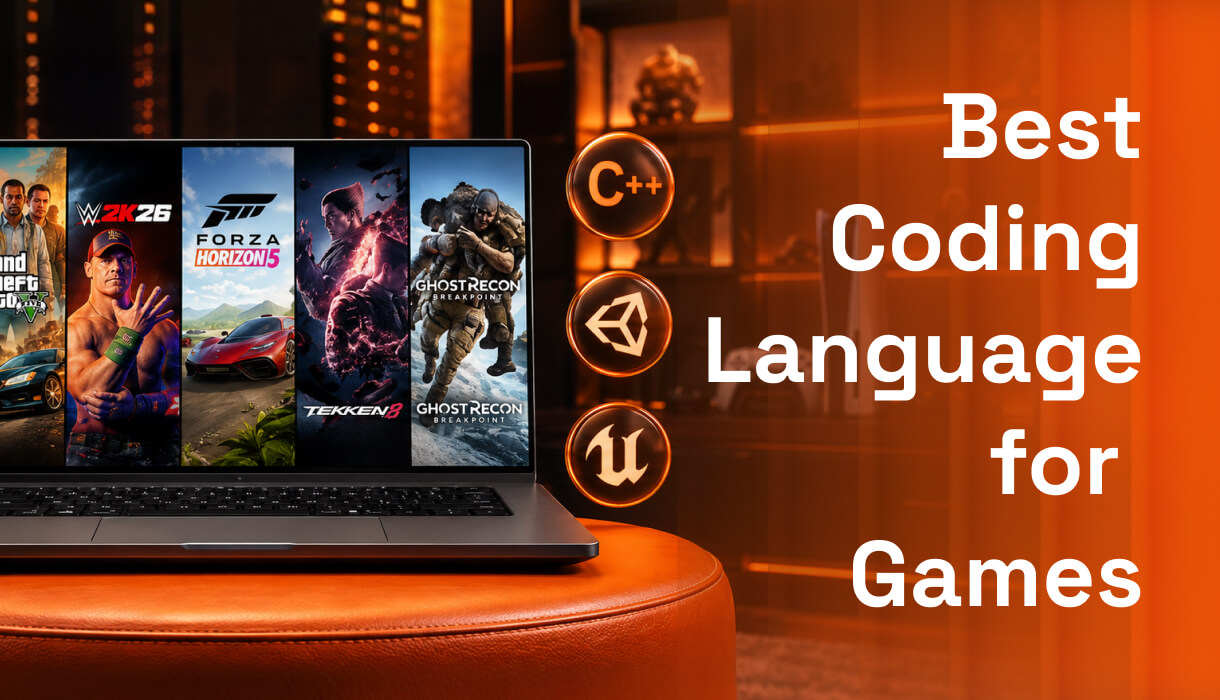
The best coding language for games depends on the type of game, target platform, and development engine you choose. Different languages serve different purposes, from high-performance AAA titles to mobile, indie, and browser-based games.
Understanding this before you begin is important because your choice affects development speed, available features, learning difficulty, and long-term career opportunities.
Many beginners spend months learning a language that does not fit their goals, which forces them to relearn new tools later.
This article will discuss the best programming languages for various game development paths, which will help you choose the right one with confidence.
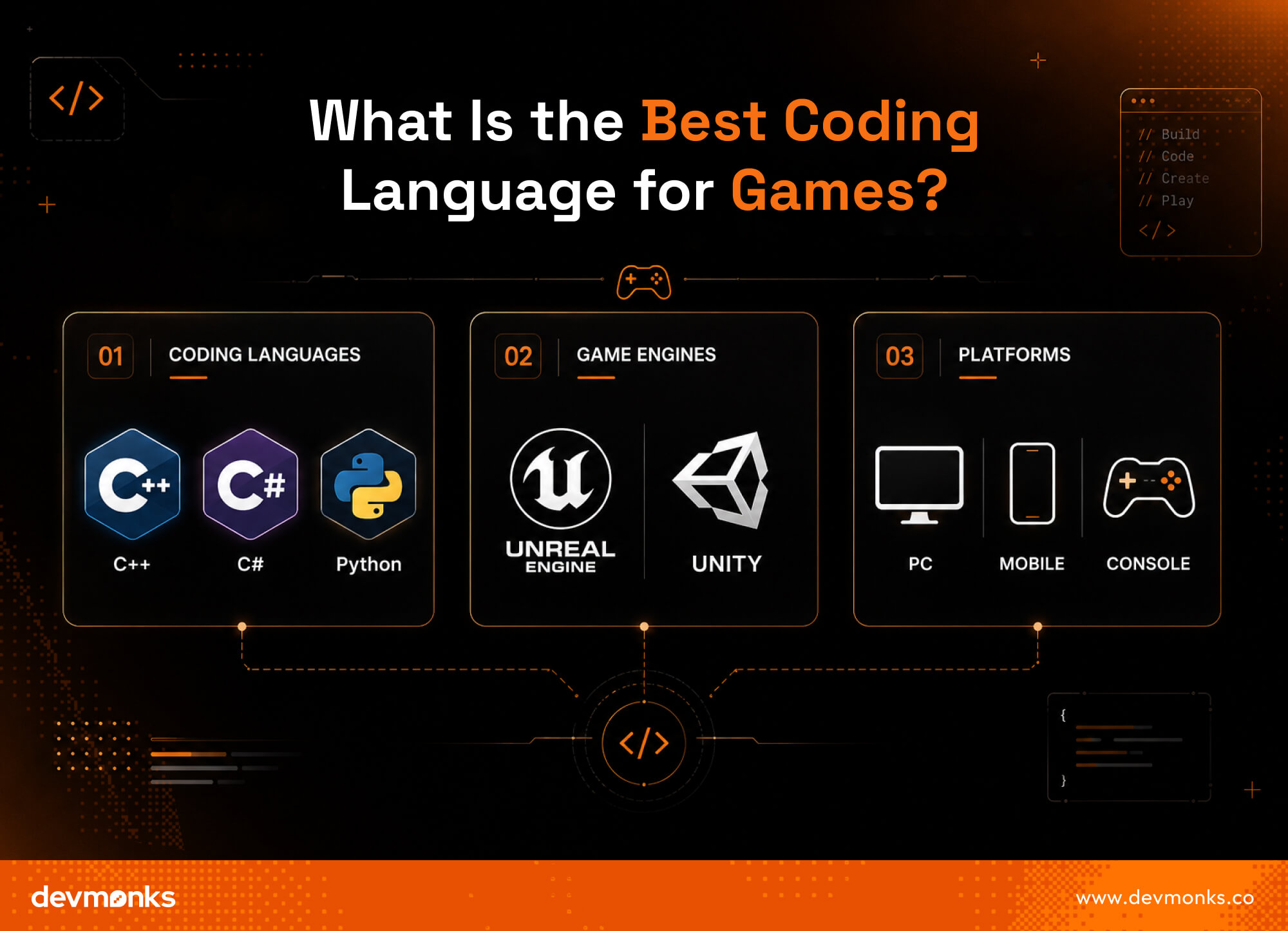
What Is the Best Coding Language for Games?
The best coding language for games depends on the type of game, platform, and game engine you choose. There is no single answer that fits every project. Different game programming languages work better in different situations.
For high-performance 3D games, many developers use Unreal Engine with C++. For mobile and indie games, Unity with C# is very popular.
So, the best coding language for games depends on your goals, your platform, and the engine you select. Most developers learn one language first and then expand later based on project needs. Engine choice often matters more than the language itself.
How Programming Languages Are Used in Game Development
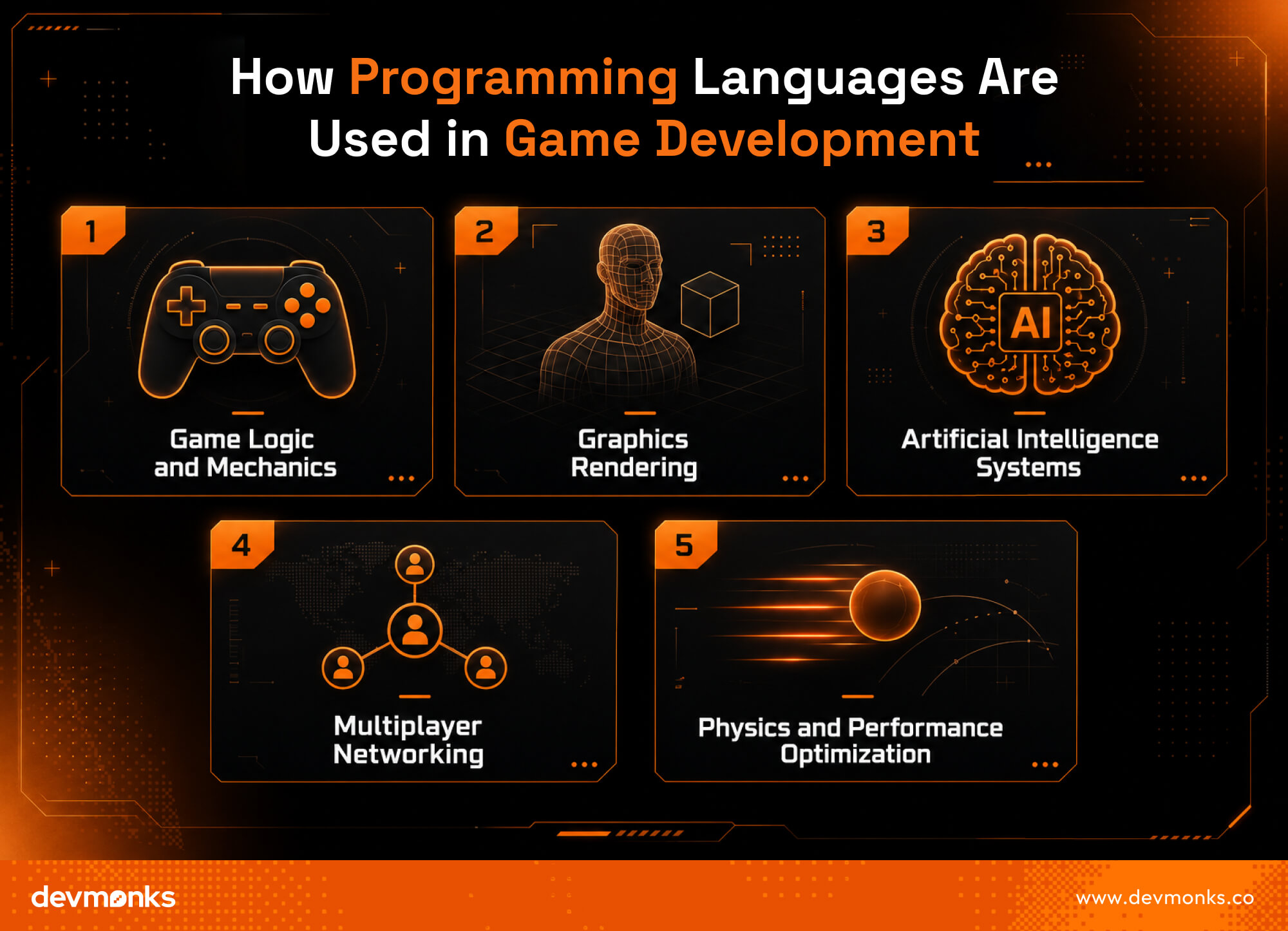
Programming languages are the core tools in game development. They control how a game works, looks, and reacts. Developers use them to build gameplay, graphics, AI, networking, and performance systems.
Game Logic and Mechanics
Game logic controls how a game behaves. It includes player movement, scoring, rules, and interactions. Languages like C++ and C# are often used to build smooth and responsive mechanics.
Graphics Rendering
Graphics rendering turns code into visual output. It helps create characters, environments, and animations. Game engines like Unity handle many rendering tasks using programming support.
Artificial Intelligence Systems
AI controls non-player characters and enemy behavior. It makes games feel smart and dynamic. Developers use AI systems to create decision-making and pathfinding logic.
Multiplayer Networking
Networking allows players to connect and play together. It manages data like player positions and actions in real time.
Physics and Performance Optimization
The Physics Engine handles gravity, collisions, and movement. Performance optimization ensures the game runs smoothly without lag.
Game development also often involves working with experienced teams or studios to speed up production.
For example, Dev Monks is a development agency that works on building and supporting game projects. Such agencies help developers turn ideas into playable products with better structure and quality.
Best Programming Languages for Game Development
Game development uses many programming languages, and each one plays a different role. There is no single “perfect” language. The best choice depends on the game type, platform, and engine support.
C++: Best for AAA Game Development
C++ is widely used in AAA games. It gives high performance and full memory control. This makes it ideal for large and complex games. Many major studios use it with Unreal Engine. It helps developers build detailed graphics and fast gameplay.
C#: Best for Unity Game Development
C# is simple and easy to learn. It is the main language for Unity. Many indie and mobile games use it because development is faster and more flexible. It is great for beginners.
Python: Best for Beginners and Prototyping
Python is simple and very beginner-friendly. It is often used to test game ideas quickly. Developers use it for scripting, small games, and learning programming concepts. It is not usually used for high-performance commercial games, but it is great for starting out.
Java: Best for Android Games
Java is widely used for Android game development. It is stable, portable, and works well on many devices. Many older mobile games are built with Java, and it still has strong support.
JavaScript: Best for Browser Games
JavaScript is used for web-based games that run in browsers. It works well with HTML5 and allows quick deployment. These games are usually simple but very accessible to users.
Swift: Best for iOS Game Development
Swift is used for Apple game development. It is fast, safe, and optimized for iPhones and iPads. It works well with Apple’s game frameworks.
Kotlin: Modern Android Game Development
Kotlin is a modern language for Android. It is cleaner and more efficient than Java. Developers prefer it for new Android game apps because it reduces code complexity.
Rust: Emerging Language for High-Performance Games
Rust is becoming popular for performance-focused game systems. It offers both speed and memory safety. While still new in game development, it is gaining attention for engine-level programming and advanced game tools.
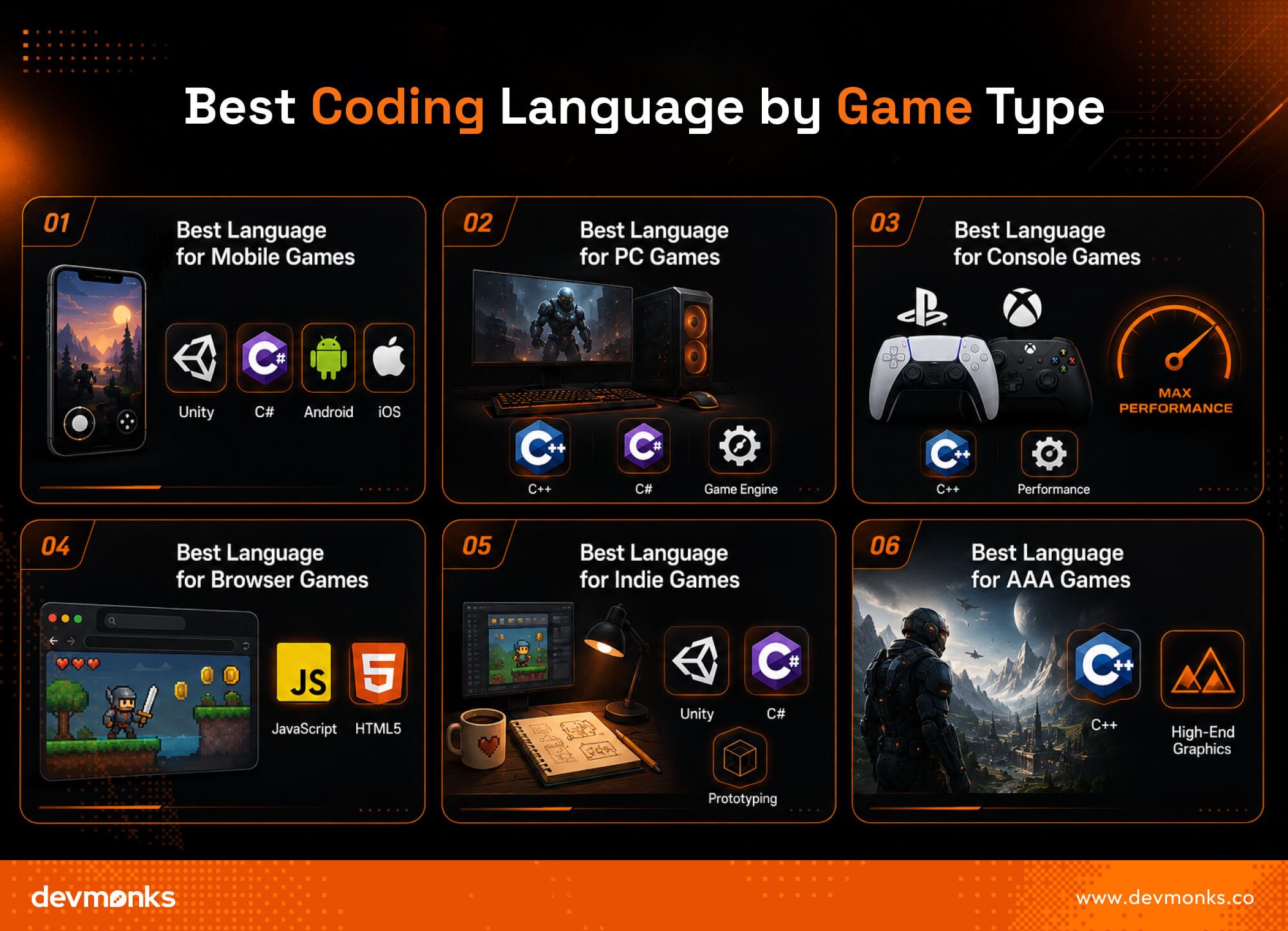
Best Coding Language by Game Type
Different games need different tools. The best coding language depends on the platform and the type of game you want to build. Choosing the right one makes development easier and faster.
Best Language for Mobile Games
Mobile games are built for Android and iOS. The most common languages are C# with Unity and Java or Kotlin for Android. Swift is used for iOS. These languages are ideal for smooth mobile performance.
Best Language for PC Games
PC games often use C++ and C#. Many developers rely on Unreal Engine and Unity for building powerful PC games with high graphics and complex systems.
Best Language for Console Games
Console games are built for platforms like PlayStation and Xbox. These games mostly use C++ because consoles need high performance and optimized code for smooth gameplay.
Best Language for Browser Games
Browser games use JavaScript along with HTML5. They run directly in web browsers, so no installation is needed. This makes them easy to access and share.
Best Language for Indie Games
Indie developers often choose C# with Unity. It is simple, fast, and beginner-friendly. Python is also used for prototypes and small creative projects.
Best Language for AAA Games
AAA games use C++ because they need maximum performance, realism, and control. These games are large, detailed, and require advanced optimization.
Best Coding Language by Game Engine
Game engines play a big role in choosing a programming language. A game engine is the main tool that helps developers build games faster.
It controls graphics, physics, and gameplay systems. Each engine supports specific languages, so your choice of engine often decides your coding path.
Unity and C#
Unity uses C# as its main language. It is popular for mobile, indie, and 3D games. C# is easy to learn and works well with Unity’s tools, which makes development smooth and fast.
Unreal Engine and C++
Unreal Engine uses C++. It is known for high-performance and realistic graphics. This combination is widely used in AAA games and large studios where power and precision matter.
Godot and GDScript
Godot mainly uses GDScript, a simple scripting language designed for the engine. It is lightweight and easy for beginners. Developers also use C# or C++ in advanced cases.
GameMaker and GML
GameMaker uses GameMaker Language (GML). It is simple and beginner-friendly. It is widely used for 2D games and quick game development.
CryEngine and C++
CryEngine also uses C++. It focuses on high-end graphics and realistic environments. It is used for visually advanced and performance-heavy games.
Game engines shape how games are built. Choosing the right engine automatically guides you toward the best programming language for your project.
C++ vs C# for Game Development
C++ and C# are two of the most popular languages in professional game development. Both are powerful, but they serve different needs. Understanding their strengths can help you choose the right language for your career and projects.
Performance Comparison
C++ offers higher performance and greater control over system resources. It allows direct memory management, which is important for large and demanding games.
This is why many AAA studios use C++ for performance-critical projects.
C# is slightly slower than C++, but the difference is often small for most games. It provides excellent performance while reducing development complexity.
Learning Curve
C# is generally easier to learn. Its syntax is cleaner, and it handles many technical tasks automatically. Beginners can become productive more quickly with C#.
C++ has a steeper learning curve. Developers need to understand concepts like memory management, pointers, and optimization. However, mastering C++ provides deeper knowledge of how games work behind the scenes.
Career Opportunities
Both languages offer strong career opportunities. C++ is highly valued in AAA game studios, engine development, and performance-focused projects.
C# is widely used in indie studios, mobile game companies, and Unity-based development teams.
Engine Compatibility
C# is the primary language for Unity, which makes it a top choice for mobile, indie, and cross-platform games.
C++ is the main language for Unreal Engine and many custom game engines used by large studios.
Development Speed
C# allows faster development because it requires less code and has simpler debugging tools. Developers can build and test features quickly.
C++ development usually takes more time, but it provides greater flexibility and control. For projects where performance is a top priority, the extra effort is often worthwhile.
Easiest Coding Languages for Beginner Game Developers
If you are new to game development, start with a simple language. The goal is to learn logic, not struggle with complex syntax. These languages are great for beginner game programming.
Python
Python is one of the easiest languages to learn. It has simple syntax and is great for understanding basic game logic. Beginners often use it for small games and prototypes.
C#
C# is also beginner-friendly and widely used in real game projects. It works well with Unity and helps you build both 2D and 3D games.
JavaScript
JavaScript is perfect for browser-based games. It runs directly in web browsers, making it easy to test and share your games quickly.
GDScript
GDScript is used in the Godot engine. It is simple, clean, and designed specifically for game development, which makes it very beginner-friendly.
These languages help you start building games quickly while learning core development skills step by step.
However, if you are building a game for a product or software purpose and are not focused on learning development yourself, it is better to work with a reliable game development agency.
Agencies like Dev Monks can help you turn your idea into a fully functional game with professional quality.
Most Popular Languages Used by Professional Game Studios
Professional game studios choose programming languages based on performance, development speed, and platform requirements.
While many languages are used across the industry, a few dominate modern game development.
AAA Studio Preferences
AAA studios often rely on C++ for large-scale game development. Companies such as Epic Games, Ubisoft, and Nintendo use C++ extensively because it delivers high performance and deep system control.
These features are essential for creating advanced graphics and complex game worlds.
Indie Studio Preferences
Indie studios frequently choose C# with Unity. It is easier to learn, speeds up development, and allows smaller teams to launch games more efficiently. This combination has become a standard choice for many independent developers.
Mobile Game Company Preferences
Mobile game companies often use C#, Kotlin, Java, and Swift. These languages support Android and iOS development while helping teams create responsive and optimized mobile experiences.
Emerging Industry Trends
The industry continues to evolve. C++ remains the leading choice for AAA games, while C# dominates many indie and mobile projects. At the same time, Rust is gaining attention for its strong performance and memory safety.
As game development tools improve, developers are adopting languages that balance speed, efficiency, and ease of use.
Factors to Consider When Choosing a Game Programming Language
The best game programming language is not always the most popular one. You should choose a language based on your goals, skills, and project requirements.
Learning Difficulty
Some languages are easier to learn than others. C# and Python are beginner-friendly, while C++ requires more time and practice.
Performance Requirements
Games with advanced graphics and complex systems need high-performance languages. C++ is often preferred for these projects because it offers greater control and speed.
Community Support
A strong community can make learning easier. Popular languages usually have more tutorials, forums, and learning resources available.
Engine Compatibility
Your game engine may determine which language you should learn. For example, Unity mainly uses C#, while Unreal Engine is closely linked with C++.
Career Opportunities
Different languages open different career paths. C++ is common in AAA studios, while C# is widely used in indie and mobile game development.
Cross-Platform Development
If you want to release games on multiple platforms, choose a language that works well across PC, mobile, and consoles. This can save development time and effort.
Future of Programming Languages in Game Development
The future of game programming is driven by new technologies and changing development needs. Studios are looking for languages that offer speed, flexibility, and efficiency.
Rise of Rust
Rust is gaining popularity in game development. It provides strong performance and better memory safety. Many developers see it as a promising option for future game engines and tools.
AI-Assisted Game Development
AI is transforming game creation. Developers use AI to generate content, automate testing, and speed up coding tasks. This helps teams develop games faster and more efficiently.
Cross-Platform Development Growth
More studios are building games for multiple platforms. Developers need languages and engines that support PC, mobile, and console releases with less effort.
Cloud Gaming Impact
Cloud gaming is changing how games are delivered and played. As games run on remote servers, developers need scalable and optimized code to ensure smooth performance.
As the industry evolves, programming languages that balance performance, security, and ease of development will become even more important.
Which Coding Language Should You Learn for Game Development?
The best coding language for game development depends on your goal, experience level, and the type of games you want to build. Instead of chasing trends, it is better to choose a path that matches your target career.
For Beginners
If you are new, start with C#. It is simple, readable, and widely used in real projects. It also helps you learn core game development concepts faster without heavy complexity.
For Indie Developers
Indie developers often stick with C#. It works very well for small teams and fast production. It allows you to build 2D and 3D games quickly and publish them on multiple platforms.
For Mobile Developers
For mobile games, C# with Unity is a strong choice. It supports both Android and iOS development. Kotlin is also useful for Android-focused games, especially if you want native performance.
For AAA Game Development Careers
If your goal is high-end studio work, learn C++. It is the standard in AAA development and is used for building complex, high-performance game systems.
For Multiplayer Game Development
Multiplayer games need strong performance and network control. C++ is widely used because it handles low-level optimization well. Rust is also growing as a modern, safer alternative.
Goal
Recommended Language
Beginner
C#
Mobile Games
C# / Kotlin
Browser Games
JavaScript
Indie Games
C#
AAA Games
C++
High Performance
C++ / Rust
The best approach is to start with one language, build real projects, and then expand based on your career direction.
Pro Tip: When developing games, ensuring compatibility with mobile platforms is very important since a large portion of games are played on Android and iOS devices.
Learning mobile development tips and tricks helps you optimize performance, improve user experience, and build games that run smoothly across different devices.
FAQs
What language is GTA 5 coded in?
C++ is the primary language used in GTA 5. It allows Rockstar Games to build a massive open world with advanced physics, AI, and rendering systems. C++ gives full performance control needed for AAA game development.
Is Python or C++ better for games?
C++ is better for full game development because it offers high speed and control. Python is easier to learn and useful for prototypes, but it is not suitable for high-performance or large-scale commercial games.
What is the most used coding language for games?
The most widely used languages are C++ and C#. C++ is common in AAA studios, while C# is popular in Unity-based indie and mobile game development across multiple platforms.
Be the first to hear about our latest projects, design insights, and studio updates. Be the first to hear about our latest projects, design insights, and studio updates.
Thank you! Your submission has been received!
Oops! Something went wrong while submitting the form.


.svg)
.svg)

.png)

.png)
.svg)