What Does Headless Mean in Web Development? Benefits & Uses
.png)

.svg)
[ key takeways ]
- Headless architecture separates frontend and backend for better flexibility and scalability.
- It improves performance by enabling faster, API-driven content delivery across platforms.
- Headless CMS manages content only and delivers it through APIs efficiently.
- It supports modern frameworks, making development more flexible and customizable overall.
- Headless is best for scalable, multi-platform, and performance-focused digital products.
.svg)
Headless architecture is becoming more popular in modern web development as businesses look for faster, more flexible digital solutions.
Many companies now use headless CMS platforms and modern frontend frameworks to improve performance, scalability, and user experience.
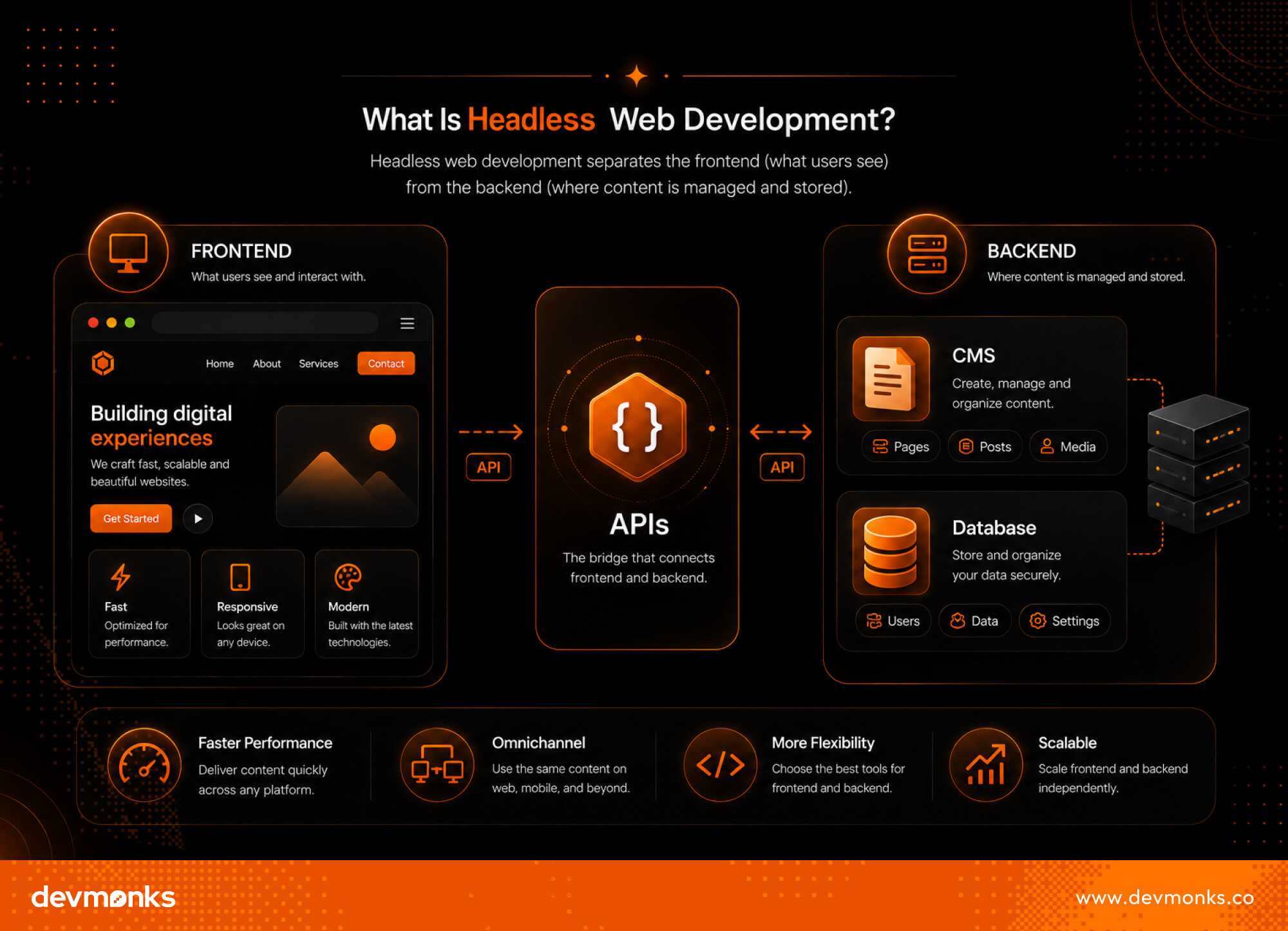
In simple terms, headless means separating the frontend from the backend. The backend manages content and data, while the frontend handles how everything looks and feels.
This separation gives developers more freedom to build across different platforms.
Understanding headless development is important for developers, business owners, and anyone building digital products today. It helps you choose the right architecture for better growth and performance.
Read the article to know what headless really means and how it works in practice.
What Is Headless Web Development?
Headless web development is a modern way to build websites and web applications. In this setup, the frontend and backend work separately.
The frontend is the part users see and interact with. The backend handles content, data, and business logic behind the scenes.
The Meaning of “Headless” in Development
In web development, the “head” refers to the frontend presentation layer. This includes the website design, layout, buttons, and user experience. In a headless setup, the “head” is removed from the backend system.
The backend works independently and sends content through APIs. This gives developers more freedom to build fast and flexible user experiences on different platforms.
How Traditional and Headless Architectures Differ
Traditional websites usually follow a monolithic architecture. The frontend and backend are tightly connected. The backend controls how content appears on the screen.
Headless architecture uses a decoupled approach. The frontend and backend work separately and communicate through APIs. This makes updates easier and improves scalability.
Core Components of a Headless Architecture
A headless architecture includes several important parts. The frontend handles the user interface. The backend manages content and logic. APIs connect the frontend and backend. A CMS helps teams create and organize content. The database stores all website data securely.
Agencies like Dev Monks can help build these systems by connecting modern frontend frameworks with powerful backend and API layers. We also support scalable architecture design that fits headless and API-driven applications.
How Headless Web Development Works?
Headless web development works through an API-driven structure. The frontend and backend stay separate but communicate continuously.
When a user opens a website, the frontend requests content from the backend using APIs. The backend then sends the required data in a structured format like JSON.
API-Driven Content Delivery
APIs are the bridge between the frontend and backend. REST APIs are commonly used to send and receive website data. They follow a simple request and response structure.
GraphQL APIs offer more flexibility. They allow developers to request only the exact data they need. This improves performance and reduces unnecessary data loading.
Most headless systems deliver data in JSON format. This makes it easier for different devices and platforms to read and display content.
Frontend Frameworks in Headless Development
Modern frontend frameworks play a major role in headless development. React is popular for building interactive user interfaces. Next.js improves React apps with faster loading and better SEO. Vue.js is known for its simplicity and flexibility.
Nuxt.js adds powerful features to Vue applications. Gatsby helps developers create fast static websites.
Backend and CMS Management
The backend manages content, databases, authentication, and business logic. A headless CMS allows teams to update content without affecting the frontend design.
What Is a Headless CMS?
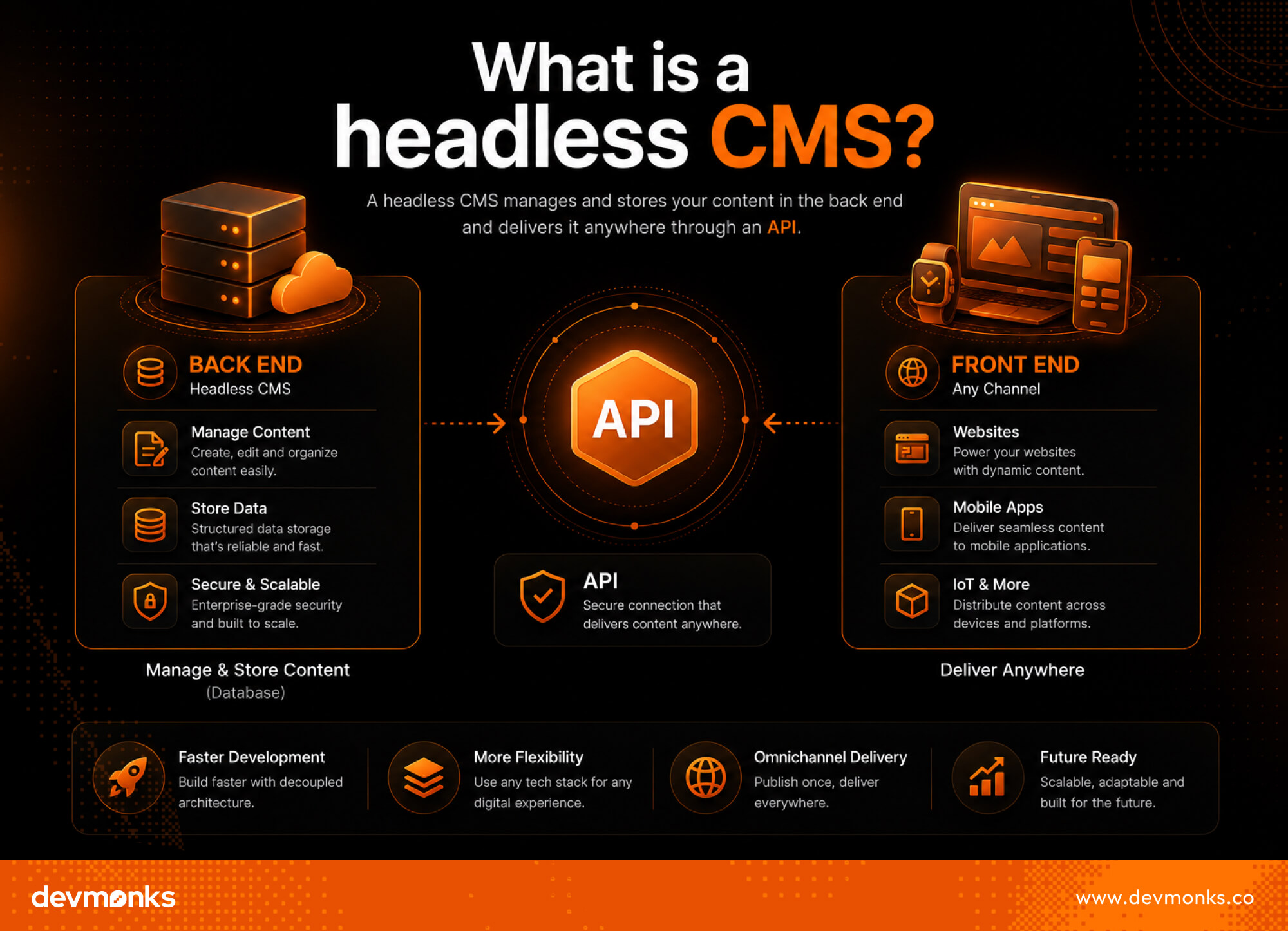
A headless CMS is a content management system that focuses only on managing and delivering content.
It does not control the frontend design or presentation layer. Instead, it sends content to websites, apps, and other platforms through APIs.
How a Headless CMS Works
A headless CMS works as a backend-only content management system. Content creators can add, edit, and organize content in one place. The frontend then pulls that content using APIs.
Most headless CMS platforms follow an API-first structure. This makes it easier to connect content with websites, mobile apps, smart devices, and other digital platforms.
Popular Headless CMS Platforms
Popular headless CMS platforms include Contentful, Strapi, Sanity, Hygraph, and WordPress Headless CMS. Each platform offers different features for content management and customization.
Headless CMS vs Traditional CMS
A headless CMS provides more flexibility and better performance than a traditional CMS. It also supports omnichannel publishing across multiple platforms. However, headless systems can be more complex to develop and manage.
Benefits of Headless Web Development
Headless web development offers many technical and business advantages. It helps companies build faster, more flexible, and scalable digital experiences.
Better Website Performance
Headless websites often load faster because the frontend is optimized separately. Static site generation improves speed by serving pre-built pages. Faster websites also help improve Core Web Vitals and overall user experience.
Greater Frontend Flexibility
Developers have the freedom to use modern JavaScript frameworks like React, Vue, and Next.js. This allows teams to create custom UI and UX experiences without backend limitations.
Improved Scalability
Headless architecture makes scaling easier for SaaS platforms and enterprise applications. Businesses can handle growing traffic and expand features more efficiently.
Omnichannel Content Delivery
Content can be delivered across multiple platforms from a single backend. This includes websites, mobile apps, smart devices, and digital kiosks.
Enhanced Developer Experience
Frontend and backend teams can work independently. This speeds up development and creates faster iteration cycles for updates and new features.
Drawbacks of Headless Architecture
Headless architecture offers many benefits, but it also comes with some challenges that teams should consider before adopting it.
Increased Development Complexity
Headless systems require both frontend and backend expertise. Developers must manage APIs, frameworks, and integrations separately, which can make the development process more complex than traditional CMS setups.
Higher Initial Development Cost
Building a headless solution often needs more custom engineering work. This can increase the initial cost, especially for small teams or startups that do not already have the required infrastructure.
Dependency on APIs
Since headless systems rely heavily on APIs, any API issue can affect the entire application. Performance, uptime, and maintenance of APIs become critical for stability.
Content Preview Challenges
Some headless CMS platforms have limited preview features. This can make it harder for content editors to see exactly how content will appear on the live site, which may slow down the publishing workflow.
Popular Technologies Used in Headless Development
Headless development uses a modern tech stack that connects frontend, backend, and APIs.
Frontend Frameworks
Popular frontend tools include React, Next.js, Vue, and Angular. These frameworks help build fast and interactive user interfaces.
Backend Technologies
Common backend options are Node.js, Laravel, Django, and Express.js. They handle business logic, authentication, and data processing.
APIs and Data Layer
APIs are the core of headless systems. REST API and GraphQL are widely used to deliver data. Webhooks help in real-time updates between systems.
Hosting and Deployment Platforms
Modern headless apps are often deployed on platforms like Vercel, Netlify, and AWS. These platforms support fast builds, scaling, and global content delivery.
When Should You Use Headless Web Development?
Headless web development is not needed for every project. It works best in specific situations where flexibility and scalability are important.
Large Content-Heavy Websites
Headless is a great choice for media platforms, enterprise websites, and multi-language sites. It helps manage large amounts of content and deliver it efficiently across different regions.
SaaS Platforms and Web Applications
SaaS products benefit from headless architecture because it supports dynamic user experiences and smooth scalability. It allows teams to update features quickly without affecting the whole system.
E-commerce Websites
Online stores use headless setups to create personalized shopping experiences. It also supports omnichannel commerce, where users can shop from multiple platforms.
Multi-Platform Digital Products
Headless is ideal when one backend needs to power multiple platforms like websites, mobile apps, and smart devices. It ensures consistent content delivery across all channels.
Agencies like Dev Monks help implement these headless and API-driven systems for scalable SaaS, ecommerce, and enterprise platforms. We focus on building flexible architectures that support multi-platform digital products efficiently.
Real-World Examples of Headless Websites
Headless architecture is widely used in real-world platforms across industries. Enterprise websites like Microsoft and IBM use it to manage large-scale, multi-region content efficiently.
SaaS platforms such as Salesforce, Slack, and Notion rely on headless systems for fast, dynamic user experiences.
E-commerce stores, which include Shopify-based brands and Amazon-like marketplaces, use headless setups for personalized shopping and omnichannel sales.
Media and publishing platforms like Netflix and BBC also use headless architecture to deliver content across web, mobile, and smart devices.
These examples show how headless improves performance, scalability, and content delivery across different digital ecosystems at scale worldwide today.
Common Misconceptions About Headless Development
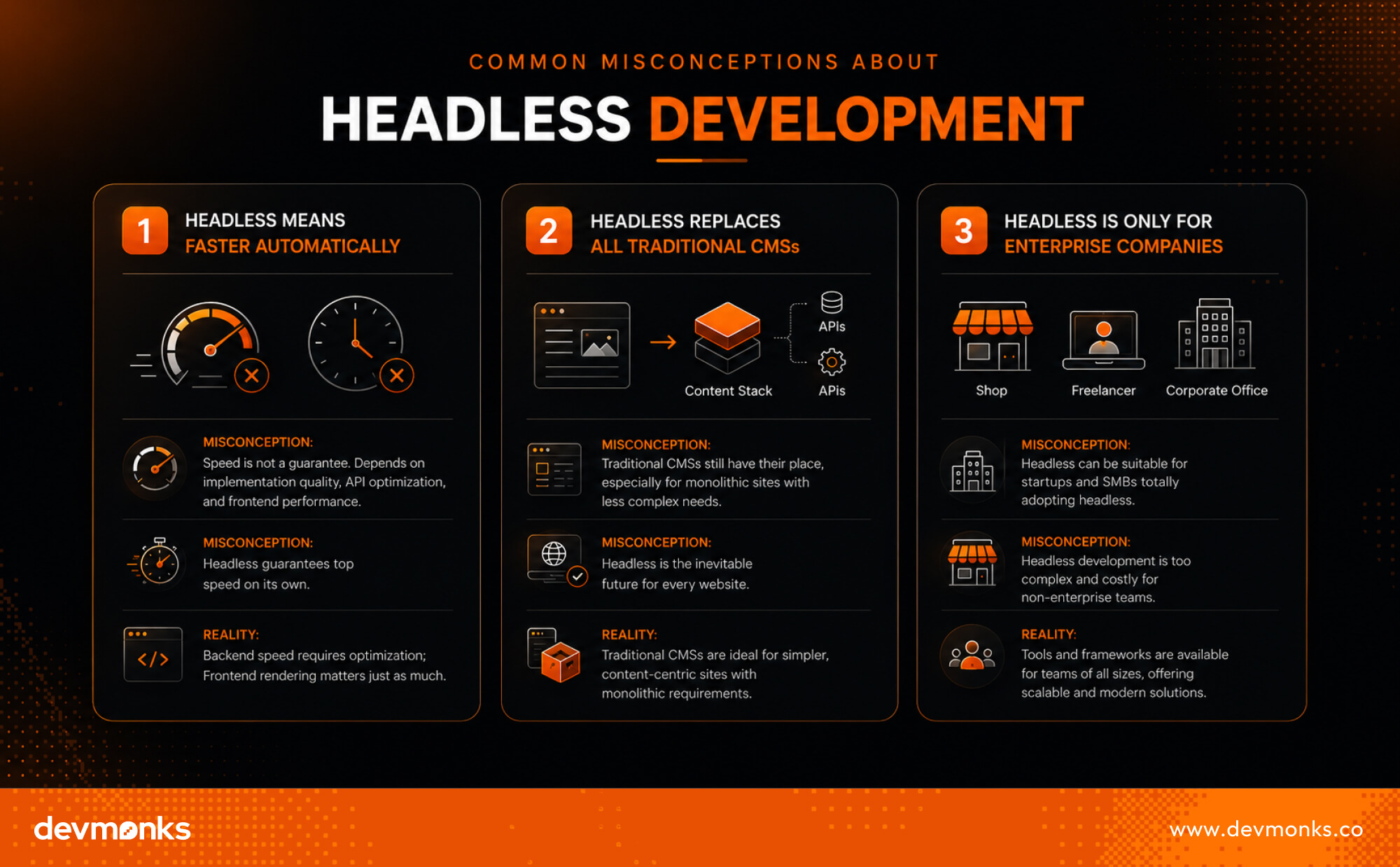
Headless development is often misunderstood, which leads to confusion about how it really works. Let’s clear up some common myths and see the reality behind them.
Headless Means Faster Automatically
Many people assume headless websites are always fast. This is not true. Speed depends on how well the frontend is built, how APIs are optimized, and how hosting is managed. If these areas are weak, performance can still suffer.
Headless Replaces All Traditional CMSs
Headless does not fully replace traditional CMS platforms in every case. It is powerful for complex and multi-platform projects, but simple websites or blogs may still work better with traditional CMSs. The right choice depends on project size and goals.
Headless Is Only for Enterprise Companies
Another common myth is that headless is only for big enterprises. In reality, startups and mid-size businesses also use it.
It helps them build flexible and scalable systems from the start. This makes future growth easier without needing major rebuilds. Headless development is becoming more common across all business sizes today.
FAQs
Is headless cms good for SEO?
Yes, a headless CMS can be very good for SEO. It improves page speed, supports modern frameworks like Next.js, and allows better control over meta tags and structure. However, SEO still depends on proper implementation, content quality, and technical optimization.
Is WordPress a headless CMS?
Yes, WordPress can be used as a headless CMS. In this setup, WordPress manages content in the backend, while a separate frontend fetches data using APIs like REST or GraphQL. This improves flexibility but needs extra development effort.
Is headless e-commerce worth it?
Yes, headless ecommerce is worth it for businesses that need flexibility, speed, and omnichannel selling. It allows custom user experiences and better scalability. However, it requires higher development cost and technical expertise, so it’s best for growing or complex stores.
Conclusion
Headless architecture means separating the frontend and backend and connecting them through APIs. It offers strong benefits like flexibility, better performance, and easy scalability.
However, it also comes with higher complexity, cost, and reliance on APIs. Headless is best suited for scalable, performance-focused digital products like SaaS, ecommerce, and enterprise platforms.
Businesses should choose their architecture based on technical needs, content strategy, and long-term growth goals.
.png)
.svg)
Frequently Asked Questions
How can I discuss an AI MVP with Dev Monks?

Book a strategy call with your use case, existing systems, and project priorities. The team can help define an initial scope and the dependencies that need to be addressed.
Does using AI replace engineering review?
Dev Monks uses AI-assisted workflows with human-guided decisions. Product requirements, engineering choices, and testing remain part of the development process.
What AI development services does Dev Monks offer?
Dev Monks offers agentic AI solutions, custom language-model solutions, workflow automation, and RAG development. Its broader services include SaaS engineering, MVP development, backend integrations, and web and mobile applications.
Is Dev Monks an official OpenAI Select Partner?
Yes. Dev Monks is now an official OpenAI Select Partner within the OpenAI Partner Network.
How long does it usually take to complete a project?
We combine AI-driven workflows with product-first engineering to provide MVP development services for startups and enterprises. Our approach balances speed, reliability, and usability while keeping teams involved. We deliver production-ready, scalable solutions, not just prototypes or demos.
What makes Dev Monks different from other development companies?
We combine AI-driven workflows with product-first engineering to provide MVP development services for startups and enterprises. Our approach balances speed, reliability, and usability while keeping teams involved. We deliver production-ready, scalable solutions, not just prototypes or demos.
How Involved Will My Team be During Development?
We combine AI-driven workflows with product-first engineering to provide MVP development services for startups and enterprises. Our approach balances speed, reliability, and usability while keeping teams involved. We deliver production-ready, scalable solutions, not just prototypes or demos.
How involved will my team be during development?
We combine AI-driven workflows with product-first engineering to provide MVP development services for startups and enterprises. Our approach balances speed, reliability, and usability while keeping teams involved. We deliver production-ready, scalable solutions, not just prototypes or demos.
Do you develop both web and mobile applications?
We combine AI-driven workflows with product-first engineering to provide MVP development services for startups and enterprises. Our approach balances speed, reliability, and usability while keeping teams involved. We deliver production-ready, scalable solutions, not just prototypes or demos.
How can Dev Monks help my startup launch faster
We combine AI-driven workflows with product-first engineering to provide MVP development services for startups and enterprises. Our approach balances speed, reliability, and usability while keeping teams involved. We deliver production-ready, scalable solutions, not just prototypes or demos.
%20vs%20new%20Date().jpg)