Telecom App Development Process: Step-by-Step Guide
.png)

.svg)
[ key takeways ]
- Telecom app development follows structured stages from discovery to maintenance.
- Proper planning reduces cost overruns, delays, and performance issues significantly.
- Modern telecom apps include real-time tracking, payments, and AI support features.
- The technology stack includes cloud, 5G, AI, IoT, and big data analytics.
- Security and compliance ensure safe telecom operations and user data protection.
.svg)
The telecom app development process is the step-by-step method used to design, build, and launch telecom applications.
If you skip or don’t understand this process properly, projects often face delays, budget overruns, weak performance, and poor user experience.
Many telecom products fail not because of ideas, but because of unclear planning, wrong architecture, or weak integration.
When you know the proper process, you can control every stage from discovery to deployment. It helps you reduce risks, improve scalability, and deliver a smooth digital experience for users.
It also ensures your app works well with telecom systems like billing, CRM, and network monitoring. In this article, you will understand the complete telecom app development process in a simple and structured way. Keep reading!
What is Telecom App Development?
Telecom app development refers to the process of creating software applications for telecom companies and their customers.
These apps help users manage mobile services, check data usage, pay bills, recharge accounts, and contact customer support from one place.
Telecom apps can also offer features such as plan management, usage tracking, rewards programs, and real-time notifications.
For telecom providers, these applications improve customer engagement and simplify service management. They also help reduce support costs by allowing users to complete many tasks on their own.
As customer expectations continue to grow, telecom app development plays an important role in delivering fast, convenient, and personalized digital experiences.
Types of Telecom Apps
Telecom companies use different types of applications to serve customers, manage networks, and improve operations. The type of app depends on the business model and user needs.
- MNO Apps: Mobile Network Operators (MNOs) use apps for subscriber management, billing, and network services.
- MVNO Apps: Mobile Virtual Network Operators (MVNOs) focus on customer onboarding, plan management, and account services.
- ISP Apps: Internet Service Provider (ISP) apps help users monitor usage, pay bills, and manage internet subscriptions.
- VoIP Apps: These apps enable voice and video communication over the internet with features like call routing and messaging.
- Customer Self-Service Apps: Customers can recharge accounts, track usage, manage plans, and access support independently.
- Field Service Apps: These applications help technicians manage installations, maintenance tasks, and service requests in real time.
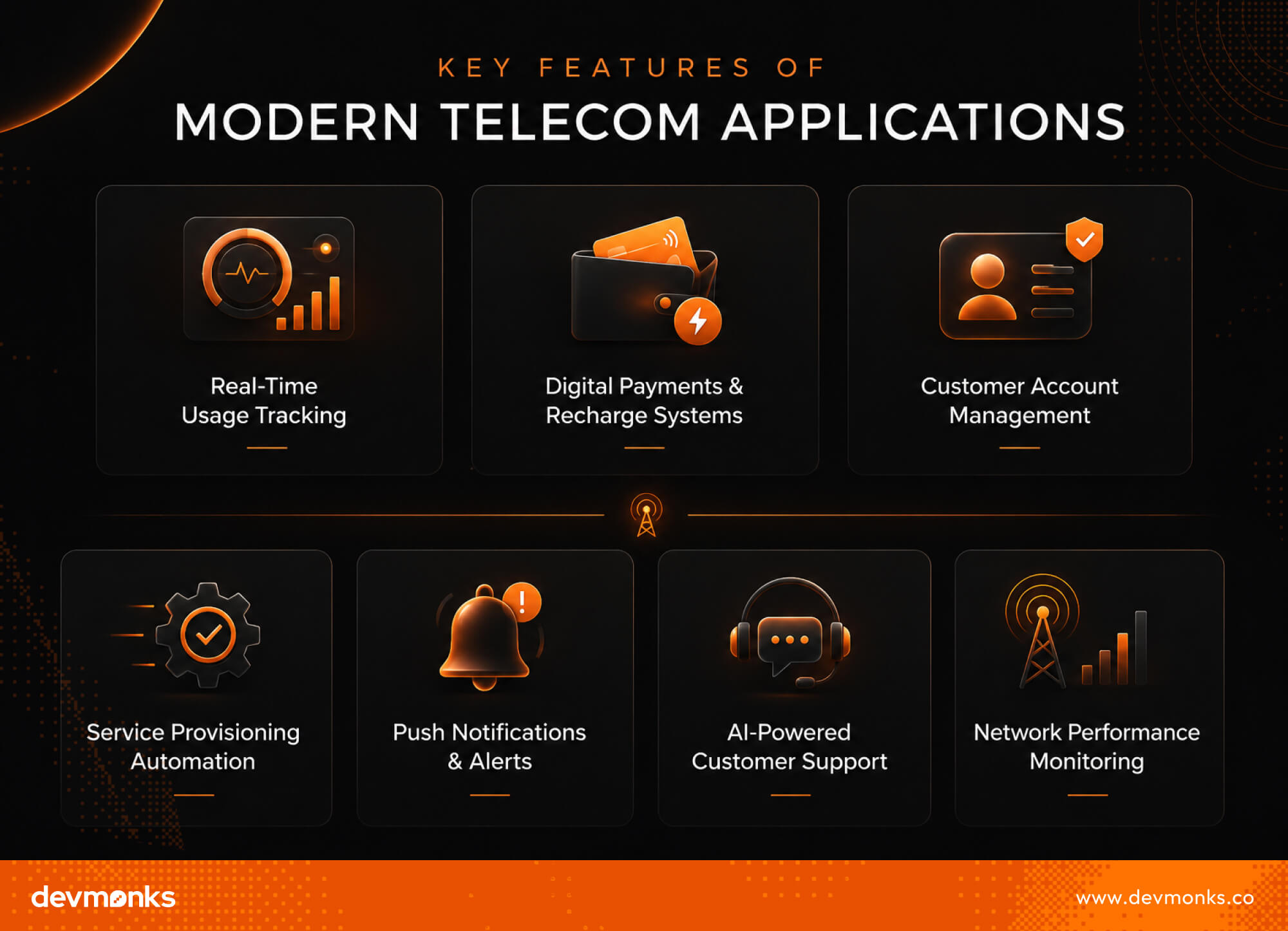
Key Features of Modern Telecom Applications
Modern telecom applications do much more than help users check their balances. They provide a complete digital experience that makes service management faster and easier.
Real-Time Usage Tracking
Users can monitor data, call, and SMS usage in real time. This helps them stay informed and avoid unexpected charges.
Digital Payments & Recharge Systems
Customers can pay bills, recharge accounts, and purchase plans directly from the app.
Customer Account Management
Strong customer management features allow users to update personal information, manage subscriptions, and view billing history.
Service Provisioning Automation
Automation speeds up service activation, plan changes, and account updates with minimal manual effort.
Push Notifications & Alerts
Apps send instant alerts about billing dates, usage limits, promotions, and service updates.
AI-Powered Customer Support
AI and Machine Learning help deliver faster support through chatbots, virtual assistants, and personalized recommendations.
Network Performance Monitoring
Built-in network monitoring tools help telecom providers track performance, identify issues, and improve service quality.
Reliable Agencies like Dev Monks integrate these capabilities into scalable systems to ensure reliability and smooth performance across telecom platforms.
Technologies Used in Telecom App Development
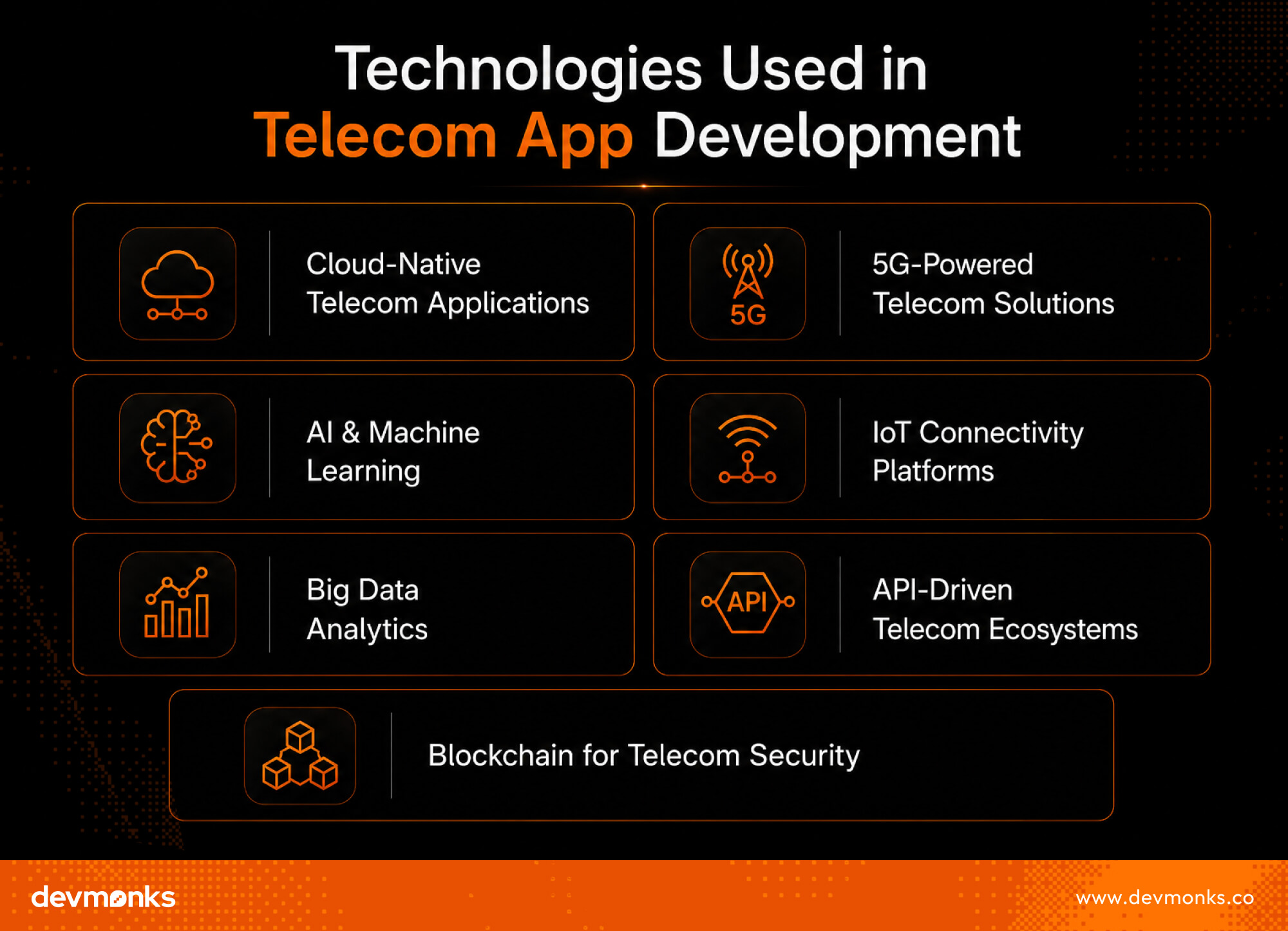
Modern telecom applications rely on a powerful telecom technology stack to deliver fast, secure, and scalable services.
Cloud-Native Telecom Applications
Cloud telecom solutions built on AWS, Azure, and Kubernetes provide flexibility, reliability, and easy scaling.
5G-Powered Telecom Solutions
5G technology enables faster connectivity, lower latency, and better support for high-demand applications.
AI & Machine Learning
AI and Machine Learning help telecom providers improve customer service, automate processes, and detect network issues.
IoT Connectivity Platforms
IoT platforms connect smart devices and support seamless communication across networks.
Big Data Analytics
Telecom companies use big data analytics to understand customer behavior, optimize services, and make better business decisions.
API-Driven Telecom Ecosystems
APIs allow telecom apps to integrate with payment gateways, CRM systems, and third-party services.
Blockchain for Telecom Security
Blockchain improves security by protecting transactions, reducing fraud, and enhancing data integrity.
Telecom App Development Process
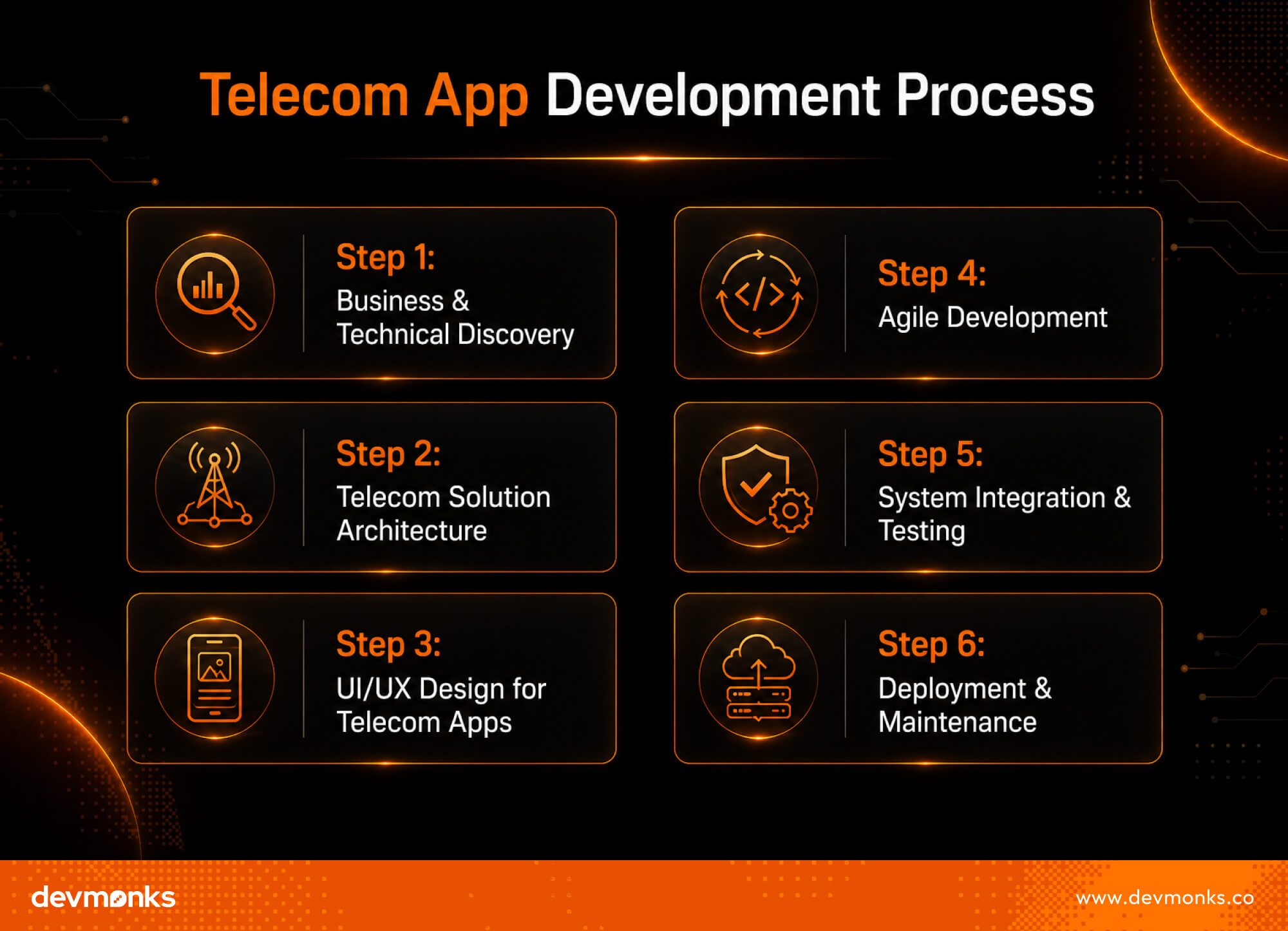
A successful telecom app requires more than great features. It needs a structured telecom app development process that ensures performance, security, and scalability. Below is a step-by-step look at the telecom software lifecycle.
Step 1: Business & Technical Discovery
The process starts with understanding business goals and user needs. The development team gathers requirements, identifies target users, and defines key features.
They also review technical requirements, compliance needs, and existing telecom systems that the app must connect with.
Step 2: Telecom Solution Architecture
Once the requirements are clear, the team creates the application architecture. This stage defines the technology stack, database structure, APIs, security framework, and integration strategy.
A strong architecture ensures the app can handle large numbers of users and growing service demands.
Step 3: UI/UX Design for Telecom Apps
The design phase focuses on creating a simple and intuitive user experience. Designers build wireframes, user flows, and interactive prototypes.
The goal is to help customers easily manage plans, track usage, make payments, and access support without confusion.
Step 4: Agile Development
After design approval, developers begin building the application using Agile methodologies. The project is divided into smaller development cycles called sprints. Features are developed, reviewed, and improved continuously.
This approach allows faster feedback and better flexibility throughout the project.
Step 5: System Integration & Testing
The app is then integrated with telecom platforms, billing systems, payment gateways, CRM software, and customer databases.
Comprehensive testing follows to ensure everything works correctly. Teams perform functional, performance, security, and compatibility testing to identify and fix issues before launch.
Step 6: Deployment & Maintenance
After successful testing, the application is deployed to production. However, the telecom app development process does not end there.
Ongoing maintenance is essential for fixing bugs, improving performance, releasing new features, and keeping the app secure. Regular updates help ensure a reliable user experience and long-term business success.
Telecom Software Solutions Dev Monks Develop for Different Business Models
Dev Monks builds custom telecom software solutions for different telecom infrastructure providers. Each business model has unique needs, so the development approach is customized for performance, scalability, and integration.
Mobile Network Operators (MNOs)
For MNOs, Dev Monks develops large-scale systems that support subscriber management, billing engines, and real-time network monitoring. These platforms are built for high traffic and complex telecom operations.
Mobile Virtual Network Operators (MVNOs)
For MVNOs, Dev Monks focuses on flexible and lightweight solutions. The systems include easy customer onboarding, pricing control, and seamless integration with host networks.
Internet Service Providers (ISPs)
Dev Monks creates ISP platforms that support bandwidth management, usage tracking, and service uptime monitoring. Stability and fast response systems are the main focus.
VoIP Service Providers
For VoIP businesses, Dev Monks develops real-time communication systems with optimized call routing, low latency, and secure voice transmission.
Enterprise Communication Providers
Dev Monks delivers enterprise-grade communication tools that include secure messaging, collaboration features, and internal communication systems for businesses.
Fiber Network Operators
For fiber operators, Dev Monks builds infrastructure monitoring systems, fault detection tools, and performance tracking dashboards.
Across all telecom infrastructure providers, Dev Monks ensures scalable architecture, strong integration, and reliable performance customized to each business model.
Telecom Integrations We Support
At Dev Monks, we provide advanced telecom integration services that connect different systems into one smooth ecosystem. Our goal is to help telecom businesses manage operations, customers, and networks without data gaps or system delays.
OSS/BSS Integration
We integrate Operations Support Systems (OSS) and Business Support Systems (BSS) to streamline network operations, service delivery, and business processes in one unified platform.
CRM Integration
Our solutions connect with leading CRM systems to improve customer management, track interactions, and enhance user experience.
Payment Gateway Integration
Dev Monks integrate secure payment gateways to support fast bill payments, recharges, and subscription purchases.
Billing Platform Integration
Dev Monks also ensures seamless integration with billing platforms for accurate invoicing, usage tracking, and revenue management.
Network Monitoring Integration
We connect telecom apps with real-time network monitoring tools to track performance and detect issues instantly.
Third-Party Communication APIs
We also integrate third-party communication APIs for SMS, email, and voice services.
With our telecom integration services, we help businesses build a connected, efficient, and scalable telecom ecosystem.
Security & Compliance in Telecom App Development
Security and compliance are critical parts of modern telecom app development. Telecom systems handle sensitive user data, payments, and communication records, so strong protection is required at every level.
Data Encryption & Security
All data is protected using strong encryption methods during transfer and storage. This helps prevent data leaks and unauthorized access.
GDPR Compliance
Telecom apps must follow GDPR rules to ensure user privacy, data transparency, and proper consent management.
PCI DSS Compliance
PCI DSS standards are used to secure payment transactions and protect financial information during billing and recharge processes.
Telecom Regulatory Requirements
Telecom applications must follow national and international telecom regulations to ensure lawful operations and service compliance.
Identity & Access Management
IAM systems control who can access what inside the platform. This reduces security risks and prevents unauthorized system usage.
With these security layers, telecom apps become safer, more reliable, and fully compliant with industry standards.
Telecom App Development Cost & Timeline
The cost of telecom app development varies widely depending on complexity, features, and integrations.
A basic or mid-range telecom app may cost around $15,000 - $70,000, while advanced enterprise-level platforms can range from $70,000 to $300,000+, depending on scalability, real-time systems, and third-party integrations.
Factors Affecting Development Cost
Cost increases with features like AI support, real-time billing, network monitoring, and integration with telecom systems. More advanced cloud infrastructure and security requirements also raise the budget.
Typical Development Timelines
Telecom app development timelines vary based on app type, complexity, and integration requirements.
Industry benchmarks suggest that a basic telecom app usually takes 3–4 months to develop, while enterprise-grade platforms can require 6–12 months or more.
- Customer self-service apps with features like billing, recharge, and usage tracking typically take 3–5 months.
- ISP and MVNO applications with CRM and payment integrations often require 4–7 months.
- VoIP applications may take 5–8 months due to real-time communication and security requirements.
- MNO platforms with advanced billing systems, network monitoring, and large-scale integrations can take 8–12+ months.
- Field service applications for technicians generally need 3–6 months, depending on offline support and workflow complexity.
The final timeline depends on factors such as third-party integrations, compliance requirements, custom features, testing scope, and team size.
Team Composition
A standard team includes a project manager, UI/UX designers, frontend and backend developers, QA engineers, and DevOps specialists.
Maintenance & Support Costs
Post-launch maintenance usually costs 15–20% of the initial development cost per year, covering updates, bug fixes, and infrastructure support.
Overall, both cost and timeline depend on the telecom app development process complexity and business requirements.
End Note
Telecom app development is not just about building software, but creating a complete digital experience for users and businesses.
If you are planning to build a telecom solution, focus on clear requirements, strong architecture, and the right technology partner.
A well-planned approach can ensure better performance, lower long-term costs, and higher customer satisfaction in a competitive telecom market.
.png)
.svg)
Frequently Asked Questions
How can I discuss an AI MVP with Dev Monks?

Book a strategy call with your use case, existing systems, and project priorities. The team can help define an initial scope and the dependencies that need to be addressed.
Does using AI replace engineering review?
Dev Monks uses AI-assisted workflows with human-guided decisions. Product requirements, engineering choices, and testing remain part of the development process.
What AI development services does Dev Monks offer?
Dev Monks offers agentic AI solutions, custom language-model solutions, workflow automation, and RAG development. Its broader services include SaaS engineering, MVP development, backend integrations, and web and mobile applications.
Is Dev Monks an official OpenAI Select Partner?
Yes. Dev Monks is now an official OpenAI Select Partner within the OpenAI Partner Network.
How long does it usually take to complete a project?
We combine AI-driven workflows with product-first engineering to provide MVP development services for startups and enterprises. Our approach balances speed, reliability, and usability while keeping teams involved. We deliver production-ready, scalable solutions, not just prototypes or demos.
What makes Dev Monks different from other development companies?
We combine AI-driven workflows with product-first engineering to provide MVP development services for startups and enterprises. Our approach balances speed, reliability, and usability while keeping teams involved. We deliver production-ready, scalable solutions, not just prototypes or demos.
How Involved Will My Team be During Development?
We combine AI-driven workflows with product-first engineering to provide MVP development services for startups and enterprises. Our approach balances speed, reliability, and usability while keeping teams involved. We deliver production-ready, scalable solutions, not just prototypes or demos.
How involved will my team be during development?
We combine AI-driven workflows with product-first engineering to provide MVP development services for startups and enterprises. Our approach balances speed, reliability, and usability while keeping teams involved. We deliver production-ready, scalable solutions, not just prototypes or demos.
Do you develop both web and mobile applications?
We combine AI-driven workflows with product-first engineering to provide MVP development services for startups and enterprises. Our approach balances speed, reliability, and usability while keeping teams involved. We deliver production-ready, scalable solutions, not just prototypes or demos.
How can Dev Monks help my startup launch faster
We combine AI-driven workflows with product-first engineering to provide MVP development services for startups and enterprises. Our approach balances speed, reliability, and usability while keeping teams involved. We deliver production-ready, scalable solutions, not just prototypes or demos.
%20vs%20new%20Date().jpg)