What is Application Development? Types, Process & Tools
.png)

.svg)
[ key takeways ]
- Application development covers web, mobile, desktop, and enterprise software types.
- SDLC ensures systematic planning, design, coding, testing, and deployment stages.
- Programming languages and frameworks power modern application functionality and structure.
- DevOps and cloud tools enable faster deployment and scalable application systems.
- Real-world apps like banking and e-commerce show practical usage examples.
.svg)
Application development is the process of creating digital solutions that power the apps people use every day. It goes beyond simple coding and focuses on building tools that solve real problems.
In today’s digital world, understanding this concept is important because it helps businesses make better technology decisions and stay competitive.
Without this knowledge, companies risk choosing the wrong solutions, wasting resources, and missing growth opportunities.
It also limits the ability to understand how modern apps are designed, built, and improved over time. Learning how application development works gives a clearer view of modern software systems and digital transformation.
Read this article to understand its types, process, technologies, and real-world uses in simple terms.
Definition of Application Development
Application development, or AppDev, means creating software that helps people and businesses complete tasks more easily and efficiently.
It focuses on building Application software that solves specific problems, such as managing finances, ordering food, or communicating with others.
Simply, it is the process of turning ideas into useful digital tools that people can use in their daily lives.
This process is a key part of Software development. It involves several important steps, which include planning, designing, coding, testing, and maintenance.
Developers usually follow a structured approach known as the Software development lifecycle to ensure the application works properly and meets user needs.
Application development is about building software applications that improve user experience, solve real problems, and support business growth in a practical way.
Choosing the right development partner also makes a big difference in quality and success. Working with a skilled team like Dev Monks ensures better execution, faster delivery, and more reliable digital solutions.

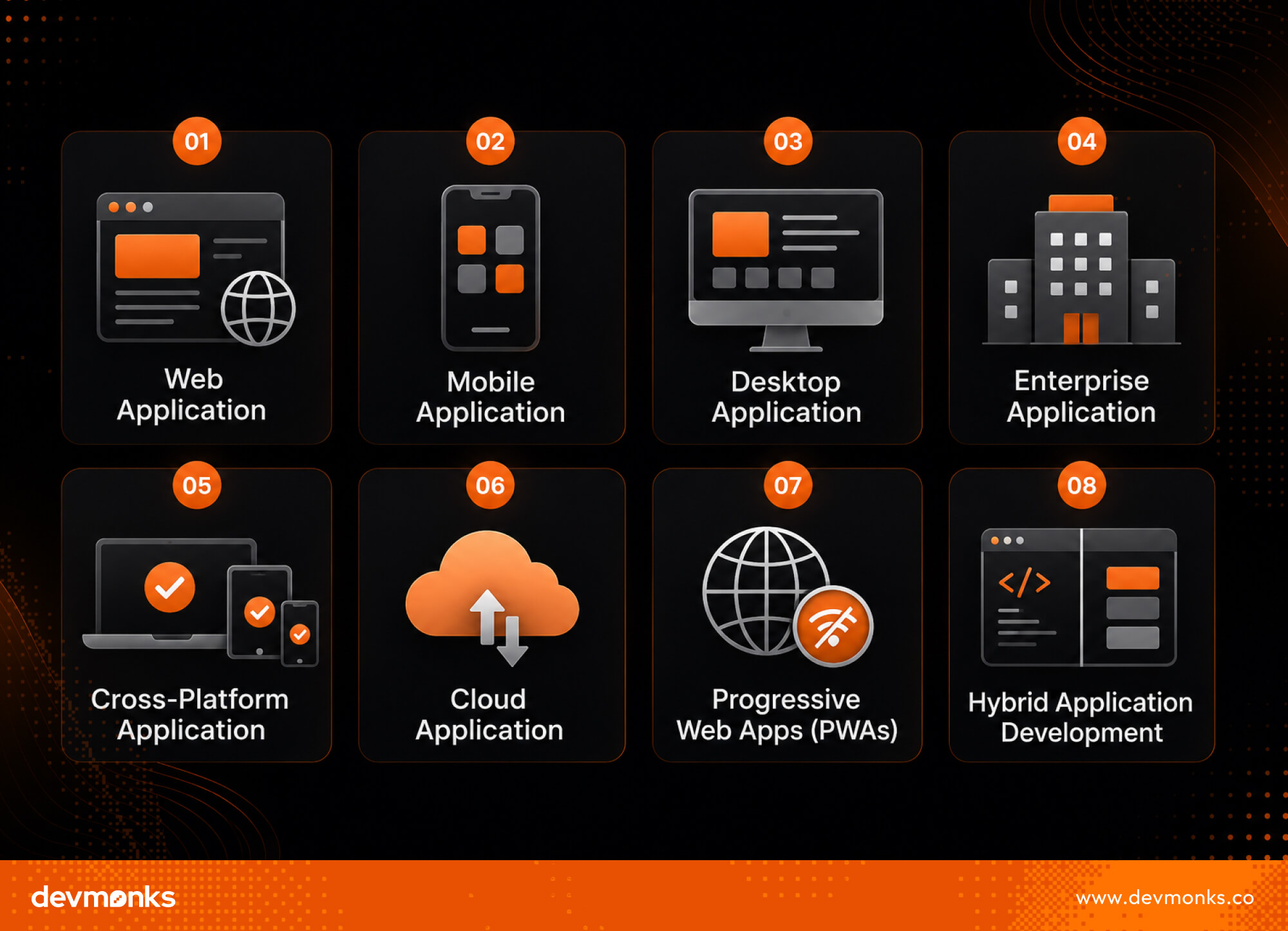
Types of Application Development
Application development includes different types based on platform, usage, and user needs. Each type described below focuses on how and where the software will run, which helps businesses choose the right solution.
Web Application Development
Web application development focuses on apps that run inside a Browser without installation. A Web application can be accessed from any device with internet access.
These online applications are often cloud-based, which makes them easy to update and maintain. This approach is ideal for businesses that want a wider reach and simple access.
Mobile Application Development
Mobile application development involves building apps for smartphones and tablets. A Mobile app is created for platforms like Android and iOS.
These apps are optimized for mobile performance and user experience. They often use device features like the camera, GPS, and notifications.
Desktop Application Development
Desktop application development focuses on software installed directly on a computer. This type of Desktop software often works offline and offers strong performance. It is commonly used for tasks that require more system power and stability.
Enterprise Application Development
Enterprise application development deals with large-scale systems used by organizations.
These applications, known as Enterprise software, manage operations like finance, HR, and supply chains. They are built to handle large amounts of data and support many users securely.
Cross-Platform Application Development
Cross-platform application development allows one app to run on multiple platforms using a single codebase. This reduces development time and cost while maintaining a consistent user experience. It is useful for businesses targeting users across devices.
Cloud Application Development
Cloud application development focuses on apps that run on remote servers instead of local devices. These apps store data online and can be accessed anytime from anywhere.
They are easy to scale and update, which makes them flexible for growing businesses.
Progressive Web Apps (PWAs)
Progressive Web Apps combine features of web and mobile apps. They run in a browser but offer app-like performance and offline access. PWAs can also be installed on devices without app stores.
Hybrid Application Development
Hybrid application development uses web technologies to build apps that run on multiple platforms. These apps are wrapped in a native container, which allows them to work on both Android and iOS.
They are faster to develop and cost-effective, though performance may be slightly lower than native apps.
Application Development Process (Step-by-Step)
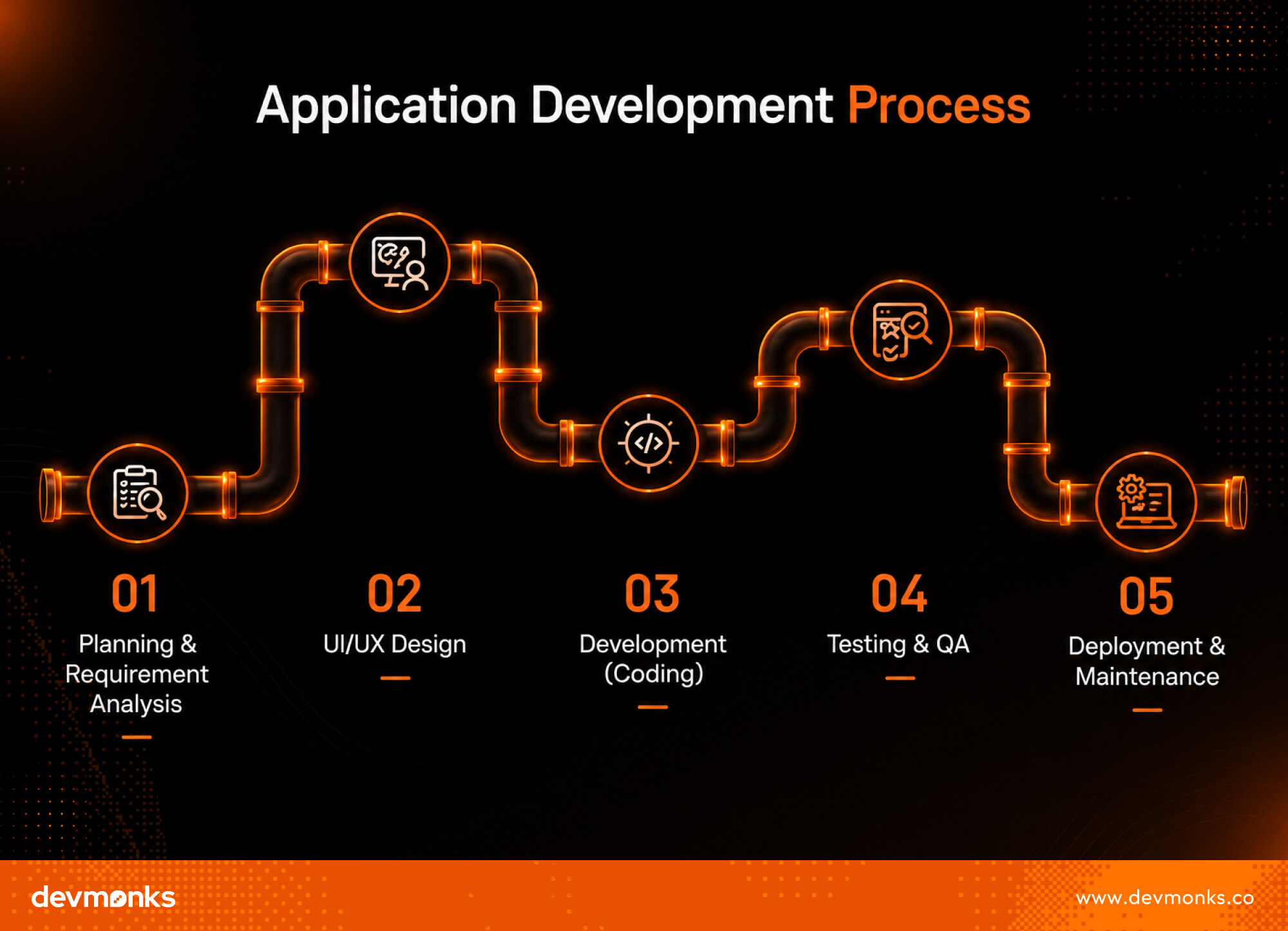
Application development follows a structured process that turns an idea into a working product. This process is part of the SDLC and ensures the application meets user needs and quality standards. The steps are described below.
Step 1: Planning & Requirement Analysis
The process starts with planning and requirement analysis, where developers identify user needs and business goals. This stage defines what the application should do and how it will solve problems effectively.
Step 2: UI/UX Design
Next comes UI/UX design, where the look and feel of the application are created. Designers focus on building simple interfaces and smooth user experiences to ensure easy navigation and engagement.
Step 3: Development (Coding)
In the development stage, programmers write code and build the core features of the application. Teams often use approaches like Agile methodology to develop features step by step and improve them continuously.
Step 4: Testing & QA
After development, the application goes through testing and quality assurance. Developers fix bugs, check performance, and ensure the software works correctly across different devices and conditions.
Step 5: Deployment & Maintenance
Finally, the application is launched for users in the deployment stage. With practices like DevOps, teams ensure smooth releases and continuous updates. Maintenance then keeps the application secure, updated, and aligned with user needs.
Key Technologies Used in Application Development
Application development uses a combination of tools and coding technologies to build efficient software. These development tools help create, manage, and scale applications across different platforms.
- Programming languages are the foundation of any application. Common choices include JavaScript, Python, Java, and C#, each suited for different use cases. These languages are part of a Programming language system that enables developers to build application logic and functionality.
- Frameworks help speed up development by providing reusable components and structure. Popular frameworks include: React for interactive front-end development. Angular for building dynamic web applications, and Node.js for backend development using JavaScript.
- Databases are used to store and manage application data efficiently. Common types include: SQL for structured data, and NoSQL for flexible and scalable storage.
- Modern application delivery relies on automation and scalable infrastructure. Tools like Docker and Kubernetes support containerization and orchestration. CI/CD tools such as Jenkins and GitHub Actions automate testing and deployment. Cloud platforms like AWS, Azure, and Google Cloud provide reliable hosting and scalability.
Application Development Methodologies
Application development methodologies define how software is planned, built, and delivered. These structured approaches help teams manage work efficiently and reduce development risks.
Agile Development
Agile focuses on flexible and iterative development. Work is divided into small cycles, which allows continuous feedback and improvement.
Waterfall Model
Waterfall follows a step-by-step process where each phase is completed before moving to the next. It is best for projects with clear and fixed requirements.
DevOps Approach
DevOps combines development and operations to improve collaboration and speed. It focuses on continuous integration, testing, and deployment.
Rapid Application Development (RAD)
RAD emphasizes quick development through prototypes and user feedback. It helps deliver applications faster by reducing planning time and focusing on functional components early.
Spiral Model
The Spiral model combines iterative development with risk analysis. It allows repeated cycles of planning, design, and evaluation, which makes it suitable for complex and high-risk projects.
Benefits of Application Development
Application development delivers several important advantages for businesses and users. It improves performance, reduces manual effort, and supports digital growth through smarter systems. Here are the core benefits of application development.
- Efficiency improvement: Speeds up workflows and reduces operational delays.
- Automation: Handles repetitive tasks with accuracy and less human effort.
- Scalability: Allows applications to grow smoothly with increasing business demands.
- Competitive advantage: Helps businesses innovate faster and stay ahead in the market.
- Better user experience: Provides simple, fast, and user-friendly interfaces for customers.
These benefits are a major part of digital transformation, which helps organizations improve productivity and overall business efficiency through modern application systems.
Challenges in Application Development
Application development brings many benefits, but it also comes with several challenges that affect both developers and businesses. These issues can impact time, cost, and overall project success.
- Security risks: Applications can face data breaches and cyber threats if not properly secured.
- Platform fragmentation: Different systems like iOS and Android require separate development efforts.
- High cost: Development, testing, and maintenance can be expensive for businesses.
- Complexity: Modern applications involve multiple technologies and integrations.
- Scope creep: Poor planning often leads to changing requirements during development.
- Maintenance: Continuous updates and bug fixes are needed after deployment.
These development challenges highlight the importance of proper planning and risk management in software projects.
Real-World Examples of Application Development
Application development powers many digital services used in daily life across industries. These real-world examples show how software supports convenience, speed, and digital transformation.
- E-commerce apps: Platforms like Amazon and Walmart use an e-commerce platform to enable fast online shopping, delivery tracking, and secure payments.
- Banking apps: Financial institutions rely on Mobile banking to let users transfer funds, manage accounts, and access financial services anytime.
- Social media apps: Platforms such as Facebook, Instagram, and X use Social media to connect millions of users for communication, networking, and content sharing.
These examples show how application development drives innovation and supports everyday digital experiences.
Application Development vs Software Development
Application development and software development are closely related but not exactly the same.
Application development focuses mainly on building specific user-facing apps like mobile, web, or desktop applications. These apps are designed to solve particular user or business problems with clear functionality.
Software development on the other hand, is a broader term that includes application development as well as system software, tools, and infrastructure. It covers everything from operating systems to complex enterprise solutions.
Application development is a part of Software engineering. While application development targets end users, software development includes both user-facing and backend systems, which makes it a wider concept in the technology field.
Future Trends in Application Development
Application development is rapidly evolving with new technologies shaping how software is built and used. These trends are driving faster innovation and smarter digital solutions.
- AI-powered apps: Applications using Artificial Intelligence deliver smarter automation, personalization, and decision-making features.
- Low-code / No-code platforms: These tools allow users to build apps with minimal coding, which makes development faster and more accessible.
- Cloud-native apps: Built using Cloud computing, these applications are scalable, flexible, and highly reliable.
These future trends show how application development is moving toward smarter, faster, and more scalable solutions.
Conclusion
Application development is the process of creating software that solves real user and business problems. It includes different types, structured development processes, and modern technologies.
From planning to deployment, each step ensures quality and performance. With evolving trends like AI and cloud computing, application development continues to drive innovation and improve digital experiences across industries.
.png)
.svg)
Frequently Asked Questions
How can I discuss an AI MVP with Dev Monks?

Book a strategy call with your use case, existing systems, and project priorities. The team can help define an initial scope and the dependencies that need to be addressed.
Does using AI replace engineering review?
Dev Monks uses AI-assisted workflows with human-guided decisions. Product requirements, engineering choices, and testing remain part of the development process.
What AI development services does Dev Monks offer?
Dev Monks offers agentic AI solutions, custom language-model solutions, workflow automation, and RAG development. Its broader services include SaaS engineering, MVP development, backend integrations, and web and mobile applications.
Is Dev Monks an official OpenAI Select Partner?
Yes. Dev Monks is now an official OpenAI Select Partner within the OpenAI Partner Network.
How long does it usually take to complete a project?
We combine AI-driven workflows with product-first engineering to provide MVP development services for startups and enterprises. Our approach balances speed, reliability, and usability while keeping teams involved. We deliver production-ready, scalable solutions, not just prototypes or demos.
What makes Dev Monks different from other development companies?
We combine AI-driven workflows with product-first engineering to provide MVP development services for startups and enterprises. Our approach balances speed, reliability, and usability while keeping teams involved. We deliver production-ready, scalable solutions, not just prototypes or demos.
How Involved Will My Team be During Development?
We combine AI-driven workflows with product-first engineering to provide MVP development services for startups and enterprises. Our approach balances speed, reliability, and usability while keeping teams involved. We deliver production-ready, scalable solutions, not just prototypes or demos.
How involved will my team be during development?
We combine AI-driven workflows with product-first engineering to provide MVP development services for startups and enterprises. Our approach balances speed, reliability, and usability while keeping teams involved. We deliver production-ready, scalable solutions, not just prototypes or demos.
Do you develop both web and mobile applications?
We combine AI-driven workflows with product-first engineering to provide MVP development services for startups and enterprises. Our approach balances speed, reliability, and usability while keeping teams involved. We deliver production-ready, scalable solutions, not just prototypes or demos.
How can Dev Monks help my startup launch faster
We combine AI-driven workflows with product-first engineering to provide MVP development services for startups and enterprises. Our approach balances speed, reliability, and usability while keeping teams involved. We deliver production-ready, scalable solutions, not just prototypes or demos.
%20vs%20new%20Date().jpg)