What Is Enterprise Web Development? Full Guide
.png)

.svg)
[ key takeways ]
- Enterprise web development helps organizations manage complex workflows through web-based systems.
- It focuses on strong architecture, security, and system integration
- It uses modern technologies like cloud platforms, APIs, and modular design
- It improves efficiency, automation, and data-driven decision-making
- It comes with challenges but offers long-term growth and flexibility
.svg)
Enterprise web development builds large, secure, and scalable web applications that run core business operations. These systems handle high traffic, complex workflows, and real-time data. Unlike basic websites, they focus on performance, integration, and long-term growth.
Understanding this matters because businesses now rely on digital systems to stay competitive. Without the right enterprise setup, operations become slow, data gets fragmented, and security risks increase.
On the other hand, a well-built system improves efficiency, supports digital transformation, and enables smarter decision-making.
This article breaks down everything you need to know about enterprise web development. From key components to technologies, benefits, and future trends, you will get a clear view of how enterprise web development works and why it matters. So, keep reading!
What Is Enterprise Web Development?
Enterprise Web Development means creating, maintaining, and scaling high-performance web applications and websites for mid-to-large-sized organizations. These systems support daily business operations and processes.
They are part of enterprise software used to manage data, users, and workflows. They follow a structured web application architecture to ensure stability and performance. They also play a role in digital transformation by moving businesses to digital platforms.
These applications handle high traffic and large data volumes. They are designed for long-term use and continuous updates.
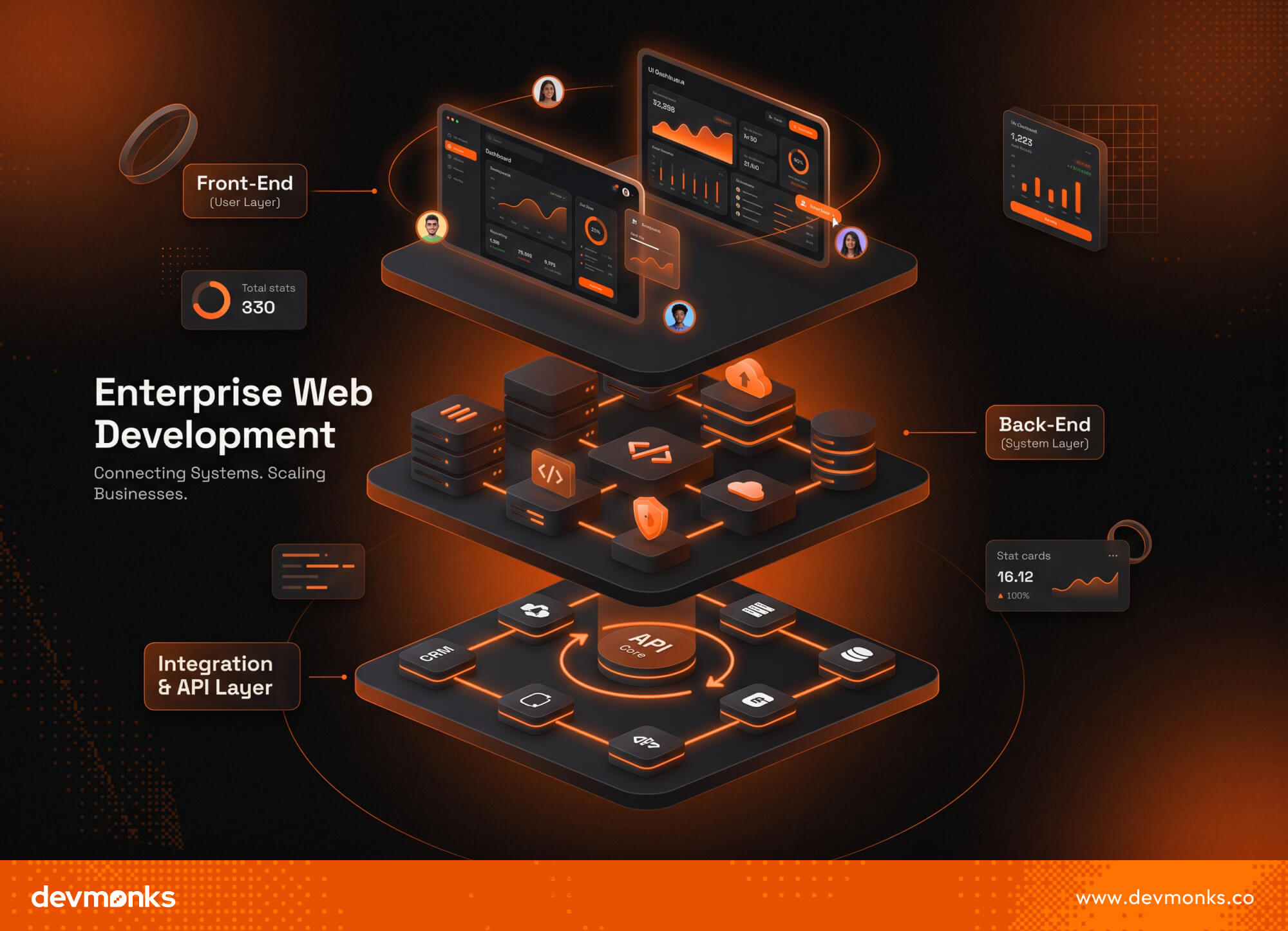
There are 3 key activities that occur under enterprise web development. Firstly, front-end development focuses on the user interface. It ensures users can interact with the system easily.
Secondly, back-end development manages data, logic, and system operations. It keeps everything running correctly.
Finally, integration and API management connect different systems. This allows enterprise solutions to share data across business platforms.
Enterprise web development is mainly used by large organizations, including banks, healthcare providers, and corporate platforms. They rely on enterprise software development to manage large-scale web systems efficiently.
Key Characteristics of Enterprise Web Applications
Here are some of the key characteristics of enterprise web development.
Scalability
Enterprise applications are built to grow. They must handle more users, more data, and more activity over time. This is where scalability becomes essential, as the system should expand without slowing down.
Security
Security is a core requirement. These systems deal with sensitive business and user data every day. A strong security architecture ensures that data stays protected and access is controlled.
Integration
Enterprise systems rarely work alone. They need to connect with other tools and platforms used across the organization. Smooth system integration allows data to move easily between systems without disruption.
User Experience
Even complex systems must feel simple to use. A clear and structured interface helps users complete tasks faster. Good user experience reduces errors and improves overall efficiency.
Performance Optimization
Speed and stability are critical. Enterprise applications must respond quickly, even under heavy load. Strong performance ensures that business operations run without delays or interruptions.
How Enterprise Web Development Differs From Regular Web Development
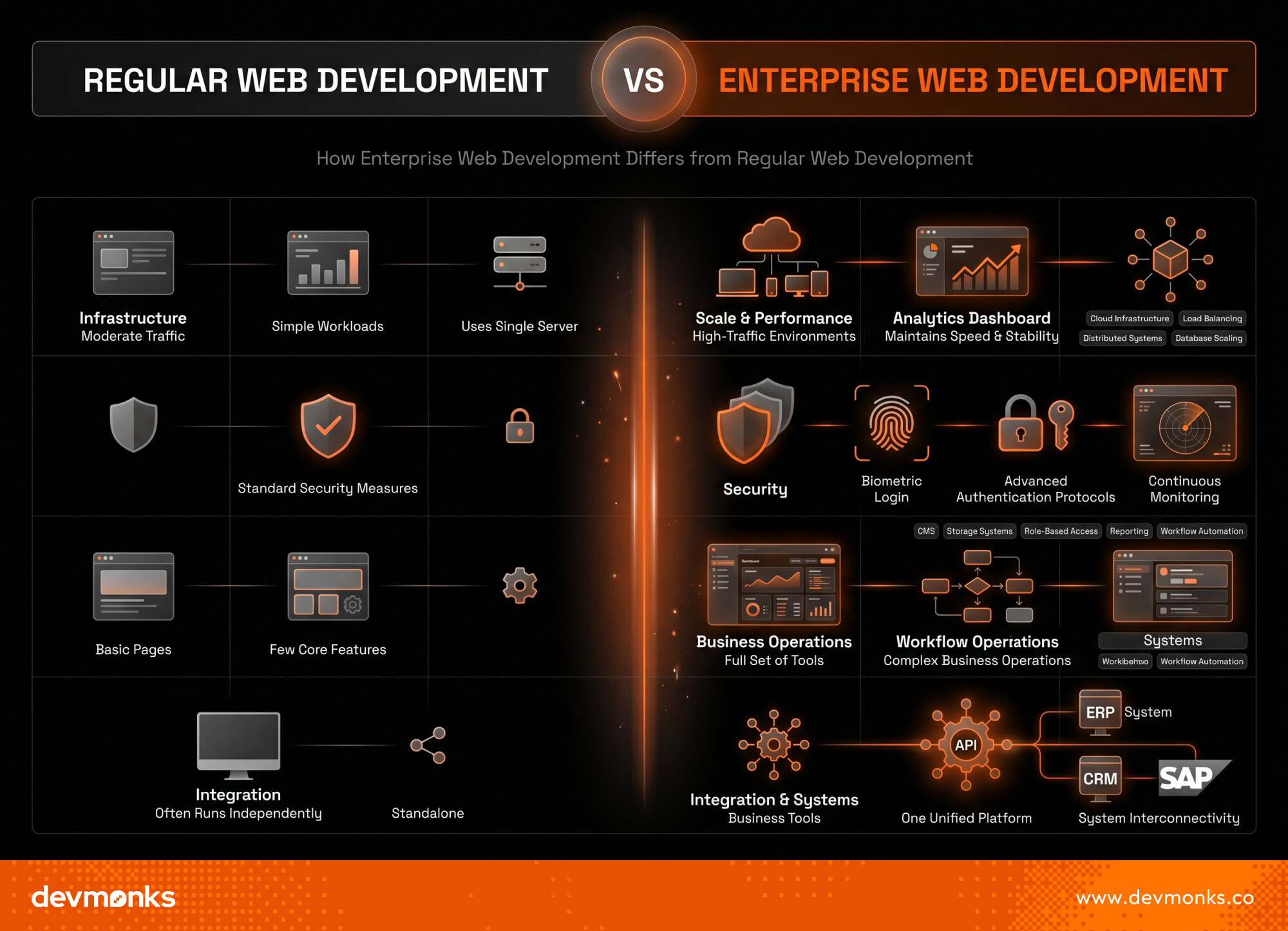
Enterprise web development is built for complexity. In contrast, regular websites focus on basic pages and limited functions. Unlike regular web development, enterprise systems handle large-scale operations, support multiple users, and run continuously.
Here are four major differences between enterprise web development and regular web development.
Scale and Performance Requirements
Regular websites handle moderate traffic and simple workloads. On the other hand, enterprise systems are designed for high-traffic environments that run continuously.
They use distributed systems to spread workloads, while smaller sites often rely on a single server. Enterprise systems also depend on cloud infrastructure, load balancing, and database scaling to maintain speed and stability.
Security and Compliance Requirements
Basic websites use standard security measures, while enterprise systems require strict protection due to sensitive data.
They follow regulations like GDPR and SOC 2. They also use advanced authentication protocols, encryption, and continuous monitoring.
Requires More Features
Regular websites usually need a few core features. In contrast, enterprise applications require a full set of tools working together.
These include CMS, storage systems, integrations, role-based access, reporting, and workflow automation. This level of functionality supports complex business operations.
Integration With Enterprise Systems
Small websites often run independently. On the contrary, enterprise systems must connect with multiple business tools.
They integrate with ERP systems, CRM platforms, and internal tools like Salesforce and SAP. API integrations ensure all systems share data and work as one unified platform.
Key Components of Enterprise Web Development
Enterprise systems rely on a few core technical components. These components ensure the system can scale, stay stable, and handle complex operations. They are not optional. They define how the entire application works.
Here are the four key components of enterprise web development.
Scalable Architecture
Enterprise applications must be built on a scalable foundation. Some systems use a single codebase, known as a monolith. This is easier to start but harder to scale over time.
Many enterprises like Netflix and Amazon now prefer a microservices architecture. It splits the system into smaller services. Each service can be updated or scaled independently.
Tools like Kubernetes help manage these services. This approach supports modular architecture and service-based architecture, which improves flexibility.
Strong Data Management Systems
Enterprise systems handle large volumes of data. They need strong and reliable databases. These are often referred to as enterprise databases.
Relational databases like PostgreSQL store structured data. NoSQL options like MongoDB handle flexible data formats.
Data pipelines are also important. They collect, process, and move data across the system. This ensures data is always available and up to date.
Enterprise Integration APIs
Enterprise systems rely heavily on APIs. They allow different services and platforms to communicate. Common approaches include REST API and GraphQL. These help systems request and exchange data efficiently.
This supports API-first development, where APIs are designed before the system itself. It ensures better integration and faster development.
Modular Architecture
Modular architecture keeps the system organized. It breaks the application into smaller, manageable parts.
Each module handles a specific function. This makes updates easier and reduces system risk.
Technologies Used in Enterprise Web Development
Enterprise web development uses a mix of reliable tools and modern frameworks. These technologies help build systems that are fast, scalable, and easy to manage.
From backend logic to frontend design and cloud deployment, each layer plays a specific role.
Backend Technologies
The backend handles data, logic, and system operations. It must be stable and able to handle heavy workloads.
Java is widely used in enterprise systems. It is known for stability and long-term support.
.NET is another strong option. It works well for building secure and high-performance applications.
Node.js is popular for fast and scalable applications. It is often used when real-time data processing is needed.
Frontend Technologies
The frontend focuses on how users interact with the system. Enterprise interfaces must be clear, fast, and responsive.
React is widely used for building dynamic user interfaces. It allows developers to create reusable components.
Angular is suitable for large-scale applications. It provides a complete structure for development.
Vue.js is known for simplicity and flexibility. It is easier to adopt and is still powerful for enterprise use.
Cloud Infrastructure
Cloud infrastructure is the backbone of modern enterprise systems. It allows applications to run without relying on physical servers.
Platforms like AWS, Microsoft Azure, and Google Cloud provide scalable resources on demand.
This means businesses can increase or reduce capacity based on need. There is no need to invest in expensive hardware upfront.
Cloud platforms also support automatic scaling. When traffic increases, the system adjusts instantly. When demand drops, resources are reduced. They also improve reliability. Data is stored across multiple servers, so failure in one does not stop the system.
Another key advantage is faster deployment. Teams can launch updates and new features quickly without downtime. This makes cloud infrastructure essential for building flexible and high-performing enterprise applications.
Benefits of Enterprise Web Development
Enterprises invest in enterprise web development to streamline operations and boost growth. Here are the major benefits of enterprise web development.
- Operational efficiency: Automates repetitive tasks and reduces manual work, which gives employees the freedom to focus on higher-value activities. This leads to smoother processes and fewer errors across departments.
- Scalable infrastructure: Supports business growth without the need to rebuild systems from scratch. As user numbers and data volumes increase, the system adapts seamlessly to meet demand.
- Data-driven decision making: Provides real-time insights and analytics to help managers make informed choices. Businesses can respond quickly to trends, optimize processes, and reduce risks.
- Cross-platform accessibility: Works across devices, including desktops, tablets, and mobile phones. Employees and clients can access the system anytime, anywhere, improving flexibility and collaboration.
- Better customizability: Adapts to specific business needs, workflows, and user roles. Companies can add features or adjust processes without disrupting the entire system.
- Better user experience: Simplifies complex operations with intuitive interfaces and clear workflows. This reduces errors, training time, and increases overall productivity.
- Higher level of security: Protects sensitive data with advanced encryption, monitoring, and role-based access controls. It also helps comply with industry regulations and standards.
- 24/7 accessibility: Keeps systems available at all times, which ensures continuous operations even during peak hours or unexpected downtime. This supports global teams and customers in different time zones.
- Improved integration: Connects multiple tools, platforms, and internal systems into a unified workflow. Data flows smoothly, which reduces duplication and improves efficiency across departments.
- Faster operations: Reduces delays in processes through automation and optimized performance. Tasks are completed more quickly. It helps the business respond faster to customer needs.
Enterprise Web Development Process
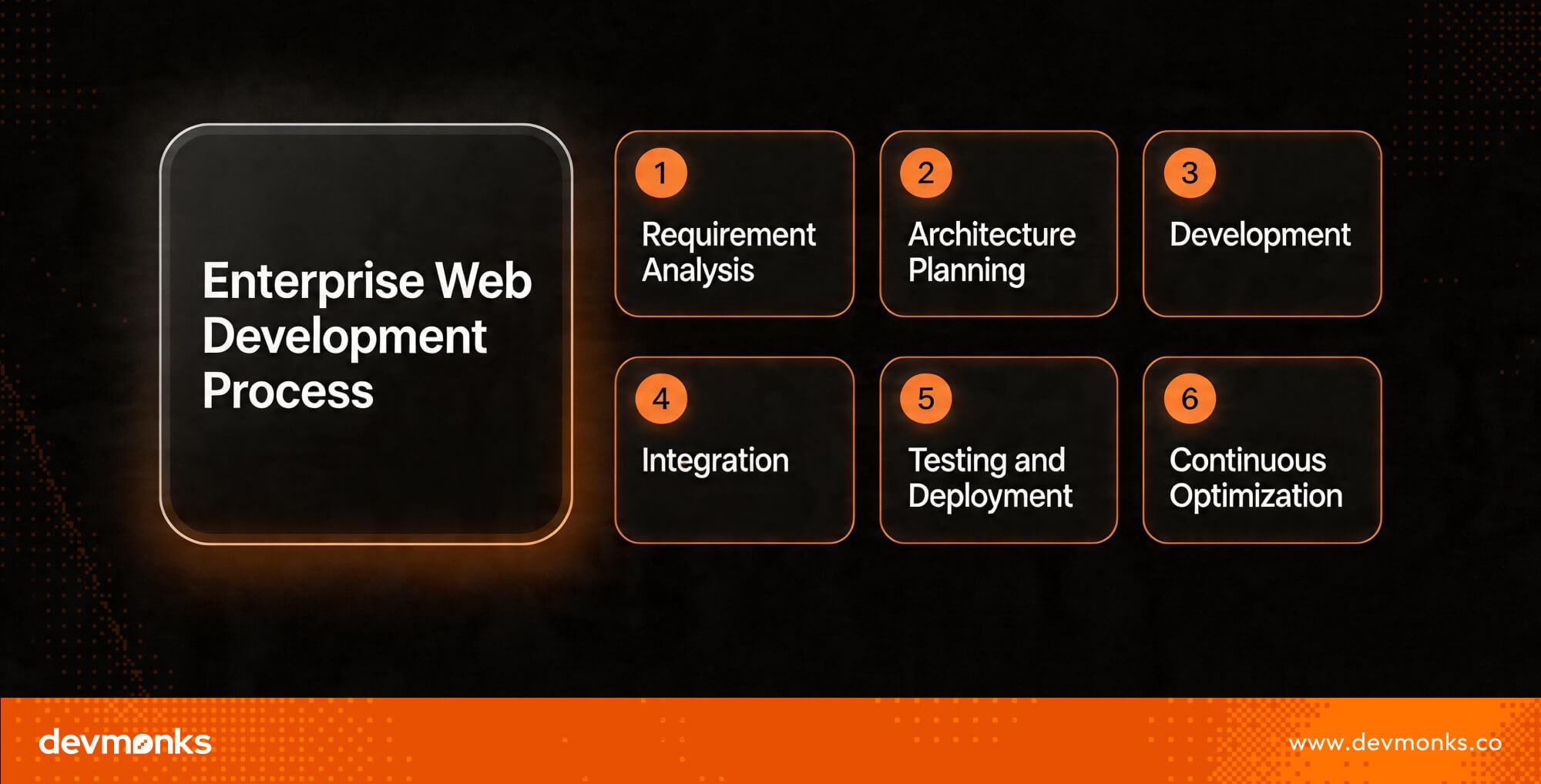
Building an enterprise system follows a structured workflow. Most teams use agile development and DevOps to ensure speed, collaboration, and reliability. Here are the six major steps in the enterprise development process.
Step 1: Requirement Analysis
First, you need to understand the business needs, define goals, and gather specifications. This step ensures the system addresses real operational challenges.
Step 2: Architecture Planning
The second step is to design a scalable and secure architecture. Decide between monolithic or microservices architecture, plan databases, APIs, and integration points.
Step 3: Development
Next comes building the front-end interface, back-end logic, and databases. Use suitable languages and frameworks to ensure stability and performance.
Step 4: Integration
After that, connect APIs, internal tools, ERP or CRM systems, and other enterprise software. This ensures smooth data flow across platforms.
Step 5: Testing and Deployment
Once the integration is done, perform functional, performance, and security testing. Deploy the system on cloud or on-premise infrastructure.
Step 6: Continuous Optimization
Lastly, monitor performance, fix issues, update features, and scale resources as the business grows.
Challenges in Enterprise Web Development
Enterprise web development comes with both technical and organizational challenges. Large systems often depend on outdated tools, complex structures, and evolving business needs. Here are the key challenges.
- Legacy system integration: Connecting modern apps with legacy systems is difficult and time-consuming.
- Data security risks: Protecting large volumes of sensitive data requires constant monitoring and updates.
- Complex system architecture: Managing multiple layers and services increases system complexity.
- Long development cycles: Large projects take more time due to planning, testing, and approvals.
- Cross-platform and browser compatibility: Ensuring smooth performance across devices and browsers adds extra effort.
- Technology adoption and maintenance: Updating systems and managing technical debt can slow down progress.
However, a professional agency like Dev Monks can handle these challenges with expertise in integrations, security, and enterprise-grade systems, ensuring reliable results.
Future Trends in Enterprise Web Development
Enterprise web development is evolving with new technologies and smarter systems. Businesses are adopting trends that improve speed, flexibility, and decision-making. Some emerging future trends are given below.
- AI-powered enterprise applications: Use of AI automation to improve workflows, analytics, and customer experience.
- Edge computing & performance: Processing data closer to users to reduce latency and improve speed.
- Serverless architecture: Use of serverless computing to run applications without managing servers.
- Low-code enterprise platforms: Faster development with minimal coding for quicker deployment.
- Headless architecture: Separates frontend and backend for better flexibility and customization.
- Cybersecurity-first approach: Strong focus on data protection and system security from the start.
- Web3 and blockchain: Decentralized systems for secure and transparent transactions.
End Note
Enterprise web development transforms how businesses operate by building scalable, secure, and high-performance web systems. It improves efficiency, supports data-driven decisions, and integrates all tools into one platform.
By investing in these systems, organizations gain flexibility, stronger security, and better user experiences. It ensures they stay competitive today while preparing for future growth and technological trends.
.png)
.svg)
Frequently Asked Questions
How can I discuss an AI MVP with Dev Monks?

Book a strategy call with your use case, existing systems, and project priorities. The team can help define an initial scope and the dependencies that need to be addressed.
Does using AI replace engineering review?
Dev Monks uses AI-assisted workflows with human-guided decisions. Product requirements, engineering choices, and testing remain part of the development process.
What AI development services does Dev Monks offer?
Dev Monks offers agentic AI solutions, custom language-model solutions, workflow automation, and RAG development. Its broader services include SaaS engineering, MVP development, backend integrations, and web and mobile applications.
Is Dev Monks an official OpenAI Select Partner?
Yes. Dev Monks is now an official OpenAI Select Partner within the OpenAI Partner Network.
How long does it usually take to complete a project?
We combine AI-driven workflows with product-first engineering to provide MVP development services for startups and enterprises. Our approach balances speed, reliability, and usability while keeping teams involved. We deliver production-ready, scalable solutions, not just prototypes or demos.
What makes Dev Monks different from other development companies?
We combine AI-driven workflows with product-first engineering to provide MVP development services for startups and enterprises. Our approach balances speed, reliability, and usability while keeping teams involved. We deliver production-ready, scalable solutions, not just prototypes or demos.
How Involved Will My Team be During Development?
We combine AI-driven workflows with product-first engineering to provide MVP development services for startups and enterprises. Our approach balances speed, reliability, and usability while keeping teams involved. We deliver production-ready, scalable solutions, not just prototypes or demos.
How involved will my team be during development?
We combine AI-driven workflows with product-first engineering to provide MVP development services for startups and enterprises. Our approach balances speed, reliability, and usability while keeping teams involved. We deliver production-ready, scalable solutions, not just prototypes or demos.
Do you develop both web and mobile applications?
We combine AI-driven workflows with product-first engineering to provide MVP development services for startups and enterprises. Our approach balances speed, reliability, and usability while keeping teams involved. We deliver production-ready, scalable solutions, not just prototypes or demos.
How can Dev Monks help my startup launch faster
We combine AI-driven workflows with product-first engineering to provide MVP development services for startups and enterprises. Our approach balances speed, reliability, and usability while keeping teams involved. We deliver production-ready, scalable solutions, not just prototypes or demos.

%20vs%20new%20Date().jpg)