Why Custom Software Development Is Important? Think Beyond SaaS


[ key takeways ]
- Custom software aligns directly with business workflows, which improves overall operational efficiency.
- It reduces dependency on rigid systems by offering flexible, customized solutions.
- Businesses achieve better scalability when software grows alongside changing operational needs.
- Integration with existing tools improves coordination, automation, and data accuracy across systems.
- Long-term value increases through improved control, security, and cost efficiency.

Custom software development is important because it aligns technology directly with how your business actually works and grows.
Many businesses struggle not because of poor effort, but because their systems do not fit their real workflows. Off-the-shelf tools often create limitations that slow down processes, reduce flexibility, and make scaling harder than it should be.
Over time, this gap between business needs and software capability can quietly affect efficiency, decisions, and growth potential.
Understanding why custom software matters helps you see how customized systems improve control, automation, and long-term performance.
This article breaks down its importance in a simple way, which helps you understand where it makes the biggest difference in real business situations. Keep reading!
What Is Custom Software Development?
Custom software development is the process of building applications designed for specific business needs. It focuses on creating customized solutions that match workflows, goals, and operational requirements.
Instead of adapting your processes, the software solution adapts to how your business operates. This makes it highly relevant for companies seeking efficiency, control, and long-term scalability.
Custom Software vs Off-the-Shelf Software

Ready-made software, often delivered through SaaS platforms, is built for a wide audience. These tools are quick to deploy and cost-effective, but offer limited flexibility for customization.
Businesses may need to adjust their processes to fit the software’s predefined structure.
In contrast, custom software is designed with flexibility and purpose in mind. It evolves with changing business needs and integrates smoothly with existing systems.
While it requires more time and investment initially, it delivers a more precise and scalable software solution.
Why Custom Software Matters for Businesses?
Custom software plays a central role in modern Digital transformation across industries. It enables companies to build systems that align perfectly with their unique business needs.
This alignment ensures that every feature supports real workflows, not generic assumptions or limitations.
When software mirrors actual operations, it drives strong business optimization and smoother daily execution. Teams can complete tasks faster because the system is designed around how they already work.
This reduces training time and minimizes confusion caused by unnecessary or irrelevant features. As a result, organizations achieve higher operational efficiency and improved overall productivity.
Automation is another major advantage of custom development for growing businesses. Repetitive tasks like data entry, reporting, and approvals can be streamlined through intelligent workflows.
This not only improves efficiency but also reduces human errors and operational risks. Employees can then focus on strategic activities that contribute more value to the organization.
Custom software also creates a meaningful competitive advantage in today’s fast-moving digital markets. Businesses can build unique features and customer experiences that competitors cannot easily copy.
This flexibility allows quick adaptation to changing trends, technologies, and customer expectations.
Full ownership and control further strengthen its long-term importance as a software solution. Companies are not restricted by third-party limitations, licensing issues, or sudden pricing changes.
They can scale, modify, and integrate the system freely as the business evolves. Over time, this level of control, efficiency, and adaptability supports sustainable growth and innovation.
However, choosing custom software is only effective when you work with the right development partner. A reliable agency like Dev Monks helps you maximize value through customized solutions, efficient execution, and long-term support.
Key Benefits of Custom Software Development
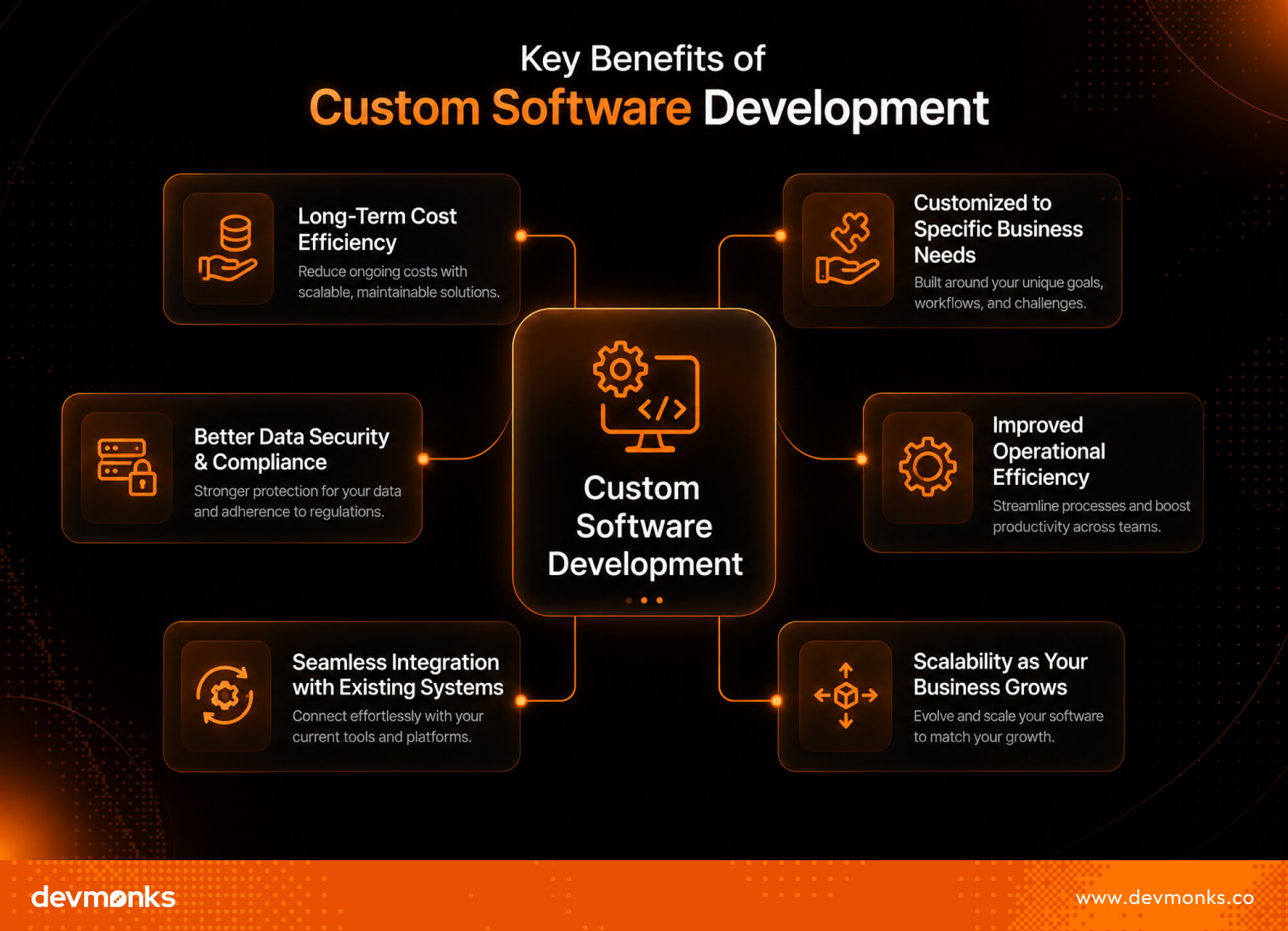
Custom software offers practical benefits that directly improve business performance and long-term growth. Each benefit given below addresses specific challenges that generic tools often fail to solve effectively.
Customized to Specific Business Needs
Custom solutions are designed around your unique requirements and operational workflows. These tailored applications ensure every feature supports actual tasks instead of unnecessary functions.
Businesses can eliminate inefficiencies caused by adapting processes to rigid, ready-made systems.
Improved Operational Efficiency
Custom software improves efficiency through workflow automation and smarter process design. Routine tasks like data entry, reporting, and approvals can be handled automatically.
This process optimization reduces errors and speeds up daily operations across departments.
Scalability as Your Business Grows
Custom systems are built with scalability in mind, which supports future expansion and evolving needs. Growth-ready systems can handle increased users, data, and features without major disruptions.
Businesses can continuously upgrade the software as strategies and market demands change.
Seamless Integration with Existing Systems
Custom software allows smooth integration with tools like CRM and ERP platforms. Through API integration, different systems can communicate and share data efficiently.
This integration improves coordination and eliminates data silos across the organization.
Better Data Security & Compliance
Custom solutions provide stronger control over cybersecurity measures and access levels. Businesses can design systems that meet specific data compliance requirements.
This ensures better data protection and reduces risks related to breaches or regulatory penalties.
Long-Term Cost Efficiency
Although initial development costs may be higher, long-term cost efficiency is significant. Businesses reduce dependency on recurring subscriptions and expensive third-party licenses over time.
Custom software becomes a long-term investment that delivers continuous value and operational savings.
When Custom Software Becomes Critical
Custom software is not always a choice. In many cases, it becomes a necessity. As business complexity increases, ready-made tools often fail to keep up with real demands.
Below are common situations where custom development becomes essential rather than optional:
Complex workflows
Businesses with multi-step processes, such as E-commerce businesses, manufacturing companies, and large organizations, often struggle with rigid, ready-made software systems.
These systems cannot fully support detailed workflows or unique approval structures.
Custom solutions are built to match exact processes, which removes system limitations and inefficiencies. This ensures smoother operations and better control over every stage of the workflow.
Industry-specific requirements
Certain industries require specialized features that generic tools simply do not provide. Sectors like healthcare, finance, or logistics often have strict operational and regulatory needs. Custom software helps meet these requirements with precision and flexibility.
It allows businesses to operate efficiently without compromising on compliance or performance.
Rapid scaling startups
Startups experiencing fast growth quickly outgrow basic tools and standard platforms. As user demand increases, system limitations begin to affect performance and scalability.
Custom software provides scalability and supports growth without constant system replacements. It allows startups to build growth-ready systems that evolve alongside their expansion.
Custom Software vs SaaS: Why Custom Wins in the Long Run
SaaS and custom software both solve business problems, but their long-term value differs greatly. SaaS tools, powered by cloud computing, offer quick setup and subscription-based access.
However, custom software focuses on ownership, flexibility, and long-term adaptability.
Here are the key differences between these two.
- Ownership vs subscription: SaaS works on recurring subscriptions, while custom software offers full ownership and control. This reduces long-term dependency on external providers.
- Flexibility: SaaS has fixed features, but custom software evolves with changing business needs. This makes it more adaptable for growing organizations.
- Cost over time: SaaS is cheaper initially, but long-term subscriptions increase total cost. Custom software is a long-term investment with better cost efficiency.
- Business alignment: SaaS fits general use cases, while custom solutions align directly with business workflows and goals.
In the long run, custom software provides greater flexibility, control, and value compared to SaaS solutions.
Impact of Custom Software on Business Growth
Custom software has a direct impact on business growth by improving efficiency, intelligence, and customer satisfaction. It transforms how companies use data, serve customers, and compete in the market.
Faster Decision-Making with Centralized Data
Custom systems integrate information into a single platform supported by data analytics. This enables better business intelligence and faster, more accurate decision-making across teams.
Enhanced Customer Experience
Custom software improves user experience by offering faster services, personalized interactions, and smoother digital journeys. This leads to higher customer satisfaction and stronger long-term relationships.
Competitive Differentiation
Businesses gain a strong advantage by building unique features that competitors cannot easily replicate. This differentiation improves brand value and helps companies stand out in competitive markets.
Overall, custom software drives measurable growth through better decisions, improved customer experience, and stronger market positioning.
Common Misconceptions About Custom Software
Many businesses avoid custom software due to common myths and misconceptions. These misunderstandings often prevent them from achieving better efficiency and growth. Here are the common myths.
- “It’s too expensive”: While initial development costs are higher, it delivers long-term cost efficiency and reduces subscription expenses.
- “It takes too long”: Modern development methods and agile processes have significantly reduced software development time.
- “SaaS is always enough”: SaaS works for general needs, but fails in complex or unique workflows.
- “Only big enterprises need it”: Startups and mid-sized businesses also benefit from customized systems that support growth and scalability.
- “Maintenance is a nightmare”: With proper design, maintenance becomes structured, predictable, and easier to manage over time.
- “It’s less secure”: Custom systems can be built with stronger security controls and better data protection than standard tools.
In reality, most of these concerns are myths that overlook the long-term value of custom development.

Is Custom Software Worth It for Your Business?
Custom software is worth the investment when your business needs better control, flexibility, and long-term value. It supports decision-making by aligning technology with real operational requirements instead of limiting them.
- Choose custom software if you have complex workflows or unique processes.
- Choose it if scalability and future growth are important goals.
- Choose it if you want long-term cost efficiency over subscriptions.
- Choose it if integration and automation are key to your operations.
If your needs are simple and standard, SaaS may be enough for now. But for long-term business value, custom software delivers stronger performance and strategic advantage.
End Note
Custom software changes how you experience your business every day, which makes everything feel more connected and controlled. You see fewer system gaps and more clarity in how work actually flows across teams.
Over time, you notice decisions becoming easier because your tools finally match your reality. That alignment quietly supports your growth and keeps your operations moving in the right direction.


Frequently Asked Questions
How can I discuss an AI MVP with Dev Monks?

Book a strategy call with your use case, existing systems, and project priorities. The team can help define an initial scope and the dependencies that need to be addressed.
Does using AI replace engineering review?
Dev Monks uses AI-assisted workflows with human-guided decisions. Product requirements, engineering choices, and testing remain part of the development process.
What AI development services does Dev Monks offer?
Dev Monks offers agentic AI solutions, custom language-model solutions, workflow automation, and RAG development. Its broader services include SaaS engineering, MVP development, backend integrations, and web and mobile applications.
Is Dev Monks an official OpenAI Select Partner?
Yes. Dev Monks is now an official OpenAI Select Partner within the OpenAI Partner Network.
How long does it usually take to complete a project?
We combine AI-driven workflows with product-first engineering to provide MVP development services for startups and enterprises. Our approach balances speed, reliability, and usability while keeping teams involved. We deliver production-ready, scalable solutions, not just prototypes or demos.
What makes Dev Monks different from other development companies?
We combine AI-driven workflows with product-first engineering to provide MVP development services for startups and enterprises. Our approach balances speed, reliability, and usability while keeping teams involved. We deliver production-ready, scalable solutions, not just prototypes or demos.
How Involved Will My Team be During Development?
We combine AI-driven workflows with product-first engineering to provide MVP development services for startups and enterprises. Our approach balances speed, reliability, and usability while keeping teams involved. We deliver production-ready, scalable solutions, not just prototypes or demos.
How involved will my team be during development?
We combine AI-driven workflows with product-first engineering to provide MVP development services for startups and enterprises. Our approach balances speed, reliability, and usability while keeping teams involved. We deliver production-ready, scalable solutions, not just prototypes or demos.
Do you develop both web and mobile applications?
We combine AI-driven workflows with product-first engineering to provide MVP development services for startups and enterprises. Our approach balances speed, reliability, and usability while keeping teams involved. We deliver production-ready, scalable solutions, not just prototypes or demos.
How can Dev Monks help my startup launch faster
We combine AI-driven workflows with product-first engineering to provide MVP development services for startups and enterprises. Our approach balances speed, reliability, and usability while keeping teams involved. We deliver production-ready, scalable solutions, not just prototypes or demos.