Guide to Choose a DevOps Consultant for Custom Software Development
.png)

.svg)
[ key takeways ]
- DevOps consultants improve CI/CD, speeding up and automating software delivery processes.
- Cloud infrastructure expertise ensures scalable, secure, and reliable custom software development systems.
- Strong DevOps strategy enhances collaboration, deployment efficiency, and long-term system performance.
- Experienced consultants reduce risks by implementing automation, security, and monitoring practices.
- Choosing the right DevOps consultant boosts scalability, reliability, and business software success.
.svg)
Choosing a DevOps consultant for custom software development requires evaluating technical expertise, industry experience, and the ability to align DevOps practices with your business goals and software requirements.
The right consultant should have proven experience with cloud platforms, CI/CD pipelines, infrastructure automation, monitoring tools, and scalable deployment strategies relevant to your project.
You should also review past projects, certifications, communication skills, and their approach to collaboration with development, operations, and security teams throughout the software lifecycle.
This guide covers the essential criteria, evaluation steps, and questions to help you confidently select a DevOps consultant.
What Does a DevOps Consultant Do in Custom Software Development?
A DevOps consultant helps businesses improve how software is built, tested, deployed, and managed. They create smooth workflows that connect development and operations teams, making projects faster and more reliable.
They work on CI/CD pipelines, infrastructure automation, and deployment strategy to reduce manual work and improve software quality. Through DevOps engineering, they help teams release updates quickly with fewer errors.
DevOps also supports Agile development by improving collaboration and speeding up the software lifecycle. In cloud-native development, it helps applications become more scalable, secure, and stable.
Unlike traditional IT consultants who mainly manage IT operations, DevOps consultants focus on software automation and continuous improvement.
They guide businesses through DevOps transformation to create faster and more efficient development processes.
Why Choosing the Right DevOps Consultant Matters?
The right DevOps consultant can improve software performance, security, and long-term business growth.
Impact on Software Scalability and Performance
For growing products and scaleups, this becomes even more critical in custom software development, where system growth and stability must be balanced.
A skilled consultant helps businesses build systems that can grow without slowing down. They use tools like Kubernetes, load balancing, and cloud scalability to manage high traffic and improve application performance.
This keeps software stable as user demand increases.
Influence on Deployment Speed and Reliability
DevOps consultants improve release speed through CI/CD and deployment automation. These processes reduce manual work and help teams launch updates faster with fewer errors.
They also use uptime monitoring tools to quickly detect and solve system issues.
Security and Compliance Considerations
Security is a major part of modern DevOps practices. Through DevSecOps, security checks become part of the development process from the beginning.
Consultants also use compliance automation and cybersecurity strategies to reduce risks, protect sensitive data, and improve overall system safety.
How to Choose the Right Skills in a DevOps Consultant?
Choosing a DevOps consultant becomes easier when you know which technical skills truly matter.
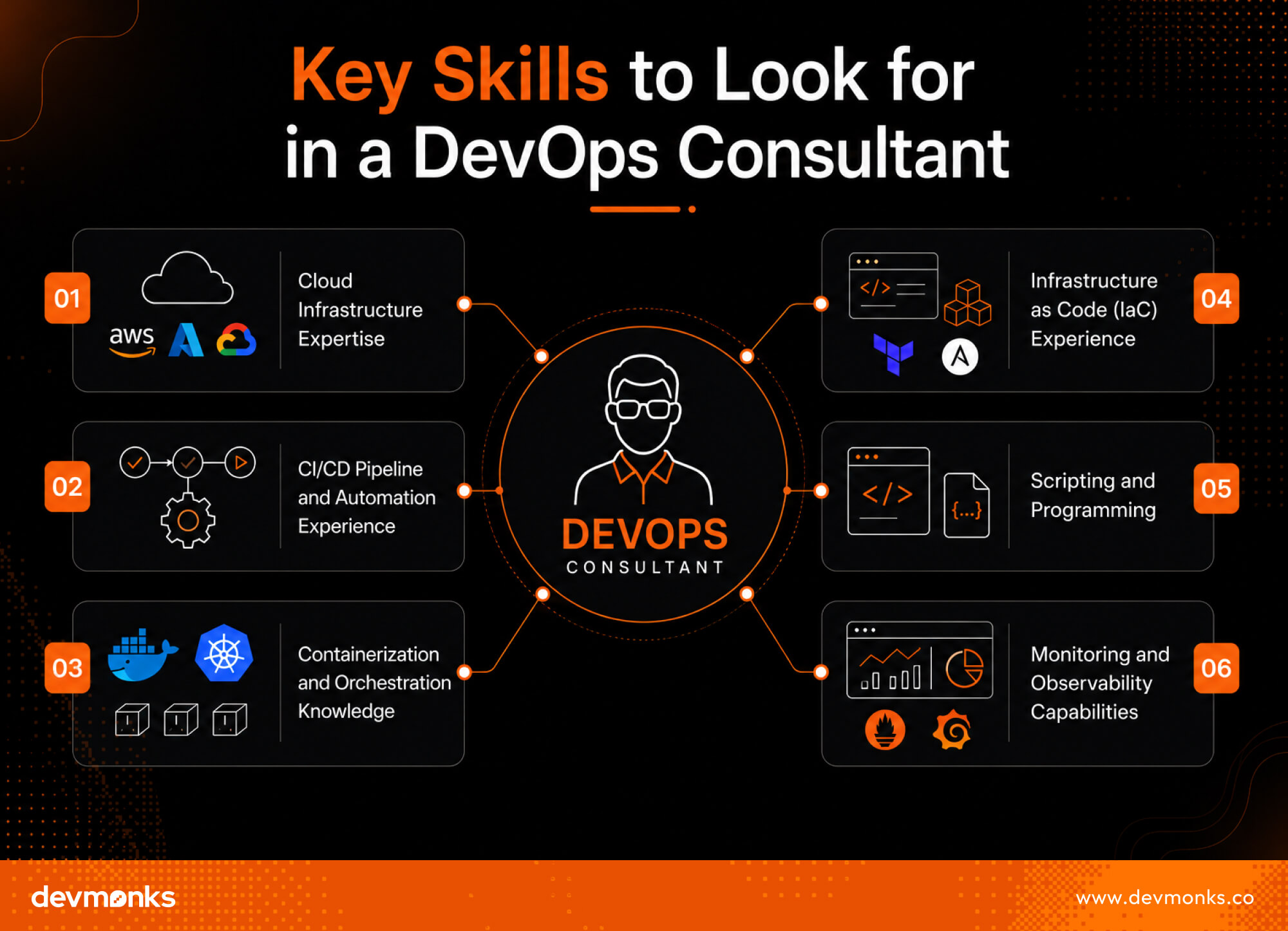
Cloud Infrastructure Expertise
A strong consultant should understand cloud architecture and major cloud platforms like AWS, Microsoft Azure, and Google Cloud Platform. Cloud experience helps businesses build scalable, secure, and flexible software systems.
CI/CD Pipeline and Automation Experience
Automation is a core part of DevOps. A good consultant should know tools like Jenkins, GitHub Actions, GitLab CI/CD, and CircleCI to automate testing, deployment, and software delivery workflows.
Containerization and Orchestration Knowledge
Modern software development depends heavily on Docker and Kubernetes. These tools support container orchestration, which makes applications easier to deploy, scale, and manage across different environments.
Infrastructure as Code (IaC) Experience
DevOps consultants should have experience with Infrastructure as Code tools like Terraform and Ansible. IaC helps automate infrastructure setup, reduce manual errors, and improve system consistency.
Scripting and Programming
Basic scripting and programming knowledge is important for automating tasks, fixing deployment issues, and improving workflows.
Monitoring and Observability Capabilities
Strong monitoring skills help maintain system performance and stability. Tools like Prometheus and Grafana support observability, logging, and fast incident detection before problems affect users.
Dev Monks: Your Ideal DevOps Consultant for Custom Software Development
Dev Monks understands that successful software development needs more than just coding. Our team combines strong technical knowledge with a practical and business-focused approach to DevOps consulting.
The company has experience working with modern cloud platforms, automation tools, and scalable infrastructure solutions.
From CI/CD pipeline setup to cloud management and deployment automation, Dev Monks helps businesses create faster and more reliable software delivery processes.
Our team also has strong expertise in Docker, Kubernetes, Infrastructure as Code, and monitoring tools that improve system performance and stability. This allows businesses to build secure and scalable applications without unnecessary complexity.
What makes Dev Monks stand out is their friendly and responsible approach. They work closely with clients, understand project goals, and provide clear communication throughout the development process.
Instead of offering one-size-fits-all solutions, we focus on building DevOps strategies that match each business’s unique needs and long-term growth plans.
Technical Questions to Ask Before Hiring a DevOps Consultant
Asking the right technical questions can help you understand whether a DevOps consultant has real experience and practical problem-solving skills.
What CI/CD Strategies Have They Implemented?
Ask about their experience with deployment pipelines, continuous integration, and release automation. A skilled consultant should explain how they improved deployment speed, reduced errors, and automated software delivery in past projects.
What Cloud Environments Have They Managed?
Cloud expertise is very important in modern development. Ask whether they have worked with AWS architecture, hybrid cloud systems, or large-scale cloud migration projects. This helps measure their ability to manage complex infrastructure.
How Do They Handle Security in DevOps Workflows?
Security should be part of the development process from the beginning. Ask about their DevSecOps practices, security scanning methods, and access management strategies to understand how they protect applications and data.
Can They Share DevOps Case Studies or Performance Improvements?
Real examples help verify their expertise. Ask about deployment frequency, downtime reduction, and improvements in software reliability achieved through their DevOps solutions.
Evaluating Industry Experience and Project Fit
Choosing a DevOps consultant with relevant industry experience can make software development much smoother and more effective.
Experience With Similar Software Development Projects
A consultant who has worked on similar projects already understands common challenges and requirements.
Experience in SaaS development, enterprise software, fintech software, or healthcare applications helps them create better solutions faster and avoid costly mistakes.
Understanding of Business Goals and Product Requirements
Technical skills alone are not enough. A good consultant should understand your business goals, product roadmap, and long-term vision.
Strong stakeholder collaboration helps ensure that technical decisions support both user needs and business growth.
Ability to Scale Development Teams and Infrastructure
As businesses grow, software systems and engineering teams also become larger and more complex.
A skilled consultant supports DevOps scaling by improving engineering workflow, automating processes, and building infrastructure that can handle future growth without performance issues.
Assessing Communication and Collaboration Skills
Strong communication is just as important as technical skills when choosing a DevOps consultant.
Collaboration With Developers and Product Teams
A good consultant should work smoothly with developers and product teams. They must fit into an Agile workflow and support Scrum teams by improving coordination and reducing delays.
Strong software collaboration ensures everyone stays aligned during development and deployment.
Documentation and Knowledge Transfer Practices
Clear documentation is key to long-term success. DevOps consultants should create proper infrastructure documentation and operational playbooks so teams can easily manage systems even after the project ends.
This also helps new team members learn faster.
Problem-Solving and Incident Response Approach
A reliable consultant should handle issues quickly and calmly. Strong incident management skills help reduce downtime and system failures.
They should also perform root cause analysis to understand why problems happen and prevent them in the future, which ensures more stable and dependable software systems.
Red Flags to Avoid When Hiring a DevOps Consultant
Not every DevOps consultant is the right fit. Some warning signs can help you avoid poor hiring decisions.
Overemphasis on Tools Instead of Strategy
If a consultant talks only about tools but not about planning, that is a red flag. DevOps is not just about software tools. A strong DevOps strategy and proper infrastructure planning are more important for long-term success than any single tool.
Lack of Automation Experience
DevOps should reduce manual work, not increase it. If a consultant relies too much on manual processes, it can lead to slow and error-prone systems.
Strong experience in infrastructure automation and deployment automation is essential for efficiency and scalability.
Limited Security or Compliance Knowledge
Security cannot be ignored in modern systems. A consultant without DevSecOps experience may put your system at risk.
They should understand compliance requirements and cloud security practices to protect sensitive data and ensure safe operations.
No Proven Metrics or Case Studies
Always ask for results. If a consultant cannot show KPIs, deployment metrics, or improvements in system reliability, it is difficult to trust their expertise.
Measurable outcomes prove real experience and help you understand their true impact on past projects.
Freelance DevOps Consultant vs DevOps Consulting Agency
Choosing between a freelance consultant and a DevOps consulting agency depends on your project needs, budget, and long-term goals.
Benefits of Hiring a Freelance DevOps Consultant
A freelance DevOps consultant can be a great choice for smaller projects or tight budgets. A freelance DevOps engineer or contract DevOps specialist usually offers more cost flexibility and focused expertise.
They are often ideal when you need help with specific tasks like CI/CD setup or cloud configuration.
Advantages of Working With a DevOps Agency
A DevOps consulting company provides a larger team with diverse skills. With managed DevOps services, agencies can handle complex systems, offer faster support, and scale resources as needed.
This makes them suitable for bigger and long-term projects.
Which Option Is Better for Custom Software Development?
The choice depends on your project size. For startup software development, freelancers can be cost-effective and quick.
But for enterprise DevOps consulting, agencies are often better because they provide stronger scalability, broader expertise, and more reliable long-term support for complex systems.
Cost Considerations When Hiring a DevOps Consultant
Understanding DevOps consulting costs helps businesses make smarter hiring decisions without compromising long-term quality and performance.
Typical DevOps Consulting Pricing Models
DevOps consulting rates usually follow three models, hourly, project-based, and retainer pricing.
Hourly DevOps consulting rates can range widely depending on experience and region, often around $50–$175 per hour, while senior experts may charge up to $300+ for complex work.
Project pricing is used for fixed tasks like CI/CD setup or cloud migration, while retainers offer ongoing support, usually around $5,000–$30,000 per month, depending on infrastructure size.
Factors That Affect DevOps Consulting Costs
Costs depend heavily on cloud infrastructure costs, project complexity, and enterprise deployment scale.
Larger systems using multi-cloud setups, Kubernetes clusters, or strict compliance needs require more expertise and, therefore, higher pricing. More automation and security requirements also increase effort and cost.
Balancing Budget With Long-Term Value
Choosing the cheapest option can lead to poor software scalability and long-term issues. Low-cost consultants may reduce upfront spending but often lack strong operational efficiency practices, which leads to higher maintenance costs later.
Investing in experienced DevOps expertise ensures stable systems, fewer outages, and better long-term value.
Best Practices for Choosing the Right DevOps Consultant
Choosing the right DevOps consultant becomes easier when you follow a clear and practical approach.
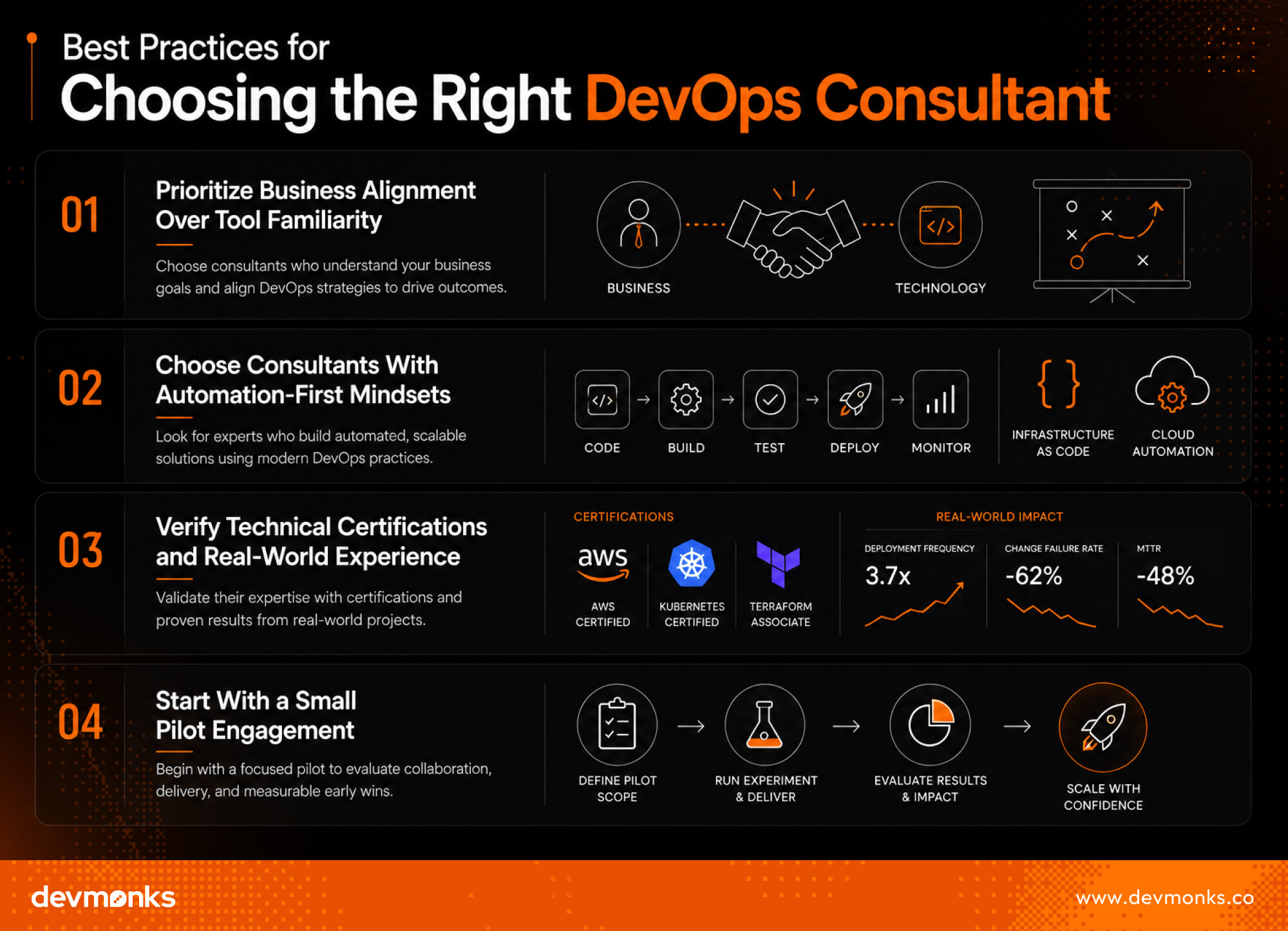
Prioritize Business Alignment Over Tool Familiarity
A good consultant should focus on your business needs, not just tools. True DevOps transformation happens when technical decisions support your overall software strategy and long-term goals.
Always check if they understand your product vision.
Choose Consultants With Automation-First Mindsets
Automation is the heart of DevOps. A strong consultant promotes Infrastructure as Code and CI/CD automation to reduce manual work, improve speed, and increase system reliability. This mindset leads to more efficient and scalable operations.
Verify Technical Certifications and Real-World Experience
Certifications like AWS Certified DevOps Engineer or Kubernetes certification show technical knowledge, but real-world experience matters more. Always look for proven project success, not just theoretical skills.
Start With a Small Pilot Engagement
Before committing long-term, start with a DevOps assessment or pilot project. This helps you evaluate communication, technical ability, and collaboration style.
A small test run reduces risk and ensures the consultant is the right fit for your team and project needs.
When choosing a DevOps consultant, focus on agencies that prioritize transparency, automation, scalability, and long-term business value over mere tool implementation.
Working with experienced teams like Dev Monks can help businesses streamline development workflows, improve deployment efficiency, and avoid costly operational challenges.
Conclusion
Choosing the right DevOps consultant is key to building strong and scalable software. Focus on technical expertise, clear communication, scalability planning, and strong security knowledge.
These factors ensure smooth development and reliable delivery. A good consultant not only solves today’s problems but also prepares your system for future growth.
DevOps is not just a process, rather, it is a long-term strategy for continuous software improvement and business success.
.png)
.svg)
Frequently Asked Questions
How can I discuss an AI MVP with Dev Monks?

Book a strategy call with your use case, existing systems, and project priorities. The team can help define an initial scope and the dependencies that need to be addressed.
Does using AI replace engineering review?
Dev Monks uses AI-assisted workflows with human-guided decisions. Product requirements, engineering choices, and testing remain part of the development process.
What AI development services does Dev Monks offer?
Dev Monks offers agentic AI solutions, custom language-model solutions, workflow automation, and RAG development. Its broader services include SaaS engineering, MVP development, backend integrations, and web and mobile applications.
Is Dev Monks an official OpenAI Select Partner?
Yes. Dev Monks is now an official OpenAI Select Partner within the OpenAI Partner Network.
How long does it usually take to complete a project?
We combine AI-driven workflows with product-first engineering to provide MVP development services for startups and enterprises. Our approach balances speed, reliability, and usability while keeping teams involved. We deliver production-ready, scalable solutions, not just prototypes or demos.
What makes Dev Monks different from other development companies?
We combine AI-driven workflows with product-first engineering to provide MVP development services for startups and enterprises. Our approach balances speed, reliability, and usability while keeping teams involved. We deliver production-ready, scalable solutions, not just prototypes or demos.
How Involved Will My Team be During Development?
We combine AI-driven workflows with product-first engineering to provide MVP development services for startups and enterprises. Our approach balances speed, reliability, and usability while keeping teams involved. We deliver production-ready, scalable solutions, not just prototypes or demos.
How involved will my team be during development?
We combine AI-driven workflows with product-first engineering to provide MVP development services for startups and enterprises. Our approach balances speed, reliability, and usability while keeping teams involved. We deliver production-ready, scalable solutions, not just prototypes or demos.
Do you develop both web and mobile applications?
We combine AI-driven workflows with product-first engineering to provide MVP development services for startups and enterprises. Our approach balances speed, reliability, and usability while keeping teams involved. We deliver production-ready, scalable solutions, not just prototypes or demos.
How can Dev Monks help my startup launch faster
We combine AI-driven workflows with product-first engineering to provide MVP development services for startups and enterprises. Our approach balances speed, reliability, and usability while keeping teams involved. We deliver production-ready, scalable solutions, not just prototypes or demos.
%20vs%20new%20Date().jpg)