Full Stack vs Front End: Skills, Salary & Jobs
.png)

.svg)
[ key takeways ]
- Front-end developers build interfaces, while full-stack developers handle entire applications end-to-end for users.
- Front-end development offers a faster learning path for aspiring developers entering the industry.
- Full-stack development requires broader skills but often provides higher salaries and career flexibility.
- Both careers remain in demand despite AI transforming software development across many industries.
- Choose front-end for design interests and full-stack for versatility in modern web development.
.svg)
Front-end developers focus on the user interface and experience, while full-stack developers work on both the front end and back end of applications. Neither is better, rather, the right choice depends on your interests and career goals.
Understanding the difference is important if you're planning a career in web development or deciding which skills to learn. Each path offers unique opportunities, salaries, and learning curves.
Whether you enjoy visual design or building complete applications, choosing the right direction can shape your future in tech. Read on to know the key differences and find the path that best fits you.
Full Stack vs Front End: What's the Difference?
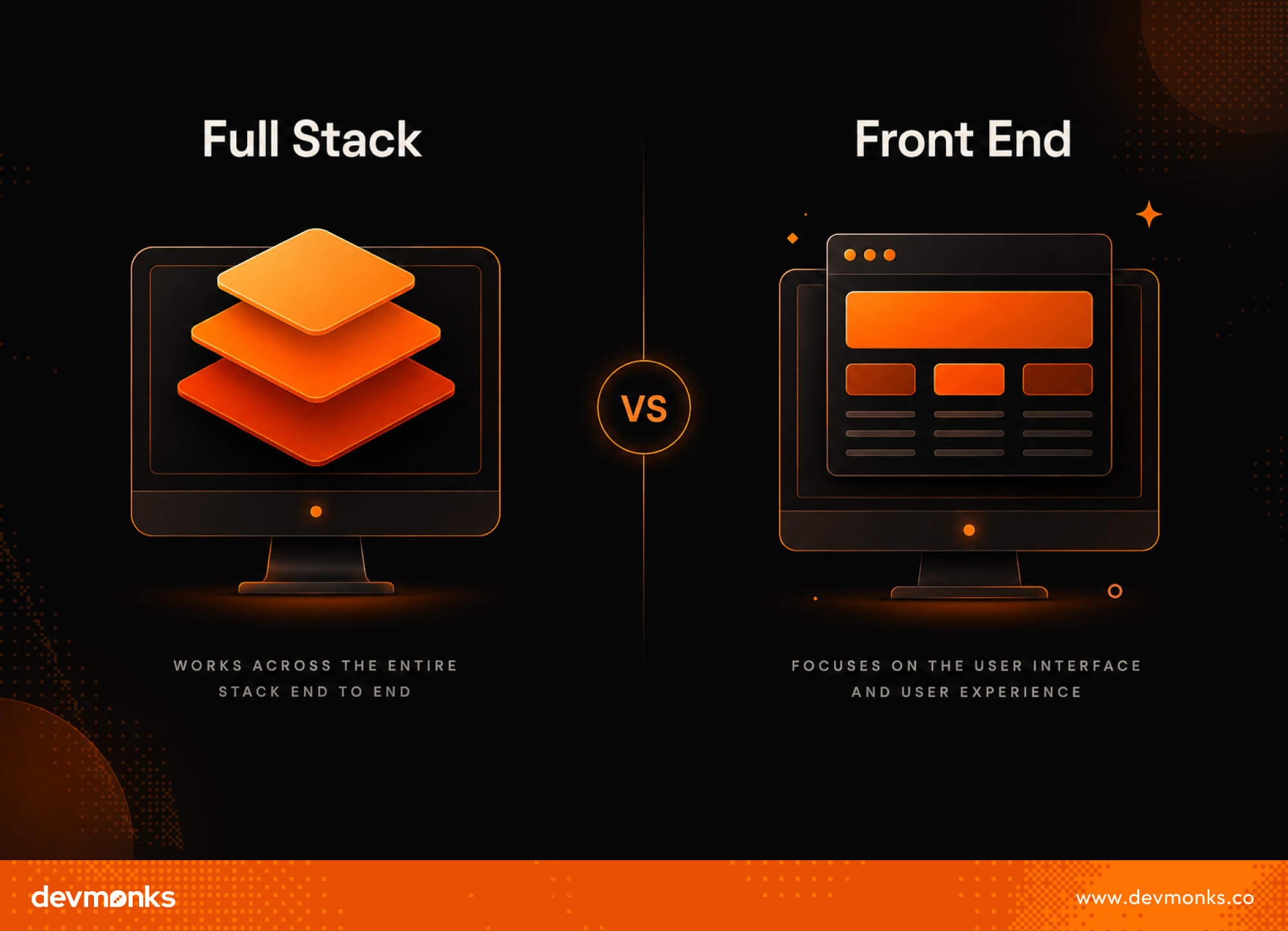
Front-end development focuses on the user interface users interact with, whereas Full-stack development covers both the front-end and the back-end systems behind an application.
In simple terms, front-end developers build what users see, while full-stack developers create and manage the entire application.
Both are important web developer roles in modern software development careers. Many professionals use JavaScript, but full-stack developers work with a broader technology stack.
Agencies like Dev Monks often work across both areas, which handles complete product development from UI to backend systems.
What Is Front-End Development?
Front-end development focuses on the browser experience and visual design of websites. It involves creating layouts, buttons, menus, and interactive features that users see and use every day.
Developers mainly use HTML to structure content, CSS to style pages, and JavaScript to add interactivity. They also ensure websites work smoothly across different devices and screen sizes.
What Is Full-Stack Development?
Full-stack development combines front-end and back-end development. Full-stack developers build user interfaces while also managing servers, application logic, and data.
They often use Node.js for server-side development, work with databases to store information, and connect services through APIs. Their broad skill set allows them to perform complete web application development from start to finish.
Full Stack Developer vs Front-End Developer Comparison Table
Both front-end and full-stack developers play vital roles in web development, but their skills, responsibilities, and career paths differ in several ways.
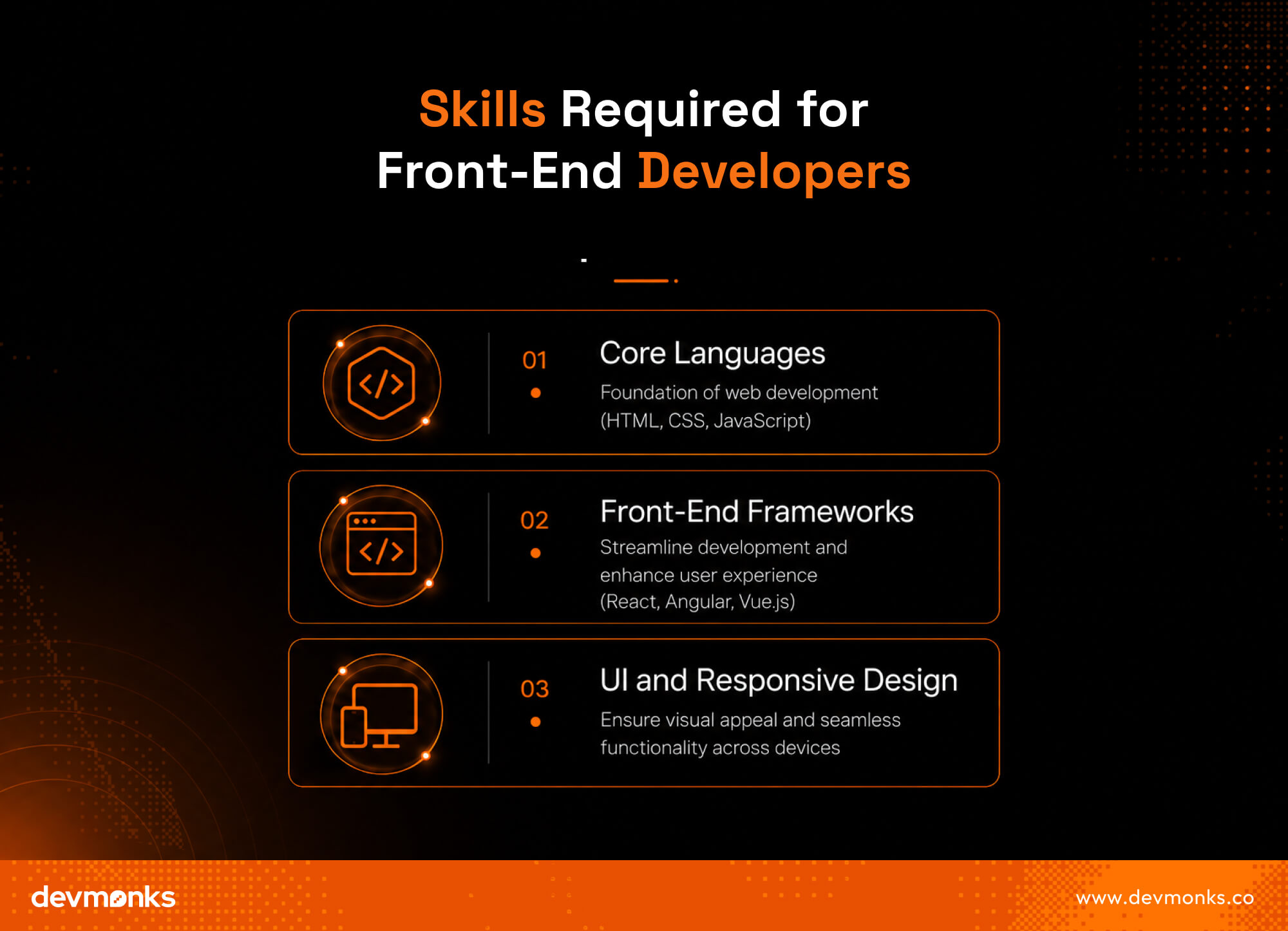
Skills Required for Front-End Developers
Front-end developers need a mix of technical and design skills to create engaging and user-friendly websites.
Core Languages
The foundation of front-end development lies in HTML, CSS, and JavaScript. HTML structures web content, CSS handles styling and layouts, and JavaScript adds interactivity to create dynamic user experiences.
Front-End Frameworks
Modern developers often use frameworks and libraries to build applications faster. React is one of the most popular choices, while Vue and Angular are also widely used for creating scalable and interactive interfaces.
UI and Responsive Design Skills
Front-end developers should understand user interface (UI) design principles and web accessibility to ensure websites are easy for everyone to use. They also need to create mobile-responsive designs that work smoothly across devices.
Knowledge of CSS frameworks like Bootstrap or Tailwind CSS can further speed up development and improve consistency.
Skills Required for Full-Stack Developers
Full-stack developers need a broad skill set because they work on both the front end and back end of applications.
Front-End Technologies
Full-stack developers should understand front-end technologies like HTML, CSS, and React. These tools help them create responsive and user-friendly interfaces.
Back-End Technologies
On the server side, developers often use technologies such as Node.js and Express to build application logic and manage requests. Other popular back-end languages include Python, Java, and PHP.
Databases and APIs
Managing data is a key part of full-stack development. Developers work with SQL databases like PostgreSQL and NoSQL databases like MongoDB to store and retrieve information.
They also use REST APIs to connect different applications and services.
Deployment and DevOps Basics
Full-stack developers should know version control tools like Git for collaboration and code management. Basic knowledge of Docker and cloud hosting platforms helps them deploy and maintain applications efficiently.

Front-End Developer vs Full-Stack Developer Salary
Salary is often a major factor when choosing between front-end and full-stack development careers. While pay varies by location and experience, full-stack developers generally earn more due to their broader skill set.
Average Front-End Developer Salary
According to salary data from Indeed, front-end developers in the United States earn an average salary of around $125,000 per year.
Glassdoor and LinkedIn also report similar ranges, though compensation varies by company and experience level.
Average Full-Stack Developer Salary
Full-stack developers in the U.S. earn an average of about $137,000 per year, according to Indeed. Data from Glassdoor places median compensation near $119,000–$120,000 annually.
Why Full-Stack Developers Often Earn More
Full-stack developers usually earn higher salaries because they handle both front-end and back-end tasks.
They work with user interfaces, servers, databases, and APIs, making them valuable across the entire development process.
Which Is Easier to Learn?
For those exploring coding for beginners, front-end development is generally easier to learn than full-stack development because it requires mastering fewer technologies.
Learning Curve of Front-End Development
Front-end development has a lower entry barrier. Beginners can start with HTML, CSS, and JavaScript and quickly build websites they can see and interact with.
This makes learning more engaging and helps developers progress faster along their developer roadmap.
Learning Curve of Full-Stack Development
Full-stack development has a steeper learning curve because it includes both front-end and back-end skills. In addition to user interfaces, learners must understand servers, databases, APIs, and deployment tools.
How Long Does It Take to Become Job-Ready?
The timeline depends on learning pace and practice. Many learners become job-ready in 3–6 months for entry-level front-end roles with consistent study.
Full-stack development usually takes 6–12 months or more because of its broader skill requirements and technologies.
Job Opportunities and Demand
Both front-end and full-stack developers are in high demand as businesses continue to invest in digital products and online services. The right choice depends on your interests and career goals.
Demand for Front-End Developers
Front-end developers remain highly sought after because every website and application needs an engaging user interface. Job platforms like LinkedIn regularly list thousands of front-end roles across industries.
Developers who showcase projects on GitHub and stay updated with modern frameworks often have better job prospects.
Demand for Full-Stack Developers
Full-stack developers are especially valuable because they can handle multiple parts of an application.
Many companies, especially startups and small teams, prefer hiring developers who can work across both front-end and back-end technologies. This versatility creates strong demand in the job market.
Which Role Is More Future-Proof?
Both roles have a promising future, even as AI tools become more advanced. AI can automate repetitive coding tasks, but businesses still need developers to solve problems, design systems, and improve user experiences.
Full-stack developers may have an advantage due to their broader skills, but front-end specialists with expertise in modern technologies will continue to be in demand.
Should You Learn Front End or Full Stack?
Choosing between front-end and full-stack development depends on your interests, career goals, and preferred way of working. Both paths offer strong job opportunities and rewarding careers.
Choose Front End If…
Front-end development may be the right choice if you enjoy creating user interfaces and visual experiences. It is ideal for those who like design, interactivity, and improving how users interact with websites.
It is also a great option if you want a faster entry into web development, as the learning curve is generally easier.
Choose Full Stack If…
Full-stack development is a better fit if you want to build complete applications from start to finish. It suits people who enjoy working on both the user-facing side and the server-side logic behind an application.
If solving a wide range of technical problems excites you, full-stack development can provide a more versatile career path.
Can a Front-End Developer Become a Full-Stack Developer?
Yes, many full-stack developers begin their careers in front-end development. Since they already understand user interfaces and browser technologies, transitioning to full-stack development becomes much easier.
Typical Learning Path
A common path is to start with front-end skills and gradually expand into other areas: Front-end → APIs → Backend → Databases → Deployment. This step-by-step approach helps developers build a strong foundation without feeling overwhelmed.
Technologies to Learn Next
After mastering HTML, CSS, and JavaScript, developers can learn Node.js and Express for server-side development. Understanding SQL helps with managing databases, while Docker simplifies application deployment.
By adding these skills over time, front-end developers can successfully transition into full-stack roles and work on complete web applications.
Front-End vs Full-Stack: Day-to-Day Responsibilities
Understanding the daily responsibilities of each role can help you decide which career path aligns with your interests and strengths.
A Day in the Life of a Front-End Developer
Front-end developers spend much of their day building user interfaces and improving website experiences. They create layouts, add interactive features, fix UI bugs, and ensure websites work across devices.
They also collaborate closely with designers to turn design concepts into functional web pages.
A Day in the Life of a Full-Stack Developer
Full-stack developers work across the entire application. Their tasks may include developing APIs, managing databases, handling deployment, and improving both front-end and back-end functionality.
Because of their broad responsibilities, they often collaborate with multiple teams throughout a project.
Full Stack vs Front End: Pros and Cons
Both front-end and full-stack development offer exciting career opportunities, but each path comes with its own advantages and challenges.
Front-End Developer Pros
- Easier to learn and start with
- Strong demand across industries
- Focus on creativity and user experience
- Faster path to entry-level jobs
Front-End Developer Cons
- Limited exposure to back-end systems
- May have lower earning potential than full-stack roles
- Requires keeping up with rapidly changing frameworks
Full-Stack Developer Pros
- Ability to build complete applications
- Higher salary potential in many cases
- Greater flexibility in job roles and projects
- Strong demand from startups and tech companies
Full-Stack Developer Cons
- Steeper learning curve
- Requires knowledge of many technologies
- Can be challenging to stay updated across the stack
- Managing both front-end and back-end tasks may increase the workload
Ultimately, the better choice depends on your interests. If you enjoy design and user experiences, front-end development may suit you.
If you prefer working across the entire application, full-stack development can offer broader opportunities.
FAQs
Can I become a full-stack developer without front-end knowledge?
Technically, yes, but it is not recommended. Full-stack development includes both front-end and back-end skills. Learning front-end technologies like HTML, CSS, and JavaScript first provides a strong foundation for building complete applications.
Will AI replace full-stack dev?
AI can automate repetitive coding tasks, but it cannot replace human creativity, problem-solving, and system design. Full-stack developers who learn AI tools and adapt to new technologies are likely to remain in demand.
Is front-end development still in demand?
Yes, front-end development remains highly sought after. Businesses need skilled developers to create fast, accessible, and engaging user experiences. As websites and apps continue to evolve, demand for front-end developers remains strong.
Final Verdict
In the debate of Full Stack vs Front End, there is no one-size-fits-all answer.
Front-end development is ideal for those who enjoy design and user experiences, while full-stack development suits those who want to build complete applications.
Choose the path that matches your interests, because the best career is one you enjoy learning and growing in.
.png)
.svg)
Frequently Asked Questions
How can I discuss an AI MVP with Dev Monks?

Book a strategy call with your use case, existing systems, and project priorities. The team can help define an initial scope and the dependencies that need to be addressed.
Does using AI replace engineering review?
Dev Monks uses AI-assisted workflows with human-guided decisions. Product requirements, engineering choices, and testing remain part of the development process.
What AI development services does Dev Monks offer?
Dev Monks offers agentic AI solutions, custom language-model solutions, workflow automation, and RAG development. Its broader services include SaaS engineering, MVP development, backend integrations, and web and mobile applications.
Is Dev Monks an official OpenAI Select Partner?
Yes. Dev Monks is now an official OpenAI Select Partner within the OpenAI Partner Network.
How long does it usually take to complete a project?
We combine AI-driven workflows with product-first engineering to provide MVP development services for startups and enterprises. Our approach balances speed, reliability, and usability while keeping teams involved. We deliver production-ready, scalable solutions, not just prototypes or demos.
What makes Dev Monks different from other development companies?
We combine AI-driven workflows with product-first engineering to provide MVP development services for startups and enterprises. Our approach balances speed, reliability, and usability while keeping teams involved. We deliver production-ready, scalable solutions, not just prototypes or demos.
How Involved Will My Team be During Development?
We combine AI-driven workflows with product-first engineering to provide MVP development services for startups and enterprises. Our approach balances speed, reliability, and usability while keeping teams involved. We deliver production-ready, scalable solutions, not just prototypes or demos.
How involved will my team be during development?
We combine AI-driven workflows with product-first engineering to provide MVP development services for startups and enterprises. Our approach balances speed, reliability, and usability while keeping teams involved. We deliver production-ready, scalable solutions, not just prototypes or demos.
Do you develop both web and mobile applications?
We combine AI-driven workflows with product-first engineering to provide MVP development services for startups and enterprises. Our approach balances speed, reliability, and usability while keeping teams involved. We deliver production-ready, scalable solutions, not just prototypes or demos.
How can Dev Monks help my startup launch faster
We combine AI-driven workflows with product-first engineering to provide MVP development services for startups and enterprises. Our approach balances speed, reliability, and usability while keeping teams involved. We deliver production-ready, scalable solutions, not just prototypes or demos.
%20vs%20new%20Date().jpg)