How to Hire a Reliable Custom Software Development Company?


[ key takeways ]
- Define clear requirements before hiring to avoid delays, confusion, and extra costs.
- Prioritize technical expertise and relevant industry experience when selecting a development partner.
- Strong communication and structured processes ensure smoother project execution and fewer misunderstandings.
- Always review portfolios, case studies, and client feedback before making final decisions.
- Focus on scalability and long-term support, not just initial development cost alone.

Hiring a reliable custom software development company requires evaluating its expertise, portfolio, communication, development process, and proven track record of delivering successful projects.
A strong team helps you build scalable, reliable, and user-friendly software, while the wrong choice can lead to delays, extra costs, and poor performance.
With the growing demand for custom solutions across SaaS, AI, fintech, healthcare, and enterprise industries, businesses need partners who truly understand both technology and business goals.
Before hiring, it’s important to evaluate key factors like expertise, process, communication, and long-term support. This article will guide you through everything you need to make the right decision confidently.
What Is a Custom Software Development Company?
A custom software development company builds software customized to a business’s specific needs instead of using ready-made solutions.
Unlike freelancers who usually work alone or in-house teams that require long-term hiring and management, these companies provide complete development support under one roof.
They usually offer web and mobile app development, SaaS products, enterprise software, UI/UX design, DevOps, and ongoing maintenance.
Startups, SaaS companies, enterprises, healthcare providers, fintech firms, and ecommerce brands often choose custom software development to create scalable and business-focused digital solutions.
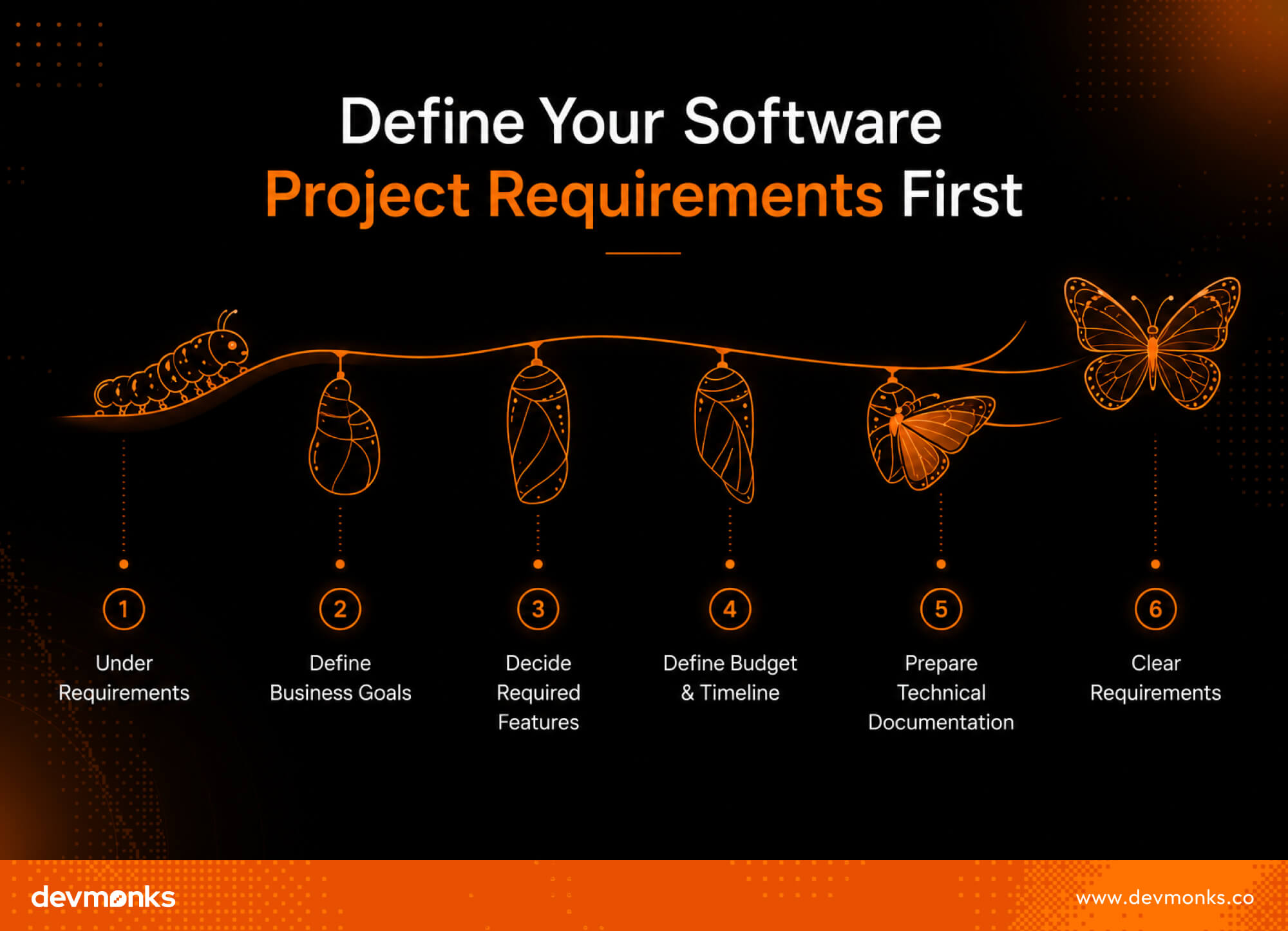
Clearly Define Your Software Project Requirements Before Hiring
Before contacting a software development company, take time to clearly define your project requirements. Many businesses rush into development without a clear plan and later face delays, extra costs, or features they do not actually need.
A well-defined project helps agencies understand your goals and provide accurate timelines, pricing, and solutions.
Identify Your Business Goals
The first thing you need to do is understand what you want the software to achieve. Your goal may be launching an MVP to test an idea, automating business processes, building a customer platform, or creating internal tools for your team.
Clear goals help developers focus on the right solution from the beginning.
Decide the Required Features
List the features your software must include. Think about core functionality, user roles and permissions, third-party integrations, APIs, payment systems, or admin dashboards.
Separating “must-have” features from “nice-to-have” ones helps control both budget and development time.
Define Budget and Timeline Expectations
Be realistic about your budget and launch timeline. An MVP usually costs less and takes less time than a full-scale product. Also consider agile development, future updates, and your long-term scaling roadmap.
Prepare Technical Documentation
Basic documentation makes communication easier. Prepare a product requirements document (PRD), user stories, wireframes, prototypes, or competitor references to help the development team understand your vision clearly.
If you’re looking for a reliable partner to turn these requirements into a real product, Dev Monks can help with end-to-end software development, from planning and design to scalable deployment.
Key Factors to Evaluate Before Hiring a Software Development Company
Choosing the right software development company requires more than comparing prices. You need a team that understands your business, communicates clearly, and can build software that grows with you.
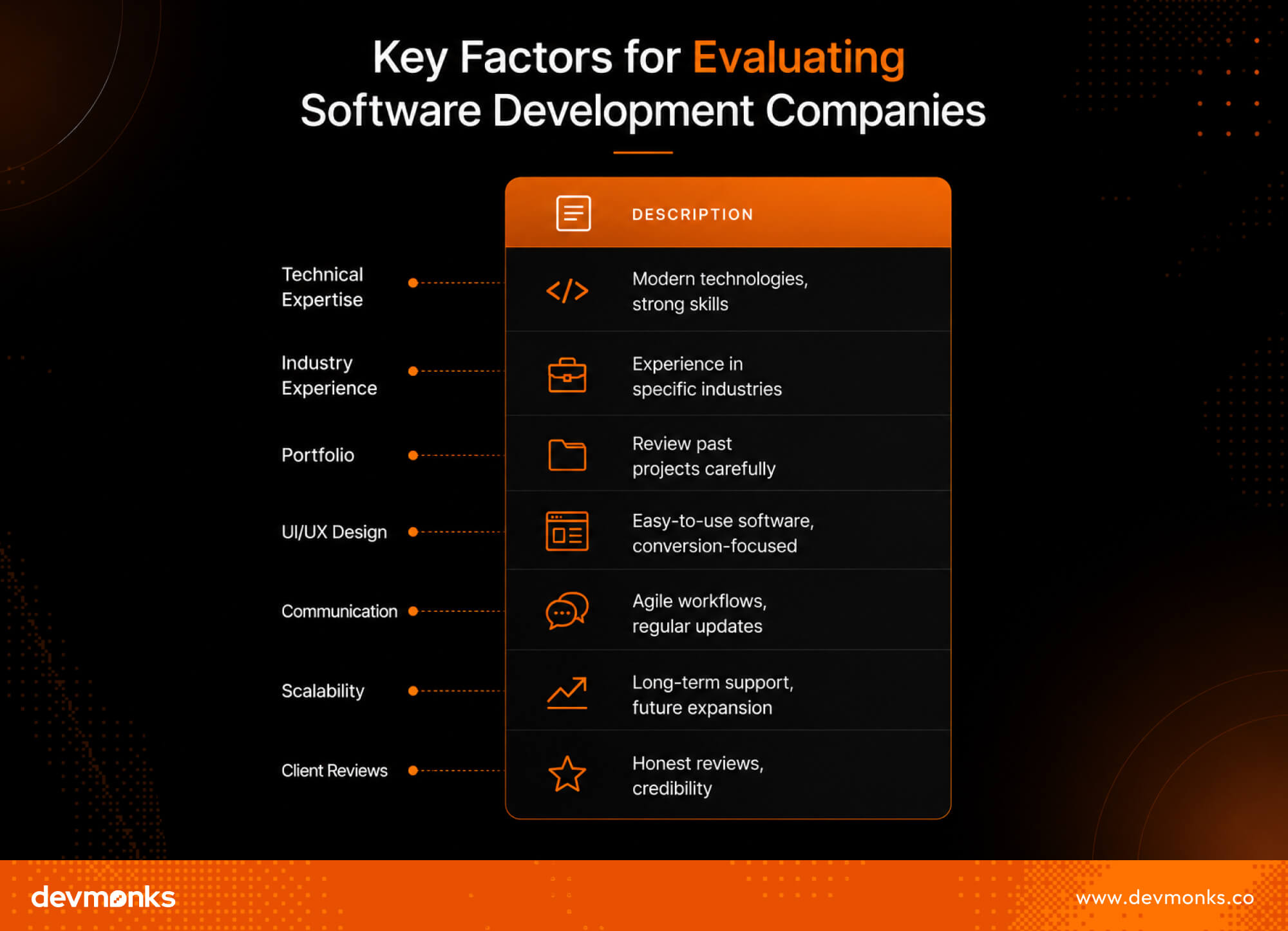
1. Technical Expertise and Technology Stack
Check whether the company works with modern technologies, such as:
- React, Angular, Vue
- Node.js, Python, .NET
- AWS, Google Cloud, Azure
- AI and automation tools
- iOS and Android development
Strong technical skills help ensure better performance, security, and scalability.
2. Industry Experience
A company with experience in SaaS, fintech, healthcare, ecommerce, or enterprise systems will better understand industry challenges, compliance needs, and customer expectations.
3. Portfolio and Case Studies
Review their past projects carefully. Look for similar products, complex solutions, measurable business results, and strong UX design. Real case studies show how they solve problems in real-world situations.
4. UI/UX Design Capability
Good software should feel easy to use. Evaluate their design process, prototyping methods, design systems, and ability to create conversion-focused user experiences.
5. Communication and Collaboration Process
Reliable companies follow agile workflows with regular sprint planning and updates. Tools like Slack, Jira, and Notion improve collaboration, especially for remote teams across different time zones.
6. Scalability and Long-Term Support
Software needs continuous maintenance, security updates, DevOps support, and future feature expansion. Make sure the company offers long-term technical support.
7. Client Reviews and Testimonials
Check platforms like Clutch, Google, and LinkedIn for honest reviews, credibility, and long-term client relationships.
Dev Monks follows a structured, transparent, and scalable approach with strong technical expertise, UI/UX focus, and reliable long-term support.
Questions to Ask Before Hiring a Custom Software Development Company
Asking the right questions helps you avoid miscommunication, delays, and poor-quality development later.
Questions About Technical Process
Ask “how they handle software architecture planning” and “what development methodology they follow, such as Agile or Scrum”.
You should also ask and understand how they maintain code quality through testing, code reviews, and documentation practices.
Questions About Project Management
Clear communication is essential for a successful project. Ask “how often progress updates are shared”, “who will manage communication”, and “what tools they use for collaboration”.
It is also important to know how they handle unexpected delays or scope changes.
Questions About Security and Scalability
Ask “how they protect user data, manage access control, and handle backups and monitoring”. You should also confirm “whether the software architecture can scale as your business grows”.
Questions About Post-Launch Support
Check “if they provide maintenance, SLA agreements, bug fixes, performance monitoring, and ongoing optimization support for future growth”.
Red Flags to Avoid When Hiring a Development Company

Not every software development company delivers the quality and reliability businesses expect. Watching for a few common red flags can help you avoid costly mistakes.
- Unrealistically low pricing that hides poor quality and future technical debt.
- No clear development process or structured project roadmap.
- Weak communication with slow or inconsistent updates.
- No dedicated project manager for coordination and accountability.
- Lack of a proven portfolio with real case studies.
- Missing client testimonials or verifiable reviews.
- Overpromising timelines that are not realistic for the scope.
- No transparency in cost estimation or project breakdown.
- Limited or unclear technical expertise in required technologies.
- No mention of testing or quality assurance practices.
- Absence of post-launch support or maintenance planning.
- Poor understanding of business goals beyond just coding tasks.
In-House Team vs Freelancers vs Development Agency
Businesses usually choose between an in-house team, freelancers, or a custom software development agency based on budget, project size, and long-term goals.
In-House Development Team
An in-house team gives you full control over development and daily operations. However, hiring developers, designers, and project managers can be expensive and time-consuming.
Freelancers
Freelancers are often more budget-friendly for small projects or short-term tasks. But managing multiple freelancers can become difficult as the project grows, especially when scalability and long-term support are needed.
Custom Software Development Agency
A custom software development agency provides a complete team with developers, designers, QA engineers, and project managers under one roof.
This allows faster execution, smoother collaboration, and access to cross-functional expertise. Agencies also help businesses with long-term strategy, scaling, maintenance, and ongoing technical support.
How Reliable Software Companies Handle the Development Process
Reliable software companies follow a structured process to keep projects organized, transparent, and efficient from start to finish.
Discovery and Product Strategy
The process usually begins with requirement analysis, market research, and user journey planning.
This stage helps the development team understand business goals, target users, and the overall product vision before development starts.
UI/UX Design Phase
Next comes the design phase, where teams create wireframes, mockups, and interactive prototypes. This helps businesses visualize the product early and make improvements before coding begins.
Agile Development and Sprint Cycles
Most modern companies use agile development with sprint-based workflows. Features are built and released in smaller iterations, allowing continuous QA testing, faster feedback, and regular improvements throughout the project.
Launch and Post-Launch Support
After development, the company handles deployment, system monitoring, bug fixes, and ongoing optimization to ensure the software performs smoothly after launch.
Best Countries for Outsourcing Custom Software Development
Many businesses outsource software development to regions like Eastern Europe, South Asia, and Latin America because of their strong tech talent and competitive pricing. Each region offers different advantages in cost, availability, and time-zone flexibility.
While location can affect pricing and communication hours, the most important factors are reliability, technical expertise, process maturity, and clear communication.
A well-structured and experienced development company will usually deliver better results than one chosen based on location alone.
Cost of Hiring a Custom Software Development Company
The cost of software development depends on features, complexity, team size, and timelines. More integrations and an advanced tech stack increase the overall budget.
MVP vs Enterprise Software Pricing
Startup MVPs are usually more affordable, often ranging from $10K to $ 50 K, depending on scope. Enterprise software costs significantly more due to scalability, security, and integrations.
Fixed Price vs Dedicated Team Model
Fixed price works best for small, clear projects. Dedicated teams are better for long-term development, offering flexibility but variable monthly costs.
How to Choose the Best Development Partner for Your Business
Choosing the right development partner becomes easier when you follow a clear, step-by-step approach instead of rushing into a decision.
Step 1: Create a Shortlist of Companies
Firstly, you should start with shortlisting a few companies based on their portfolios, client reviews, and technical expertise. Compare their past work to see if they have experience in similar projects or industries.
Step 2: Start With a Discovery Call
A discovery call helps you understand how they communicate and think. Pay attention to how clearly they explain solutions and whether they understand your business goals, not just technical requirements.
Step 3: Test With a Small Project or MVP
Before committing long-term, start with a small project or MVP. This helps you evaluate their quality, delivery speed, and reliability while reducing overall risk.
Why Hiring the Right Development Company Matters?
Choosing the right development company directly impacts your product’s success.
Business Risks of Choosing the Wrong Team
- Budget overruns due to poor planning
- Delayed product launches
- Poor code quality that is hard to maintain
- Security vulnerabilities in the system
- Communication failures that create confusion
Benefits of Working With a Reliable Development Partner
- Faster product delivery
- Better scalability for future growth
- Strong and clean technical architecture
- Long-term maintenance and support
- Strategic guidance to improve product direction
FAQs
What should I look for in a development partner?
Look for a development partner with strong technical expertise, relevant industry experience, clear communication, and a structured development process. They should have a proven portfolio, focus on scalability, follow agile practices, and offer reliable long-term support and transparent collaboration throughout the project.
How do I know if a software company is reliable?
A reliable software company has a proven portfolio, positive client reviews, and clear communication. They follow a structured development process, provide realistic timelines, show technical expertise, and offer long-term support. Transparency, consistency, and accountability in delivery are strong reliability indicators.
How long does custom software development take?
Custom software development usually takes 2-6 months for an MVP and 6-12+ months for full-scale products. The timeline depends on feature complexity, team size, integrations, and design requirements. Agile development may deliver usable versions in shorter iterative cycles during the process.
Conclusion
Hiring the right software development company requires a clear framework, which involves defining requirements, evaluating technical expertise, checking communication, and assessing scalability.
Focus on long-term partnership value rather than low pricing. The best approach is to start with a discovery phase or an MVP engagement to validate fit and reduce risk early.

Frequently Asked Questions
How can I discuss an AI MVP with Dev Monks?

Book a strategy call with your use case, existing systems, and project priorities. The team can help define an initial scope and the dependencies that need to be addressed.
Does using AI replace engineering review?
Dev Monks uses AI-assisted workflows with human-guided decisions. Product requirements, engineering choices, and testing remain part of the development process.
What AI development services does Dev Monks offer?
Dev Monks offers agentic AI solutions, custom language-model solutions, workflow automation, and RAG development. Its broader services include SaaS engineering, MVP development, backend integrations, and web and mobile applications.
Is Dev Monks an official OpenAI Select Partner?
Yes. Dev Monks is now an official OpenAI Select Partner within the OpenAI Partner Network.
How long does it usually take to complete a project?
We combine AI-driven workflows with product-first engineering to provide MVP development services for startups and enterprises. Our approach balances speed, reliability, and usability while keeping teams involved. We deliver production-ready, scalable solutions, not just prototypes or demos.
What makes Dev Monks different from other development companies?
We combine AI-driven workflows with product-first engineering to provide MVP development services for startups and enterprises. Our approach balances speed, reliability, and usability while keeping teams involved. We deliver production-ready, scalable solutions, not just prototypes or demos.
How Involved Will My Team be During Development?
We combine AI-driven workflows with product-first engineering to provide MVP development services for startups and enterprises. Our approach balances speed, reliability, and usability while keeping teams involved. We deliver production-ready, scalable solutions, not just prototypes or demos.
How involved will my team be during development?
We combine AI-driven workflows with product-first engineering to provide MVP development services for startups and enterprises. Our approach balances speed, reliability, and usability while keeping teams involved. We deliver production-ready, scalable solutions, not just prototypes or demos.
Do you develop both web and mobile applications?
We combine AI-driven workflows with product-first engineering to provide MVP development services for startups and enterprises. Our approach balances speed, reliability, and usability while keeping teams involved. We deliver production-ready, scalable solutions, not just prototypes or demos.
How can Dev Monks help my startup launch faster
We combine AI-driven workflows with product-first engineering to provide MVP development services for startups and enterprises. Our approach balances speed, reliability, and usability while keeping teams involved. We deliver production-ready, scalable solutions, not just prototypes or demos.