How Long Does It Take to Learn Web Development?
.png)

.svg)
[ key takeways ]
- Learning web development basics takes 1-3 months with consistent daily practice.
- Frontend development usually requires 3-6 months to build responsive, interactive websites.
- Backend development typically takes 6-12 months, which includes APIs, databases, and deployment skills.
- Full-stack development may take 3-12 months or up to 2 years for beginners.
- Project-based learning and structured roadmaps significantly speed up skill development progress.
.svg)
Web development can take anywhere from a few months to a couple of years, depending on your goals.
A beginner can learn HTML, CSS, and JavaScript basics in a short time, while intermediate learners take longer to build real projects, and job-ready developers need more time for frontend development, backend development, and full-stack development skills.
The timeline is not fixed because it depends on your consistency, learning style, and the path you choose. That’s why having a clear roadmap is very important if you want to learn in the shortest time without confusion.
In this article, you will find a simple guide that breaks everything down step by step. Keep reading to understand how to plan your journey and learn web development in the easiest way possible.
How Long Does It Take to Learn Web Development?
The time to learn web development depends on your goal and how much you practice. For most beginners, it can take anywhere from a few months to a year to become confident.
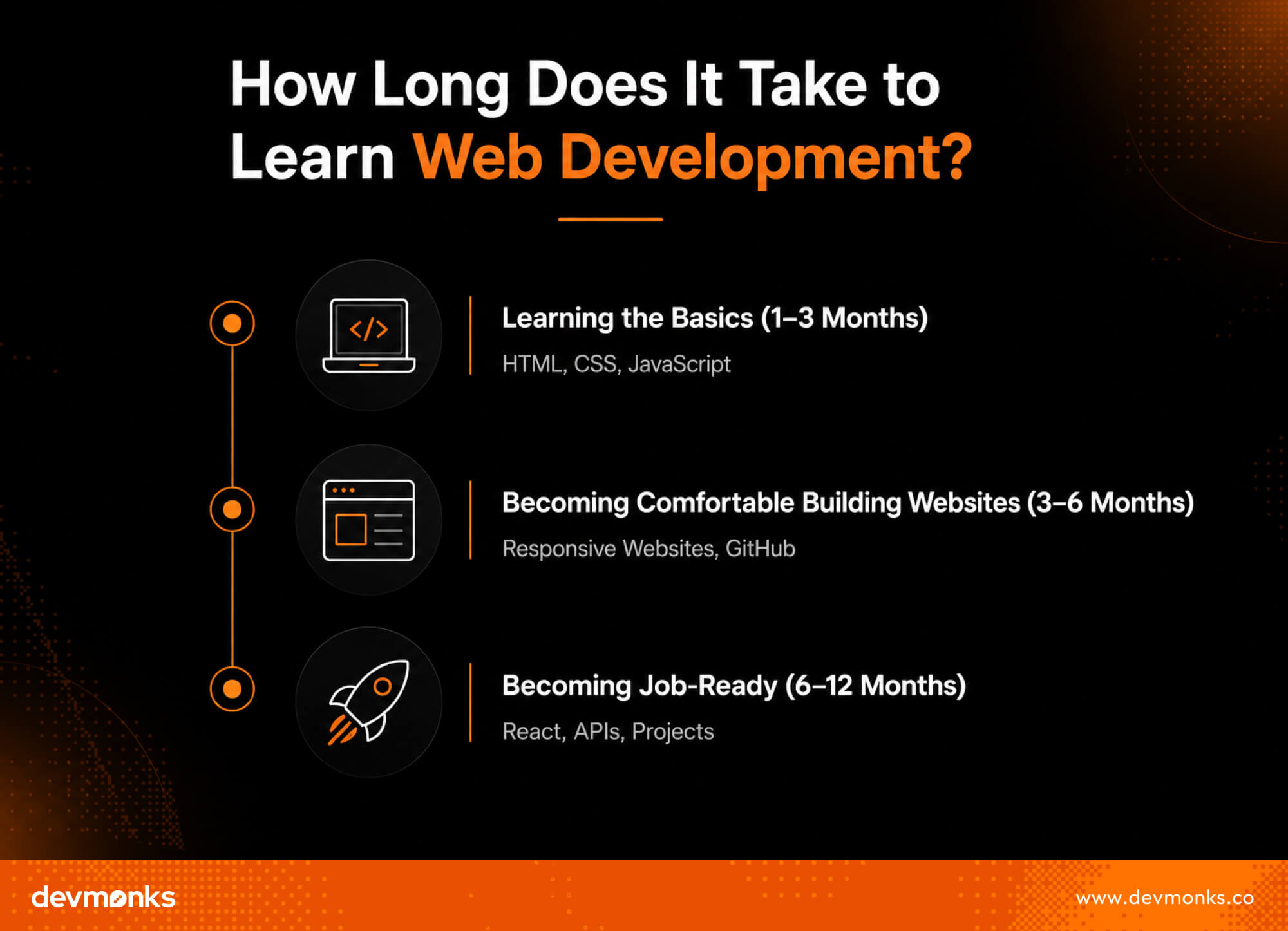
Learning the Basics
In the beginning, you focus on HTML, CSS, and JavaScript. It will take you 1-3 months, as these are the core web development basics.
You learn how websites are built, styled, and made interactive. With regular coding practice, you start following a simple beginner coding roadmap and build small practice projects.
Becoming Comfortable Building Websites
Next, you start building real responsive websites that work on mobile and desktop. In 3 to 6 months, you will learn GitHub to save your code and create simple portfolio projects.
This stage helps you follow a clear frontend roadmap and grow your practical web development skills.
Becoming Job-Ready
Now you move to tools like React, Node.js, and APIs. You build larger portfolio projects, learn debugging, and prepare for interviews. This is where you become a junior developer and start becoming an employable web developer with real-world skills.
This stage usually takes around 6 to 12 months, and it can take even longer if you prefer to learn at a slower, more comfortable pace.
Learning web development takes time, patience, and consistent effort, so dedication is key. If you only need a website and not the learning journey, it’s better to consult a skilled agency like Dev Monks.
In this case, experts can build it for you while you focus on ideas, strategy, and business growth.
What Affects How Fast You Learn Web Development?
Everyone learns web development at a different speed. Your timeline depends on a few important factors.
Your Daily Study Time
If you study just 1 hour a day, your progress will be slow but steady. If you study full-time, you can move much faster.
A strong learning schedule and daily coding consistency help you improve quickly and support learning coding faster through regular coding practice.
Previous Technical Experience
If you already have a background in computer science, IT, or basic programming, you will learn faster.
Even simple programming basics or design experience can give you a big coding background advantage. It helps you understand web development skills more easily.
Learning Method You Choose
Your path also matters. A coding bootcamp gives fast, structured learning. Platforms like freeCodeCamp or Udemy allow flexible online learning.
Many people also become self-taught web developers through practice and projects. Each method affects how quickly you progress.
How Long Does It Take to Learn Frontend Development?
Frontend development focuses on what users see and interact with on a website. It includes HTML, CSS, JavaScript, and React. The time to learn it depends on how consistently you practice.
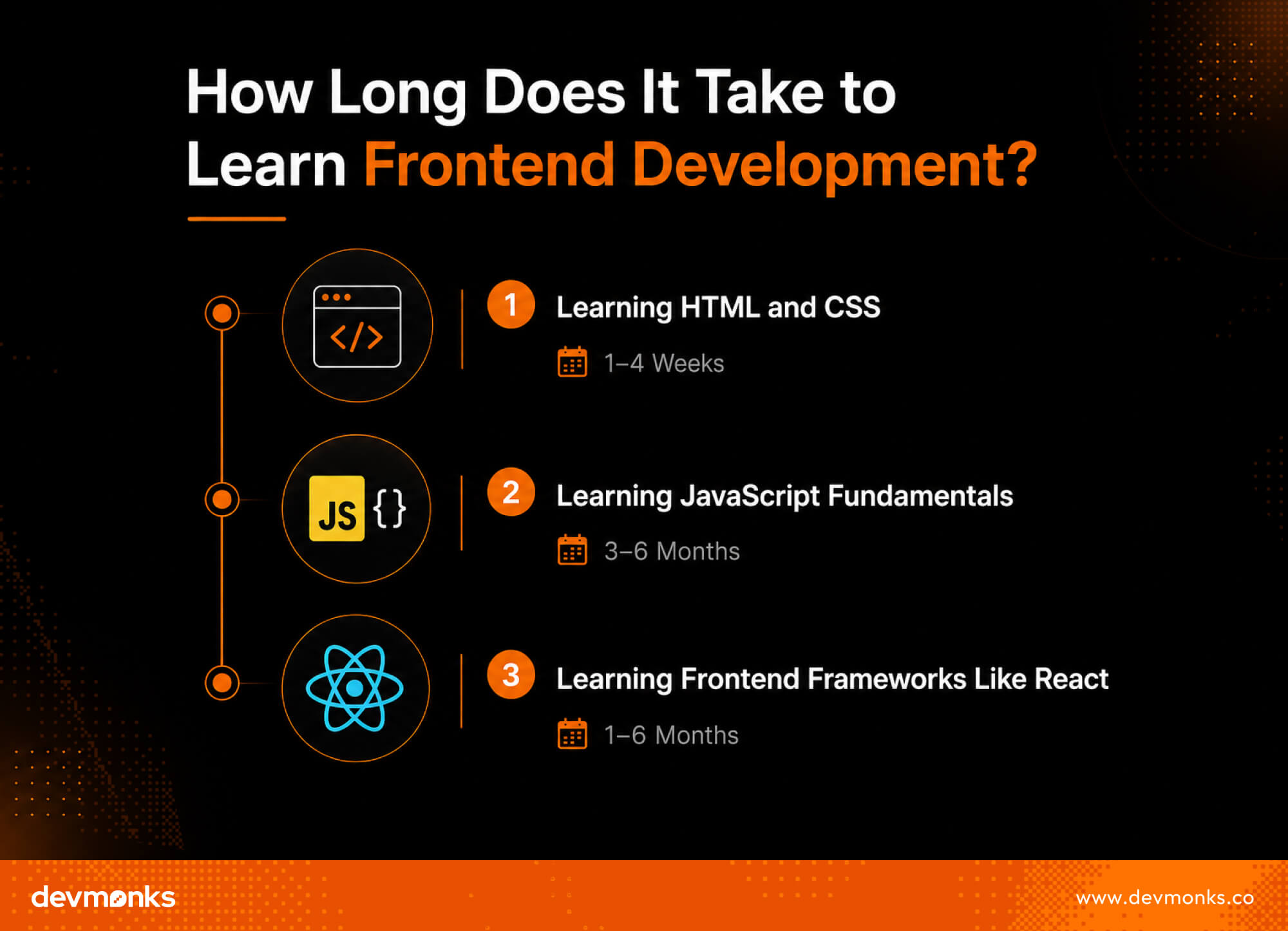
Learning HTML and CSS
You can learn HTML in about 1 to 2 weeks and CSS fundamentals in around 3 weeks. HTML helps you create the structure of a website, while CSS handles design and layout.
You will learn things like Flexbox, Grid, and responsive design so your websites work on all screen sizes. These are your basic beginner frontend skills and are essential for building responsive websites.
Learning JavaScript Fundamentals
JavaScript usually takes 3-6 months to learn well. Here, you focus on variables, functions, and DOM manipulation to make websites interactive.
You also learn basic async concepts. This is where you start building truly interactive websites using strong JavaScript fundamentals through regular practice.
Learning Frontend Frameworks Like React
After JavaScript, you can learn React in 1-6 months. React is a modern frontend framework used to build dynamic user interfaces using components.
This stage helps you understand modern frontend development and grow into a skilled frontend developer.
How Long Does It Take to Learn Backend Development?
Backend development is more complex because it handles how a website works behind the scenes. It usually takes around 6 to 12 months of consistent study to become comfortable with it.
You work with Node.js, APIs, databases, and Express.js to build the server-side of applications.
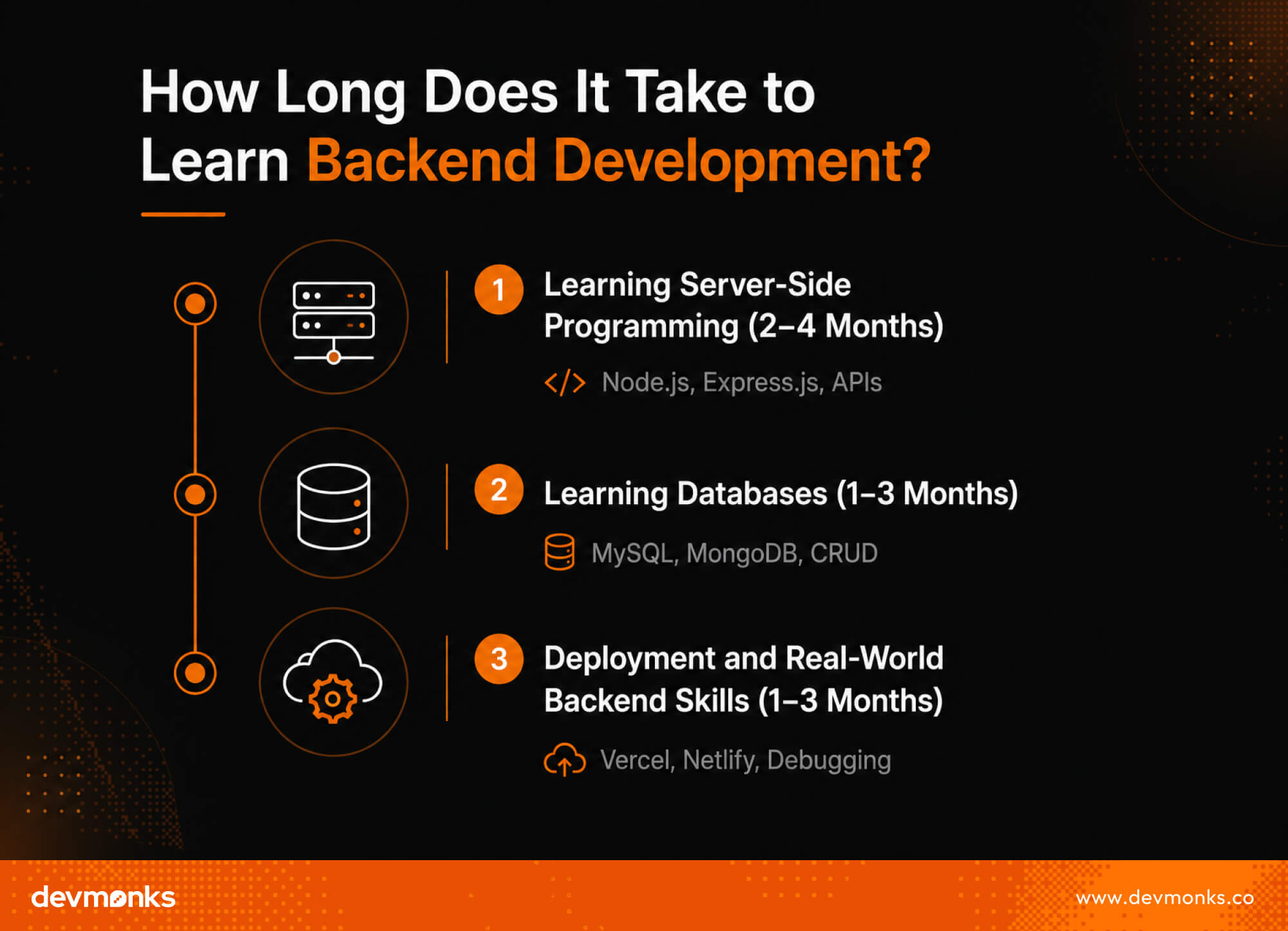
Learning Server-Side Programming
This stage takes about 2 to 4 months. You start with Node.js and Express.js, where you learn how servers work. You build routes, handle authentication, and create REST APIs.
This is the core of backend engineering, where you manage business logic and make the website functional for users.
Learning Databases
This stage usually takes 1 to 3 months. You learn databases like MySQL and MongoDB. You understand how data is stored, updated, and retrieved using CRUD operations.
You also compare SQL and NoSQL systems. This builds your understanding of backend systems and helps you write efficient database queries.
Deployment and Real-World Backend Skills
This stage takes around 1 to 3 months. You learn how to deploy applications using tools like Vercel and Netlify. You also practice debugging and basic scalability concepts.
This stage helps you build production-ready applications and improve your server-side development skills for real-world projects.
How Long Does It Take to Become a Full-Stack Developer?
Becoming a full-stack developer usually takes about 3 to 12 months of focused and intensive learning. However, if you are starting from zero, it may take up to around 1.5 to 2 years to become truly confident and job-ready.
This is because you need to learn both frontend and backend development.
General Full-Stack Learning Timeline
Full-stack development takes longer because you are learning two areas at once. You need to understand how websites look and how they work behind the scenes.
Many learners follow the MERN stack (MongoDB, Express.js, React, Node.js) to become complete web developers. This full-stack development path gives you more opportunities but requires consistent practice and a clear full-stack roadmap.
Skills You Need Before Calling Yourself Full-Stack
To call yourself a full-stack developer, you should know frontend skills, backend logic, databases, and deployment.
You also need to work with GitHub, APIs, and real projects. These skills help you become a job-ready developer and build strong web development skills for real-world applications.
However, if you want to learn enterprise web development, it may take longer than 2 years and a team, as they are very complex.
Best Ways to Learn Web Development Faster
Learning web development becomes much faster when you follow the right approach instead of random studying.
Build Projects Instead of Watching Tutorials
Focus on creating real portfolio projects instead of only watching videos. This helps you learn faster through hands-on project-based learning. Upload your work to GitHub so you can track progress and improve your coding practice.
Follow a Structured Learning Roadmap
A clear web development roadmap keeps your learning focused. It stops you from jumping between random topics and helps you follow a proper coding journey step by step.
Join Developer Communities
Being active in Stack Overflow, GitHub, and Discord communities helps you learn from others. You get feedback, support, and motivation, which improve your coding support and speed up your growth.
Realistic Month-by-Month Web Development Roadmap
This roadmap shows a simple and realistic path to learn web development step by step. Everyone learns at a different speed, but this gives you a clear direction.
Months 1-2: Learning the Basics
In the first two months, focus on HTML, CSS, and basic layouts. You learn how websites are structured and styled. Start building simple static websites to understand how elements work together. This is your foundation stage.
Months 3-4: Adding JavaScript
Now you move to JavaScript, where you learn DOM manipulation, functions, forms, and events. This is where websites become interactive. You can now build small dynamic projects instead of just static pages.
Months 5-6: Building Real Projects
In this stage, you work with APIs and create responsive projects that work on all devices. You also start using Git and GitHub workflows to manage your code like a real developer.
Months 6-12: Becoming Job-Ready
Now you focus on advanced skills like React or backend frameworks. You build a strong portfolio, deploy your projects online, and start interview preparation. This stage turns you into a job-ready developer with practical experience.
Common Mistakes That Slow Down Learning
Here are some common mistakes that slow down your progress in web development and make learning harder than it needs to be.
- Skipping fundamentals: Rushing past HTML, CSS, and JavaScript creates gaps in understanding and slows down progress later.
- Tutorial hell: Watching YouTube tutorials or coding courses without practice leads to tutorial dependency and weak coding practice.
- Skipping real projects: Without portfolio projects, you miss hands-on development, which is key to becoming a frontend developer.
- Copy-pasting without understanding: Copying code without learning the logic blocks real skill growth.
- Trying to memorize everything: Web development is too large to memorize and leads to learning overwhelm.
- Trying to learn everything at once: Jumping between frontend development and backend development without a web development roadmap causes confusion and slow progress.
Frequently Asked Questions
Is Web Development Hard to Learn?
Web development is not hard if you start step by step. The basics like HTML, CSS, and JavaScript are simple, but it becomes challenging when you move to frameworks and real projects.
Can You Learn Web Development Without a Degree?
Yes, you can learn web development without a degree. Many developers are self-taught using online resources, practice, and portfolio projects instead of formal education.
Can I Learn Web Development in 3 Months?
In 3 months, you can learn the basics like HTML, CSS, and simple JavaScript. However, you won’t be job-ready yet. It is enough to build small projects and understand core concepts.
How Many Hours a Day Should I Study?
Studying 2-4 hours daily is ideal for beginners. Consistent practice matters more than long hours, so regular coding and project building will give better results than occasional heavy study.
End Note
Web development takes time, but consistent practice makes it easier every day. Focus on building small projects instead of rushing through everything at once.
Stay patient, follow a clear roadmap, and keep improving step by step. Even slow progress is still progress, and with dedication, you can become a confident developer faster than you think.
.png)
.svg)
Frequently Asked Questions
How can I discuss an AI MVP with Dev Monks?

Book a strategy call with your use case, existing systems, and project priorities. The team can help define an initial scope and the dependencies that need to be addressed.
Does using AI replace engineering review?
Dev Monks uses AI-assisted workflows with human-guided decisions. Product requirements, engineering choices, and testing remain part of the development process.
What AI development services does Dev Monks offer?
Dev Monks offers agentic AI solutions, custom language-model solutions, workflow automation, and RAG development. Its broader services include SaaS engineering, MVP development, backend integrations, and web and mobile applications.
Is Dev Monks an official OpenAI Select Partner?
Yes. Dev Monks is now an official OpenAI Select Partner within the OpenAI Partner Network.
How long does it usually take to complete a project?
We combine AI-driven workflows with product-first engineering to provide MVP development services for startups and enterprises. Our approach balances speed, reliability, and usability while keeping teams involved. We deliver production-ready, scalable solutions, not just prototypes or demos.
What makes Dev Monks different from other development companies?
We combine AI-driven workflows with product-first engineering to provide MVP development services for startups and enterprises. Our approach balances speed, reliability, and usability while keeping teams involved. We deliver production-ready, scalable solutions, not just prototypes or demos.
How Involved Will My Team be During Development?
We combine AI-driven workflows with product-first engineering to provide MVP development services for startups and enterprises. Our approach balances speed, reliability, and usability while keeping teams involved. We deliver production-ready, scalable solutions, not just prototypes or demos.
How involved will my team be during development?
We combine AI-driven workflows with product-first engineering to provide MVP development services for startups and enterprises. Our approach balances speed, reliability, and usability while keeping teams involved. We deliver production-ready, scalable solutions, not just prototypes or demos.
Do you develop both web and mobile applications?
We combine AI-driven workflows with product-first engineering to provide MVP development services for startups and enterprises. Our approach balances speed, reliability, and usability while keeping teams involved. We deliver production-ready, scalable solutions, not just prototypes or demos.
How can Dev Monks help my startup launch faster
We combine AI-driven workflows with product-first engineering to provide MVP development services for startups and enterprises. Our approach balances speed, reliability, and usability while keeping teams involved. We deliver production-ready, scalable solutions, not just prototypes or demos.

%20vs%20new%20Date().jpg)