Finance Chatbot Development Company for Banks & Fintech


[ key takeways ]
- Finance chatbot development companies build AI assistants for financial businesses.
- AI chatbots automate support, operations, and personalized financial services.
- Security, compliance, and integrations are essential for finance chatbots.
- Development costs depend on complexity, AI, integrations, and maintenance.
- Choose a company with AI expertise, finance experience, and reliable support.

A finance chatbot development company designs, builds, and deploys AI-powered chatbots for banks, fintech companies, insurers, lenders, and investment firms.
These chatbots automate customer support, streamline financial operations, and deliver personalized assistance while meeting strict security and compliance requirements.
Understanding what these companies offer can help you choose the right technology partner, reduce operational costs, improve customer experiences, and stay competitive in a rapidly evolving financial market.
In this article, you'll know what finance chatbot development companies do, the technologies they use, essential features, development costs, security requirements, and how to select the right partner for your business.
What Is a Finance Chatbot Development Company?
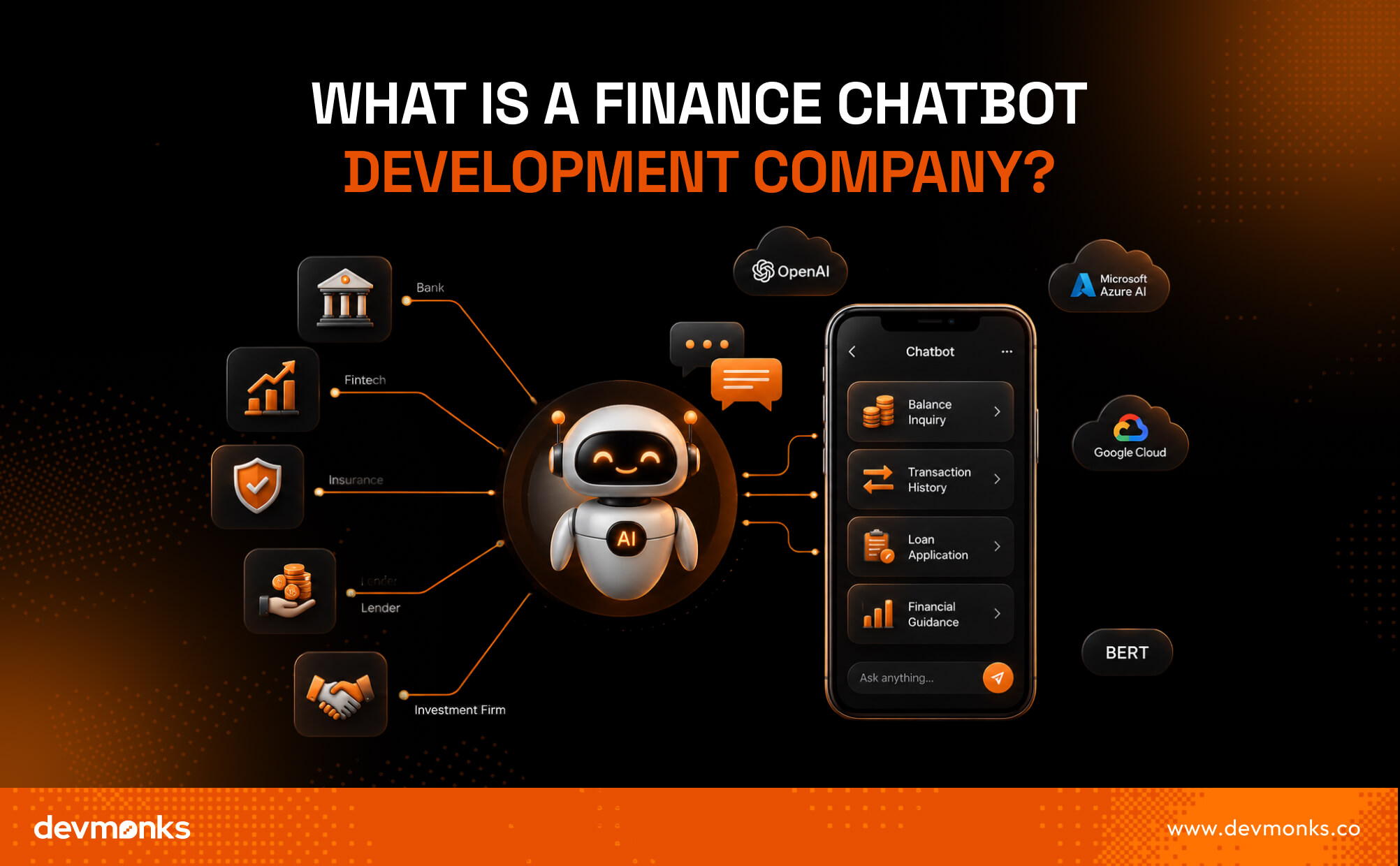
A finance chatbot development company builds intelligent chatbots for banks, fintech companies, insurance providers, lenders, and investment firms.
These companies create AI-powered assistants that answer customer questions, automate routine tasks, and improve financial services.
Using technologies like OpenAI, Microsoft Azure AI, Google Cloud AI, and BERT, they develop secure and accurate AI financial assistants for conversational banking.
A banking chatbot or virtual banking assistant can help users check balances, track transactions, apply for loans, or receive personalized financial guidance.
A trusted fintech chatbot development partner also ensures security, compliance, and seamless integration with existing financial systems.
Companies looking for reliable finance chatbot solutions often work with agencies like Dev Monks, which combine AI expertise with customer-focused development and ongoing support.
Types of Financial Chatbots Businesses Can Build
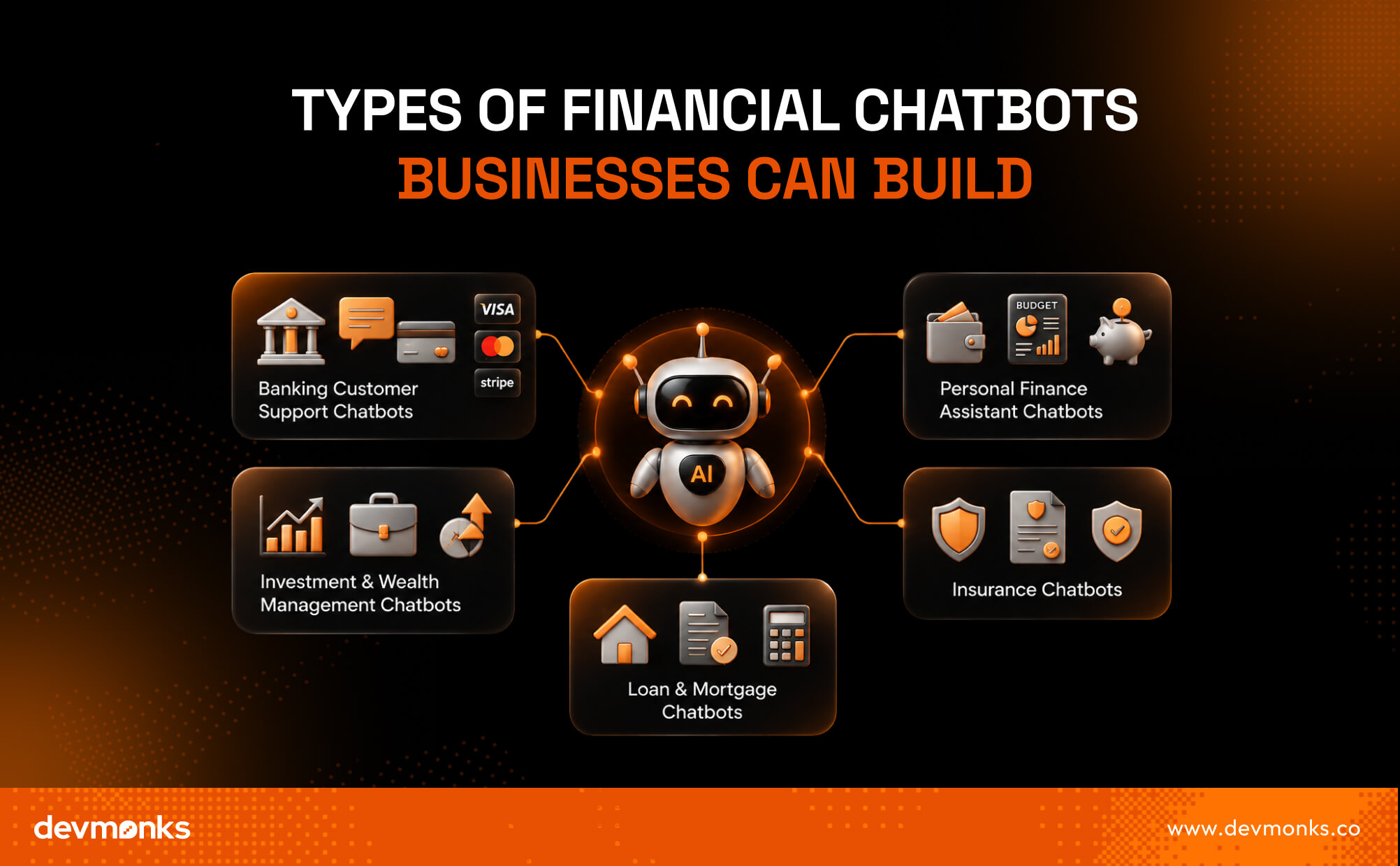
Financial chatbots are designed to solve different business challenges. Some focus on customer support, while others help users manage money, apply for loans, or receive investment guidance.
Choosing the right chatbot depends on your business goals and the services you offer.
Banking Customer Support Chatbots
Banking customer support chatbots automate everyday customer service tasks. They answer account inquiries, provide transaction history, explain banking services, and help users reset passwords or block lost cards.
They can also guide customers through payments made with Visa, Mastercard, or digital payment platforms like Stripe, which reduces wait times and improving customer satisfaction.
Personal Finance Assistant Chatbots
Personal finance assistant chatbots help users take control of their money. They support budget planning, track daily expenses, analyze spending habits, and suggest practical savings recommendations.
These AI assistants encourage better financial decisions through personalized insights and timely reminders.
Investment & Wealth Management Chatbots
Investment and Wealth Management chatbots provide portfolio management support, market updates, and personalized investment insights.
They can answer common investment questions and offer basic financial advisory services, helping users make more informed decisions while reducing the workload for financial advisors.
Loan & Mortgage Chatbots
Loan and mortgage chatbots simplify the borrowing process. They check loan eligibility, guide customers through application assistance, collect required information, and even provide mortgage calculator estimates.
This creates a faster and smoother experience for both lenders and applicants.
Insurance Chatbots
Insurance chatbots help customers with claims processing, policy assistance, renewals, and frequently asked questions.
They reduce manual work, speed up response times, and improve customer service for insurance providers while making support available 24/7.
Finance Chatbot Features Every Business Should Consider
A modern financial chatbot should do more than answer basic questions. It should provide secure, accurate, and personalized support while making financial services faster and easier for customers.
Here are the key AI chatbot features every business should consider.
Natural Language Processing (NLP)
NLP helps chatbots understand customer questions in everyday language. Combined with Machine Learning and powerful LLMs like GPT-4, Claude, and Gemini, it enables natural, human-like conversations and more accurate responses.
Secure User Authentication
A secure chatbot should verify user identity through multi-factor authentication, biometric login, or one-time passwords before providing access to sensitive financial information.
Account & Transaction Lookup
Customers should be able to check account balances, review transaction history, monitor recent payments, and receive real-time account updates without waiting for a support agent.
AI-powered Financial Recommendations
AI analyzes customer behavior to provide personalized budgeting tips, spending insights, savings suggestions, and relevant financial product recommendations.
Document Processing
The chatbot can collect, verify, and process documents such as identity cards, bank statements, or loan forms, which reduces manual work and speeds up approvals.
Omnichannel Support
A financial chatbot should deliver consistent support across websites, mobile apps, messaging platforms, and social media.
Voice Banking
Voice-enabled chatbots allow customers to perform banking tasks using simple voice commands, which makes services more convenient and accessible.
Human Agent Handoff
When a request becomes too complex, the chatbot should instantly transfer the conversation to a human agent without losing the chat history.
AI Technologies Used in Finance Chatbot Development
Building an enterprise-grade finance chatbot requires more than a single AI model. Modern chatbots combine several AI technologies to deliver accurate answers, understand financial data, and protect sensitive information.
Together, these technologies create faster, smarter, and more reliable customer experiences.
Large Language Models (LLMs)
Large Language Models (LLMs) such as OpenAI, Claude, and Gemini understand natural language and generate human-like responses. They power conversations, explain financial products, and answer customer questions with greater accuracy.
Retrieval-Augmented Generation (RAG)
RAG improves chatbot accuracy by retrieving information from trusted internal sources before generating a response. This helps the chatbot provide up-to-date answers based on company policies, financial documents, and compliance guidelines.
AI Agents
AI agents can complete multi-step tasks without constant user input. They can collect customer information, verify requests, schedule appointments, or guide users through complex financial processes.
Knowledge Bases
A knowledge base stores FAQs, policies, product details, and financial regulations. The chatbot uses this information to deliver consistent and reliable answers.
Vector Databases
Vector databases like Pinecone help chatbots quickly find relevant information based on meaning instead of exact keywords. This improves search quality and response accuracy.
OCR & Document Intelligence
OCR and document intelligence, powered by platforms such as Azure AI, extract information from bank statements, IDs, invoices, and loan documents. This speeds up verification, reduces manual work, and improves the overall customer experience.
Finance Chatbot Use Cases Across Different Industries
Finance chatbots are helping businesses deliver faster, smarter, and more personalized financial services. From Banking to Fintech and Investment firms, these AI assistants automate routine tasks, improve customer support, and reduce operational costs.
Retail Banking
Retail banks use chatbots to answer customer questions, check account balances, provide transaction details, and help users manage cards, payments, and everyday banking services.
Digital Banking
Digital banks rely on AI chatbots to offer 24/7 support. Customers can open accounts, verify identities, transfer funds, and receive instant assistance without visiting a physical branch.
Fintech Startups
Fintech startups use chatbots to onboard users, explain financial products, process payments, and provide personalized recommendations. This helps them deliver better customer experiences while scaling quickly.
Credit Unions
Credit unions use chatbots to support members with account inquiries, loan information, payment reminders, and self-service options, which reduces the workload on support teams.
Investment Firms
Investment firms use AI chatbots to provide portfolio updates, market insights, investment education, and basic financial guidance. This keeps investors informed while allowing advisors to focus on more complex client needs.
Insurance Companies
Insurance providers use chatbots to answer policy questions, process claims, send renewal reminders, and guide customers through insurance services with faster response times.
Lending Platforms
Lending platforms use chatbots to check loan eligibility, collect application details, verify documents, update application status, and answer borrower questions throughout the lending process.
Finance Chatbot Development Process
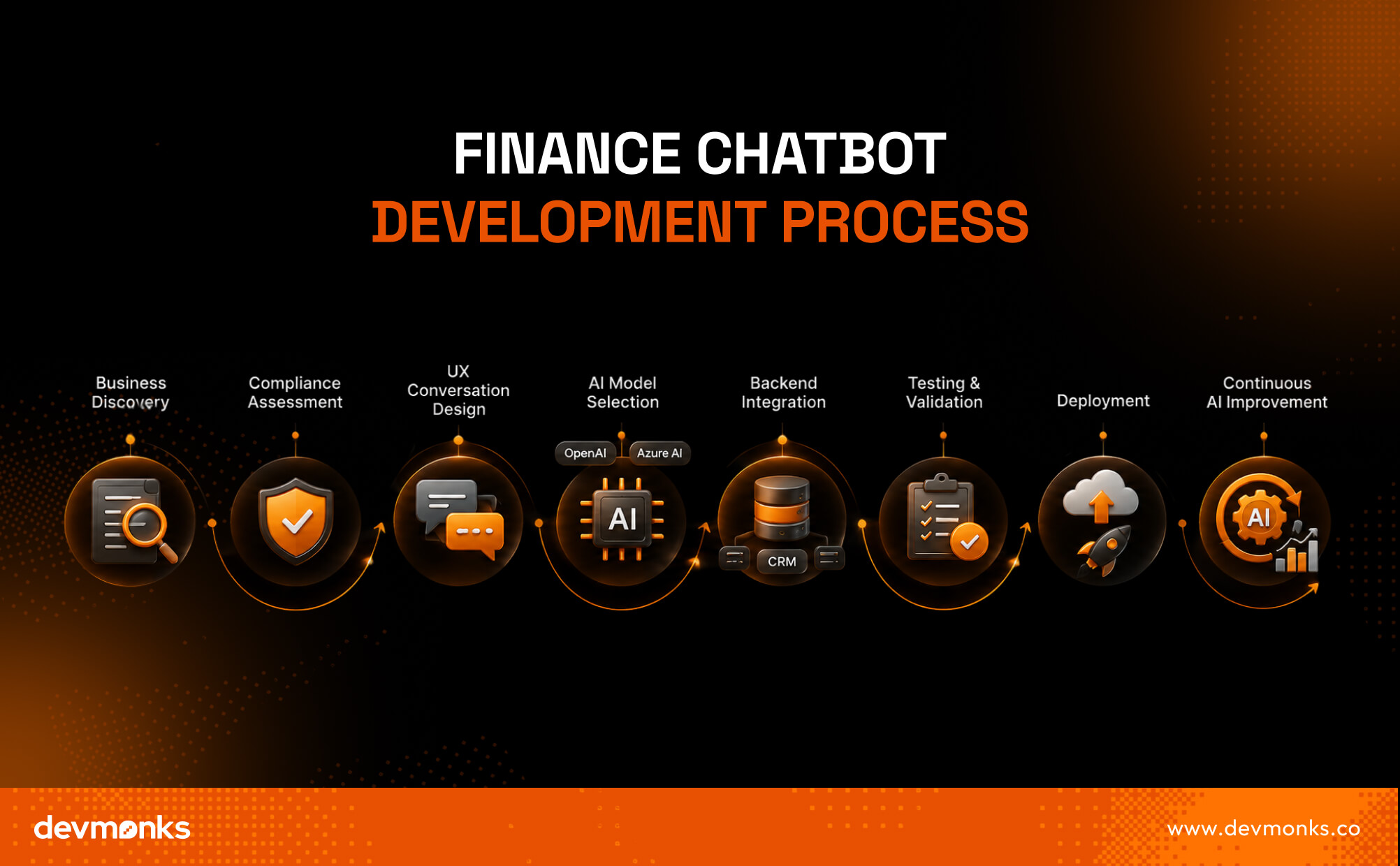
A successful chatbot development process starts with understanding your business and continues even after the chatbot goes live. At every stage, the goal is to build a secure, accurate, and scalable AI assistant that delivers real value.
Many development teams follow an Agile approach to release features faster and improve the chatbot through continuous feedback.
Step 1: Business Discovery
The first step of this process is understanding your business goals, target users, and customer pain points. This helps define the chatbot's purpose, key features, and success metrics.
Step 2: Compliance Assessment
Financial chatbots must follow industry regulations and protect sensitive customer data. The development team reviews compliance requirements and security standards before development begins.
Step 3: UX Conversation Design
Next, designers create conversation flows that feel natural and easy to follow. The chatbot is planned to handle common questions, guide users, and provide smooth interactions.
Step 4: AI Model Selection
The right AI model is selected based on your business needs. Solutions may use the OpenAI API, custom AI models, or Azure AI services to deliver accurate and reliable responses.
Step 5: Backend Integration
The chatbot is connected with banking systems, CRMs, payment gateways, databases, and other business tools so it can access real-time information and perform useful tasks.
Step 6: Testing & Validation
Before launch, the chatbot is tested for accuracy, security, performance, and user experience. Every conversation is reviewed to ensure reliable responses.
Step 7: Deployment
After testing, the chatbot is deployed across websites, mobile apps, and messaging platforms with minimal disruption.
Step 8: Continuous AI Improvement
Once live, the chatbot is continuously monitored and improved using customer feedback, analytics, and new AI capabilities to keep responses accurate and relevant over time.
Security & Compliance in Financial Chatbots
Security and compliance are essential when developing financial chatbots. Since these chatbots handle sensitive customer and financial data, they must meet strict industry standards to protect information and build user trust.
GDPR
GDPR ensures that personal data is collected, stored, and processed responsibly. Businesses must also give users control over their personal information.
PCI DSS
PCI DSS protects payment card information by setting security requirements for processing, storing, and transmitting card data.
SOC 2
SOC 2 focuses on data security, availability, confidentiality, and privacy. It helps businesses demonstrate that customer information is managed securely.
AML & KYC
AML (Anti-Money Laundering) and KYC (Know Your Customer) procedures help verify customer identities, prevent fraud, and meet financial regulations.
Encryption
Strong encryption protects sensitive data while it is stored and transmitted, which reduces the risk of unauthorized access.
Access Control
Role-based access control ensures that only authorized employees can access customer data and chatbot management systems.
Audit Logging
Audit logs record chatbot activities, user actions, and system changes, which makes it easier to monitor operations, investigate incidents, and maintain regulatory compliance.
Security, scalability, and regulatory compliance are also common challenges when building enterprise applications.
Integrations Finance Chatbots Need
To deliver accurate responses and automate financial services, finance chatbots must integrate with the systems businesses already use. Common integrations include:
- CRM: Connect with Salesforce or HubSpot to access customer profiles, interaction history, and support requests.
- Banking APIs: Retrieve real-time account details, balances, and transaction information.
- Core Banking Systems: Enable secure access to banking operations and customer records.
- Payment Gateways: Integrate with platforms like Stripe to process payments and payment-related inquiries.
- ERP Systems: Connect with SAP to manage financial data, business operations, and reporting.
- Accounting Software: Sync invoices, expenses, and financial records automatically.
- Knowledge Base: Provide accurate answers using company policies, FAQs, and documentation.
- Help Desk: Create, update, and track customer support tickets.
- Live Chat: Transfer complex conversations to human agents without losing the chat history.
- Financial Data APIs: Connect with platforms like Plaid to securely access banking and financial account data.
Benefits of Hiring a Finance Chatbot Development Company
Partnering with an experienced finance chatbot development company helps businesses improve customer service, reduce costs, and scale operations more efficiently. Key benefits include:
- Reduced support costs: Automate repetitive customer queries and lower the workload on support teams.
- Faster customer service: Provide instant responses to common banking and financial questions.
- Better compliance: Build chatbots that follow financial regulations and security standards.
- Higher customer satisfaction: Deliver personalized, accurate, and consistent support experiences.
- 24/7 availability: Assist customers anytime without depending on business hours.
- Better lead qualification: Identify potential customers and collect important information before handing them to sales teams.
- Increased operational efficiency: Automate routine tasks so employees can focus on high-value work and complex customer requests.
How Much Does Finance Chatbot Development Cost?
The chatbot development cost depends on the features, technology, and business requirements. The main cost factors include:
- Complexity: Advanced chatbots with automation and AI capabilities require more development time.
- AI Model: The choice of AI model and API usage affects both development and ongoing costs.
- Integrations: Connecting with banking APIs, CRMs, payment gateways, and other systems increases development effort.
- Security: Features like encryption, authentication, and fraud protection add to the overall cost.
- Compliance: Meeting financial regulations requires additional planning, testing, and documentation.
- Custom Workflows: Personalized business logic and conversational flows require custom development.
- Maintenance: Regular updates, AI improvements, monitoring, cloud hosting, and technical support create ongoing operational costs.
How to Choose the Right Finance Chatbot Development Company
Choosing the right development partner is important for building a secure, reliable, and scalable finance chatbot. Before making a decision, evaluate these key factors:
- AI Expertise: Look for experience with AI, LLMs, NLP, and enterprise chatbot development.
- Finance Experience: Choose a company that has worked with banking, fintech, insurance, or lending businesses.
- Compliance Knowledge: Ensure the team understands GDPR, PCI DSS, KYC, AML, and other financial regulations.
- Portfolio: Review previous chatbot projects, case studies, and client success stories.
- Team: Verify the company has AI engineers, developers, UX designers, and QA specialists.
- Communication: Select a partner that provides clear updates and transparent collaboration.
- Post-launch Support: Make sure they offer maintenance, AI optimization, security updates, and ongoing technical support.
Choosing the right development partner is just as important as selecting the right AI technology because it directly impacts security, scalability, and long-term success.
Why Choose Our Finance Chatbot Development Services
At Dev Monks, we build secure, AI-powered finance chatbots that solve real business challenges. Our team combines expertise in AI, fintech, and enterprise software to create reliable, scalable solutions customized to your needs.
From strategy and development to deployment and ongoing support, we stay with you at every step.
With transparent communication, excellent customer service, and a strong focus on quality, Dev Monks helps businesses launch finance chatbots with confidence.
FAQs
Are AI chatbots secure for banks?
Yes, AI chatbots can be highly secure when built correctly. They use encryption, secure authentication, role-based access control, and comply with standards like GDPR, PCI DSS, AML, and KYC. Regular security testing and monitoring also help protect sensitive customer and financial data.
How long does development take?
The development timeline depends on the chatbot's complexity, AI capabilities, integrations, and compliance requirements. A basic chatbot can be built in a few weeks, while an enterprise finance chatbot with custom features and banking integrations may take several months.
Can chatbots integrate with banking systems?
Yes. Finance chatbots can integrate with core banking systems, banking APIs, payment gateways, CRM platforms, accounting software, and customer support tools. These integrations enable real-time account access, transaction lookups, payments, and personalized customer assistance while maintaining security.
End Note
Finance chatbots are transforming how financial institutions serve customers by automating support, improving efficiency, and delivering personalized experiences.
Choosing the right development partner is the key to building a secure and scalable solution.
If you're planning to invest in AI-powered financial services, work with an experienced finance chatbot development company that understands both advanced AI technologies and the unique demands of the financial industry.


Frequently Asked Questions
How can I discuss an AI MVP with Dev Monks?

Book a strategy call with your use case, existing systems, and project priorities. The team can help define an initial scope and the dependencies that need to be addressed.
Does using AI replace engineering review?
Dev Monks uses AI-assisted workflows with human-guided decisions. Product requirements, engineering choices, and testing remain part of the development process.
What AI development services does Dev Monks offer?
Dev Monks offers agentic AI solutions, custom language-model solutions, workflow automation, and RAG development. Its broader services include SaaS engineering, MVP development, backend integrations, and web and mobile applications.
Is Dev Monks an official OpenAI Select Partner?
Yes. Dev Monks is now an official OpenAI Select Partner within the OpenAI Partner Network.
How long does it usually take to complete a project?
We combine AI-driven workflows with product-first engineering to provide MVP development services for startups and enterprises. Our approach balances speed, reliability, and usability while keeping teams involved. We deliver production-ready, scalable solutions, not just prototypes or demos.
What makes Dev Monks different from other development companies?
We combine AI-driven workflows with product-first engineering to provide MVP development services for startups and enterprises. Our approach balances speed, reliability, and usability while keeping teams involved. We deliver production-ready, scalable solutions, not just prototypes or demos.
How Involved Will My Team be During Development?
We combine AI-driven workflows with product-first engineering to provide MVP development services for startups and enterprises. Our approach balances speed, reliability, and usability while keeping teams involved. We deliver production-ready, scalable solutions, not just prototypes or demos.
How involved will my team be during development?
We combine AI-driven workflows with product-first engineering to provide MVP development services for startups and enterprises. Our approach balances speed, reliability, and usability while keeping teams involved. We deliver production-ready, scalable solutions, not just prototypes or demos.
Do you develop both web and mobile applications?
We combine AI-driven workflows with product-first engineering to provide MVP development services for startups and enterprises. Our approach balances speed, reliability, and usability while keeping teams involved. We deliver production-ready, scalable solutions, not just prototypes or demos.
How can Dev Monks help my startup launch faster
We combine AI-driven workflows with product-first engineering to provide MVP development services for startups and enterprises. Our approach balances speed, reliability, and usability while keeping teams involved. We deliver production-ready, scalable solutions, not just prototypes or demos.