What Is Joint Application Development (JAD)? Process & Benefits


[ key takeways ]
- Joint Application Development gathers project requirements through structured, collaborative stakeholder workshops.
- JAD improves communication and reduces misunderstandings before software development begins.
- Successful JAD workshops require planning, skilled facilitation, and active stakeholder participation.
- JAD works best for enterprise software, ERP, SaaS, and digital transformation projects.
- Combining JAD with Agile improves planning, collaboration, and overall project success.

Joint Application Development (JAD) is a structured requirements gathering method where business users, stakeholders, and developers work together in collaborative workshops to define project requirements before development begins.
It helps teams make faster decisions, reduce misunderstandings, and create software that better meets business needs.
Understanding JAD can help you decide whether it is the right approach for your next software project. Whether you're planning an enterprise application, ERP system, or SaaS product, knowing how JAD works can save time and improve project outcomes.
In this article, you'll learn the JAD process, key roles, benefits, challenges, and best practices for running successful workshops.
What Is Joint Application Development (JAD)?
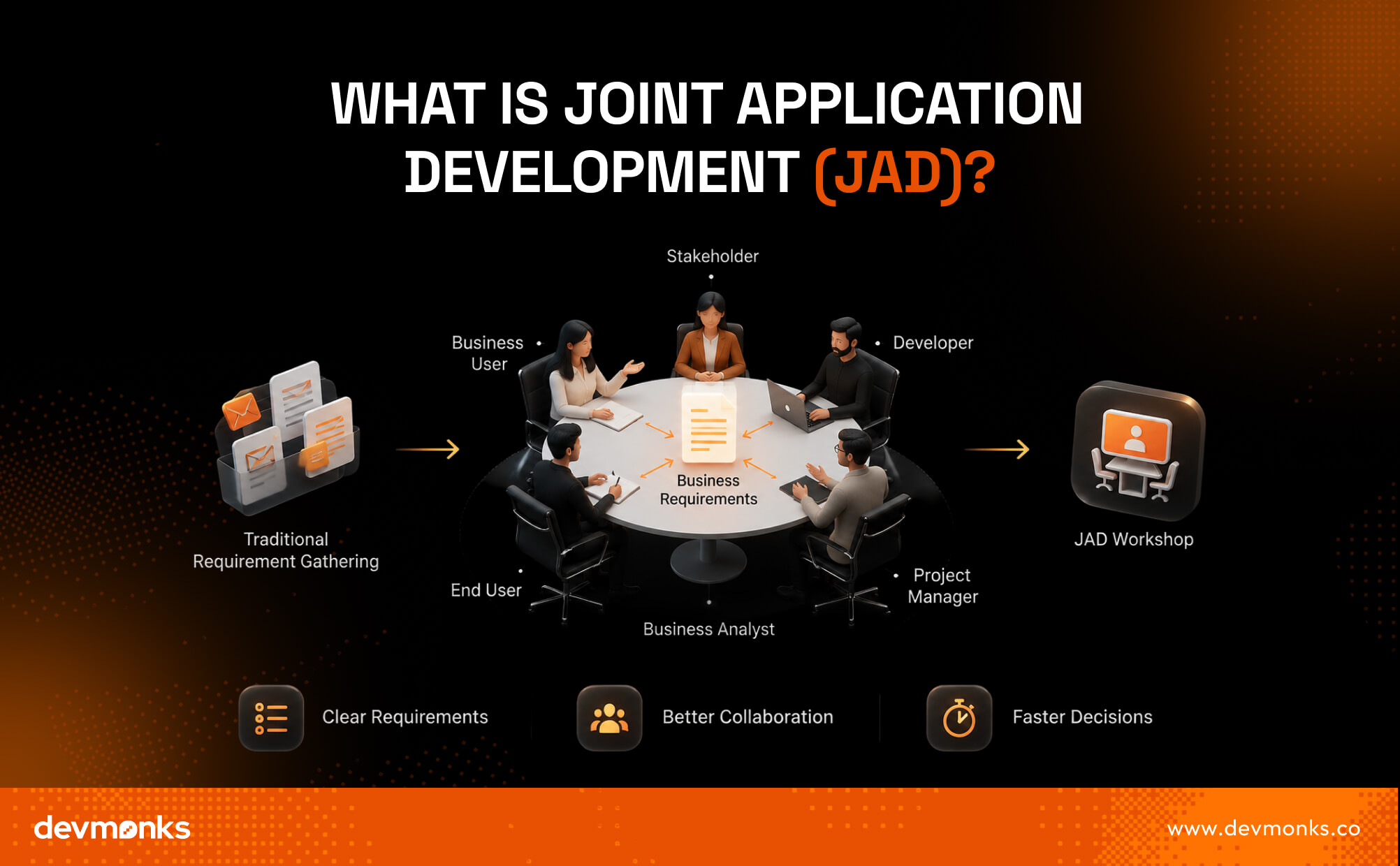
Joint Application Development (JAD) is a collaborative requirements gathering method used in software development. Instead of collecting feedback from people separately, everyone joins structured meetings to discuss the project together.
These sessions usually include business users, stakeholders, developers, project managers, and sometimes end users.
The purpose of JAD is to gather clear business requirements before development begins. By discussing ideas as a group, teams can resolve questions, avoid misunderstandings, and create a shared understanding of the project.
This collaborative requirements gathering approach helps everyone stay aligned from the beginning.
JAD was introduced by IBM to improve communication between business and technical teams. It became popular because it made requirements gathering faster, more accurate, and more organized.
Why JAD Was Introduced
Traditional requirement gathering often relied on interviews, emails, and lengthy documents. This process took time and sometimes led to incomplete or unclear business requirements.
As a result, development teams could build features that did not match user expectations.
JAD was designed to solve these issues through stakeholder workshops and structured meetings. Bringing the right people together allows teams to discuss problems, answer questions, and make decisions in real time.
If you're planning a custom software project, working with an experienced development partner like Dev Monks can make JAD workshops more productive by helping translate business goals into clear technical requirements from the start.
Primary Objective of JAD Sessions
The main objective of JAD sessions is to define accurate requirements, align business and technical goals, and reduce confusion before development starts. A clear agreement early in the development process helps teams avoid costly changes later.
By improving communication and decision-making, JAD creates a smoother development process and increases the chances of delivering software that truly meets business requirements.
Since JAD is used during the early planning stage, understanding the overall application development lifecycle can help you see where this methodology fits into a software project.
How Does the Joint Application Development Process Work?
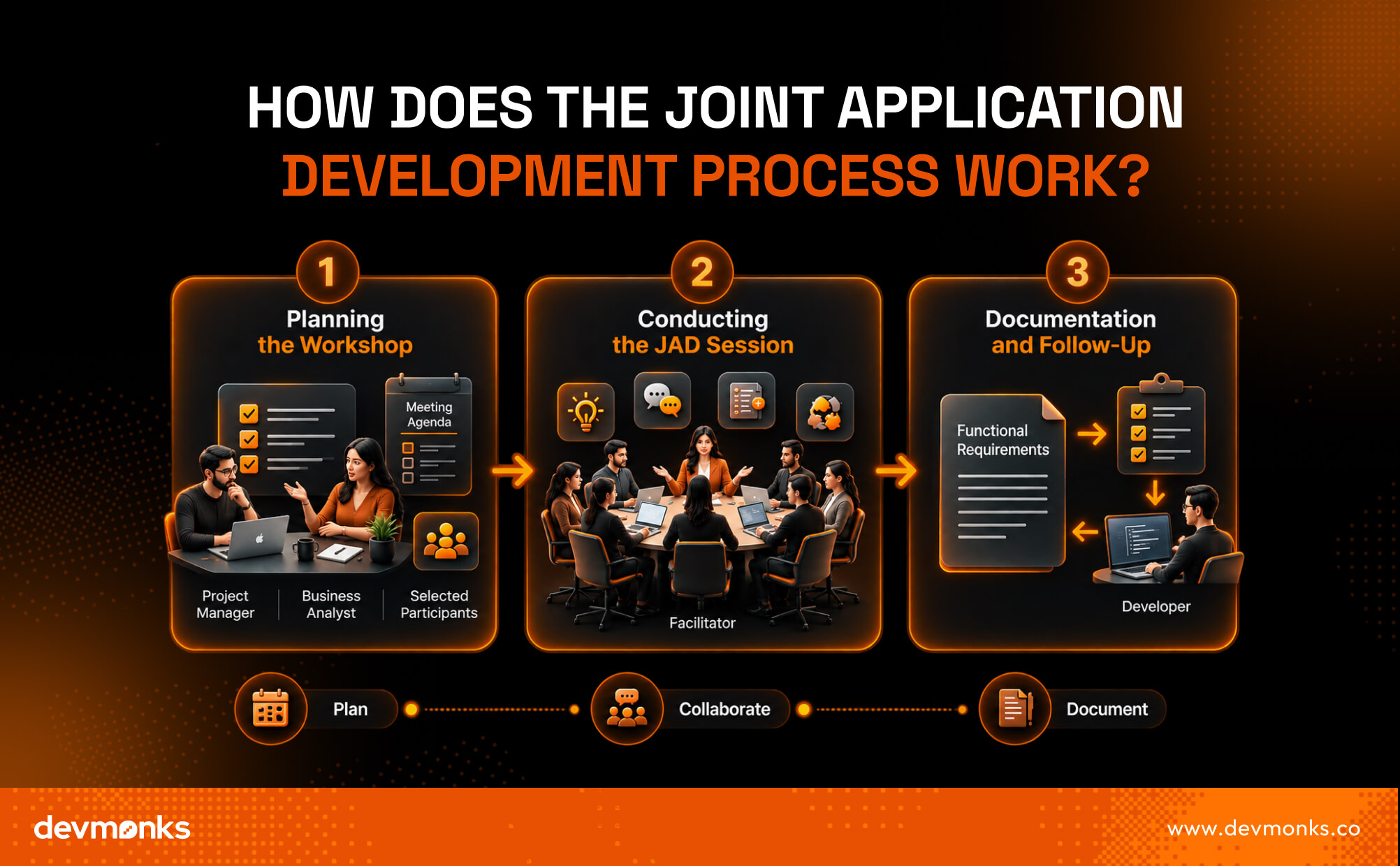
The Joint Application Development process follows a structured workflow that helps teams gather accurate requirements and make decisions faster.
Each stage focuses on improving collaboration, reducing misunderstandings, and keeping the project aligned with business goals.
Planning the Workshop
Every successful JAD session starts with careful planning. The Project Manager and Business Analyst identify the project's goals, prepare the workshop agenda, and select the right participants.
These participants often include business users, developers, decision-makers, and other key stakeholders. Good workshop preparation ensures everyone understands the objectives before the meeting begins.
A well-planned planning session also keeps discussions focused and productive.
Conducting the JAD Session
Once the workshop begins, a Facilitator leads the discussion and makes sure every participant has a chance to contribute. Stakeholders share their ideas, discuss business needs, ask questions, and resolve disagreements together.
The team brainstorms possible solutions, prioritizes important features, and clarifies user expectations. This collaborative decision-making process helps everyone reach an agreement faster.
Throughout the session, requirement elicitation takes place as ideas, business rules, and user needs are carefully captured and organized.
Documentation and Follow-Up
After the workshop, all discussions are converted into clear documentation. The team organizes the agreed requirements, updates the project scope, and prepares detailed Functional Requirements for the development team.
Any unresolved questions are reviewed, and changes are discussed before final approval. Once everyone agrees on the documented requirements, the project can move forward with greater confidence.
This final step reduces misunderstandings, keeps the project aligned with business goals, and provides developers with a clear roadmap for implementation.
Key Roles in a Joint Application Development Workshop
A successful JAD workshop depends on the right people working together. Each participant has a specific role that helps the team gather accurate user requirements and make informed decisions.
Executive Sponsor
The Executive Sponsor provides overall direction and supports the project. They approve major decisions, remove obstacles, and ensure the workshop stays aligned with business goals.
Facilitator
The Facilitator leads the workshop and keeps discussions productive. They encourage participation, manage time, resolve conflicts, and make sure every topic is covered without bias.
Business Users
Business users are the people who will use the final solution. As key user representatives, they explain daily workflows, business challenges, and expectations. Their feedback helps the team understand real user requirements.
Business Analyst
The Business Analyst translates business needs into clear requirements. They ask detailed questions, clarify ideas, document discussions, and ensure everyone has a shared understanding of the project.
Developers & Technical Team
Developers and other technical experts evaluate whether the requested features are technically possible. They suggest practical solutions, identify technical limitations, and estimate the effort needed to build the system.
Decision Makers
Decision makers, including key Stakeholders, approve important choices during the workshop. They resolve disagreements, set priorities, and confirm project requirements so the team can move forward without delays.
When all workshop participants work together, communication improves, misunderstandings decrease, and project stakeholders can build a solution that meets both business goals and user requirements.
Benefits of Joint Application Development
Joint Application Development remains a valuable approach because it brings the right people together at the right time. By encouraging open discussions, JAD helps teams work more efficiently and build software that better meets business needs.
Faster Requirement Gathering
JAD speeds up requirement gathering by collecting ideas and feedback in one place. Instead of holding multiple meetings, teams discuss and finalize requirements during a single workshop.
Better Stakeholder Collaboration
JAD encourages business users, developers, and decision-makers to work together from the beginning. This improved communication creates stronger collaboration and helps everyone stay focused on the same goals.
Reduced Miscommunication
When questions are answered in real time, there is less room for confusion. Teams develop a shared understanding of project requirements, which reduces costly mistakes and changes later in development.
Improved Software Quality
Clear and accurate requirements help developers build the right features from the start. Better planning leads to higher software quality, fewer revisions, and solutions that meet user expectations more effectively.
Faster Decision Making
JAD workshops allow key stakeholders to discuss issues and make decisions immediately. This reduces delays, keeps the project moving, and improves overall project alignment.
By improving communication, collaboration, and planning, Joint Application Development increases the chances of project success. Teams can deliver reliable software faster while reducing risks, misunderstandings, and unnecessary rework.
Challenges and Limitations of JAD
While Joint Application Development offers many benefits, it is not the right choice for every project. Organizations should understand its challenges before deciding whether to use this approach.
Scheduling Difficulties
JAD workshops require multiple participants to meet at the same time. Finding a schedule that works for everyone can be difficult, especially in large organizations.
Stakeholder Availability
The success of JAD depends on active participation from key stakeholders. If important people are unavailable or unprepared, valuable feedback may be missed, which leads to incomplete requirements.
Dominant Participants
Sometimes a few individuals control the discussion while others hesitate to share their ideas. Without proper meeting management, this can create an unbalanced discussion and overlook valuable input from the rest of the team.
High Preparation Time
A productive JAD session requires careful planning. Teams must prepare agendas, collect background information, and identify the right participants before the workshop begins. This preparation can take significant time and effort.
Scope Creep
As discussions continue, new ideas and feature requests often emerge. If these are not managed properly, requirement conflicts and changing priorities can expand the project scope, which increases costs and delays delivery.
Despite these project risks, JAD remains an effective approach when workshops are well planned, discussions are properly managed, and participants stay focused on the project's objectives.
When Should You Use Joint Application Development?
Joint Application Development works best when a project involves multiple teams, complex requirements, and frequent collaboration. It is especially useful during software planning, where early decisions can significantly impact the project's success.
Use JAD when your project involves:
- Enterprise Software: Large systems with multiple departments that need clear business requirements and strong collaboration.
- ERP implementation: Projects that require input from finance, HR, operations, and other business units to ensure the system supports every workflow.
- SaaS products: Applications where user feedback and feature prioritization are essential before development begins.
- Digital transformation: Projects that replace manual processes with modern technology and require alignment across different teams.
- Legacy modernization: Updating older systems while preserving critical business processes and minimizing disruption.
- Cross-functional projects: Initiatives involving developers, business users, managers, and other stakeholders who must agree on shared goals before development starts.
JAD is especially valuable for custom software development, where gathering accurate business requirements early helps create solutions customized to specific organizational needs.
If your enterprise projects require frequent communication, quick decision-making, and accurate requirement gathering, Joint Application Development can help reduce misunderstandings and create a smoother path to successful software development.
JAD vs Traditional Requirement Gathering
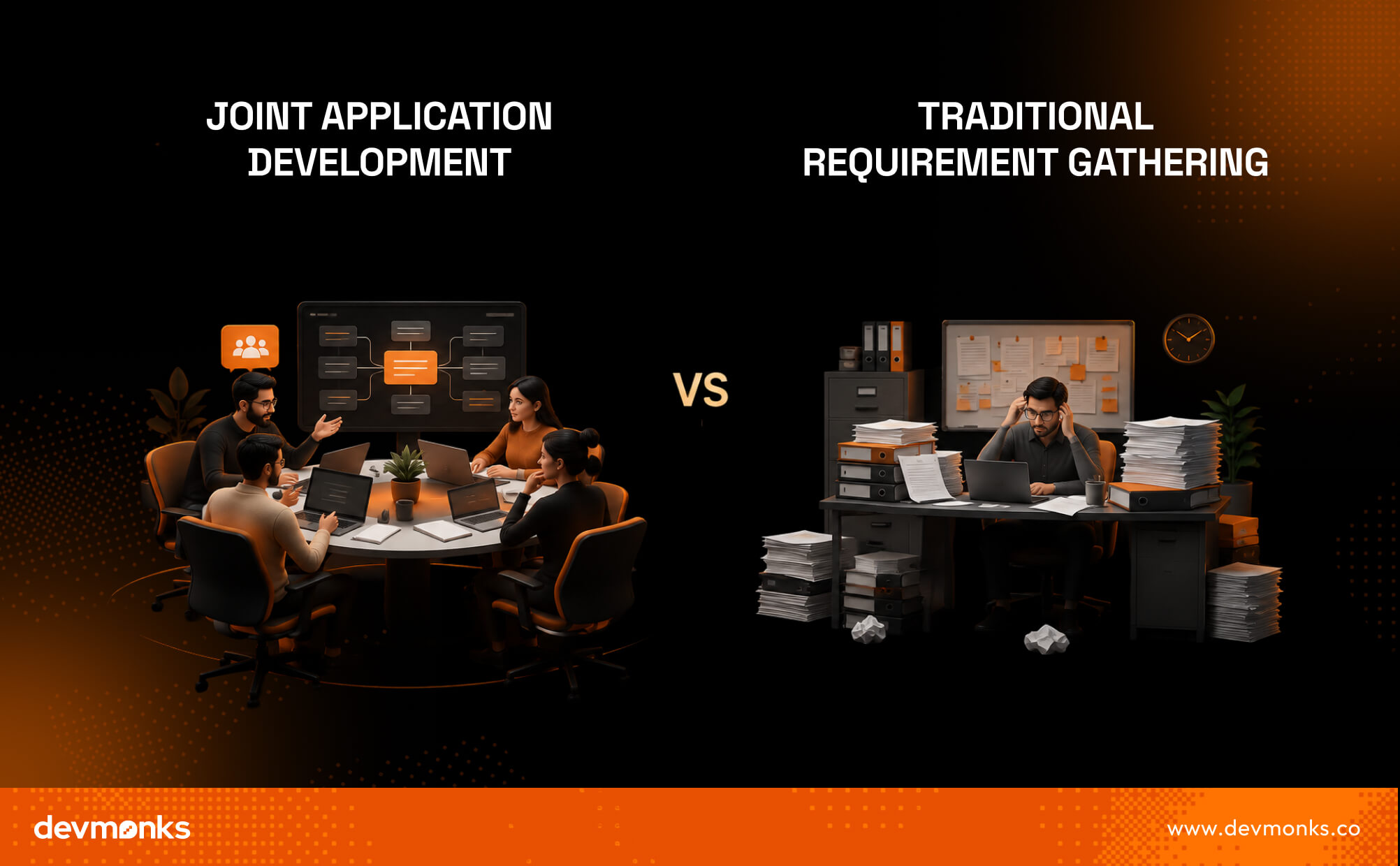
Both Joint Application Development and traditional requirement gathering aim to understand business needs. The main difference is how information is collected.
JAD uses collaborative workshops where everyone discusses requirements together, while traditional analysis gathers information through separate activities over time.
This makes JAD more effective for requirement elicitation when projects require quick decisions and strong collaboration.
JAD is often the preferred choice for large or complex projects because it combines multiple perspectives into one structured workshop, which reduces delays and improves collaboration.
Joint Application Development vs Agile Workshops
Joint Application Development and Agile workshops both encourage collaboration, but they serve different purposes.
JAD focuses on gathering and agreeing on requirements before development begins. Agile workshops support iterative planning and continuous improvement throughout the software development lifecycle.
JAD is ideal for defining clear requirements at the start of a project, while Agile workshops help teams adapt, prioritize, and improve as development progresses. Together, they can create a more efficient and user-focused development process.
Real Example of a JAD Session
A Healthcare company wants to build an appointment booking app for patients. Before development begins, the team holds a JAD workshop to define the project requirements.
- Participants: Product Owner, business users, doctors, reception staff, developers, a Business Analyst, and a Facilitator.
- Objectives: Understand user needs, identify key features, and agree on business goals.
- Workshop Discussion: Participants discuss appointment scheduling, doctor availability, patient notifications, cancellations, and online payments. They also clarify workflows and resolve conflicting ideas.
- Outputs: A prioritized feature list, documented business rules, user workflows, and identified project risks.
- Final Requirements: The team approves the workshop outcome, including functional requirements, project scope, and development priorities before the project moves into the design and development phase.
This practical example shows how JAD helps teams reach agreement faster and reduce misunderstandings
Best Practices for Successful JAD Workshops
Following a few simple best practices can make JAD workshops more productive and help teams gather accurate requirements without unnecessary delays.
- Set clear objectives: Define what the workshop should achieve before it begins.
- Invite decision-makers: Include people who can approve requirements and make important decisions during the session.
- Limit participants: Keep the group focused by inviting only people directly involved in the project.
- Prepare an agenda: Share the discussion topics and goals with participants in advance.
- Use visual collaboration tools: Flowcharts, wireframes, and whiteboards make ideas easier to understand and discuss.
- Document everything: Record requirements, decisions, action items, and unresolved questions throughout the workshop.
- Confirm decisions immediately: Review and approve key decisions before the session ends to avoid confusion and reduce future changes.
These practices help improve collaboration, keep discussions focused, and increase the chances of a successful project.
Joint Application Development delivers the best results when experienced professionals guide the planning process and keep stakeholders aligned.
If you're planning a custom software project and need expert support, partnering with a reliable development agency like Dev Monks can help you turn well-defined requirements into scalable, business-focused solutions.
FAQs
Is JAD still used today?
Yes. JAD is still widely used, especially for enterprise software, ERP implementations, digital transformation projects, and complex business applications. Many organizations also combine JAD with modern development methods to improve requirement gathering and stakeholder collaboration.
Is JAD part of Agile?
No. JAD is not part of Agile, but the two work well together. JAD is mainly used to gather and define requirements before development, while Agile focuses on iterative planning, development, testing, and continuous improvement throughout the project.
How long should a JAD workshop last?
A JAD workshop can last from a few hours to several days, which depends on the project's size and complexity. Small projects may need one session, while larger projects often require multiple workshops to finalize all requirements.
End Note
Joint Application Development is a proven way to gather better requirements, improve collaboration, and reduce costly misunderstandings.
If your project involves multiple stakeholders or complex business needs, JAD can provide a strong foundation for success.
By planning workshops carefully and involving the right people, you can make smarter decisions and deliver software that truly meets user and business expectations.


Frequently Asked Questions
How can I discuss an AI MVP with Dev Monks?

Book a strategy call with your use case, existing systems, and project priorities. The team can help define an initial scope and the dependencies that need to be addressed.
Does using AI replace engineering review?
Dev Monks uses AI-assisted workflows with human-guided decisions. Product requirements, engineering choices, and testing remain part of the development process.
What AI development services does Dev Monks offer?
Dev Monks offers agentic AI solutions, custom language-model solutions, workflow automation, and RAG development. Its broader services include SaaS engineering, MVP development, backend integrations, and web and mobile applications.
Is Dev Monks an official OpenAI Select Partner?
Yes. Dev Monks is now an official OpenAI Select Partner within the OpenAI Partner Network.
How long does it usually take to complete a project?
We combine AI-driven workflows with product-first engineering to provide MVP development services for startups and enterprises. Our approach balances speed, reliability, and usability while keeping teams involved. We deliver production-ready, scalable solutions, not just prototypes or demos.
What makes Dev Monks different from other development companies?
We combine AI-driven workflows with product-first engineering to provide MVP development services for startups and enterprises. Our approach balances speed, reliability, and usability while keeping teams involved. We deliver production-ready, scalable solutions, not just prototypes or demos.
How Involved Will My Team be During Development?
We combine AI-driven workflows with product-first engineering to provide MVP development services for startups and enterprises. Our approach balances speed, reliability, and usability while keeping teams involved. We deliver production-ready, scalable solutions, not just prototypes or demos.
How involved will my team be during development?
We combine AI-driven workflows with product-first engineering to provide MVP development services for startups and enterprises. Our approach balances speed, reliability, and usability while keeping teams involved. We deliver production-ready, scalable solutions, not just prototypes or demos.
Do you develop both web and mobile applications?
We combine AI-driven workflows with product-first engineering to provide MVP development services for startups and enterprises. Our approach balances speed, reliability, and usability while keeping teams involved. We deliver production-ready, scalable solutions, not just prototypes or demos.
How can Dev Monks help my startup launch faster
We combine AI-driven workflows with product-first engineering to provide MVP development services for startups and enterprises. Our approach balances speed, reliability, and usability while keeping teams involved. We deliver production-ready, scalable solutions, not just prototypes or demos.