MVP vs Prototype for Hardware Development: Full Comparison


4 min to read

[ key takeways ]
- A hardware prototype validates technical feasibility, while an MVP validates real-world product value.
- Prototypes test concepts; MVPs combine integrated hardware, firmware, testing, and user feedback.
- Build prototypes when technical risks, design changes, or feasibility questions remain unresolved.
- Build MVPs when core technology works and real-user validation becomes the priority.
- Prototype and MVP services differ in engineering depth, integration, testing, and manufacturing readiness.

A hardware prototype and a hardware MVP are both functional physical products, but they answer different validation questions.
A prototype tests whether the technology, components, and design can work, while an MVP tests whether a working product delivers value to real users.
The difference also affects engineering depth, PCB design, firmware, mechanical integration, testing, BOM optimization, and production readiness.
Knowing where a prototype ends and an MVP begins helps you choose the right development approach, avoid unnecessary engineering costs, and reduce product development risk.
Keep reading to understand the key differences, development services, costs, timelines, and when to build each.
What Is a Hardware Prototype?
A hardware prototype is an early physical model used to test a product before full-scale production. In hardware product development, it helps validate technical feasibility, design, component integration, and basic functionality.
What Is the Main Purpose of a Hardware Prototype?
A prototype answers key engineering questions: Do the components work together? Does the mechanical design function properly? Does the embedded system behave as expected?
Early testing helps uncover technical issues before they become costly problems.
What Does a Hardware Prototype Usually Include?
Prototype development may include development boards, off-the-shelf electronics, sensors, temporary wiring, basic firmware, and experimental mechanical parts.
A 3D-printed enclosure can also help test size, fit, and usability before the design moves toward production.
What Is a Hardware MVP?
A hardware MVP is the minimum functional version of a physical product that delivers its core value to real users.
Unlike a prototype, it is built for real-world testing, customer validation, and early user feedback. It brings together electronics, firmware, mechanical components, and PCB design.
What Is the Purpose of a Hardware MVP?
The question shifts from “Can we make this work?” to “Does this solve a real customer problem?” The goal is to test the product with users and learn what needs improvement.
What Does a Hardware MVP Usually Include?
A hardware MVP may include integrated electronics, a functional PCB, firmware, mechanical components, an enclosure, core UX, reliability testing, an optimized BOM, and testing documentation.
These elements support real-world testing and early market validation.
A reliable development agency like Dev Monks can help teams choose the right approach and manage electronics, firmware, and mechanical development from prototype to MVP.
Hardware Prototype vs MVP: What's the Difference?
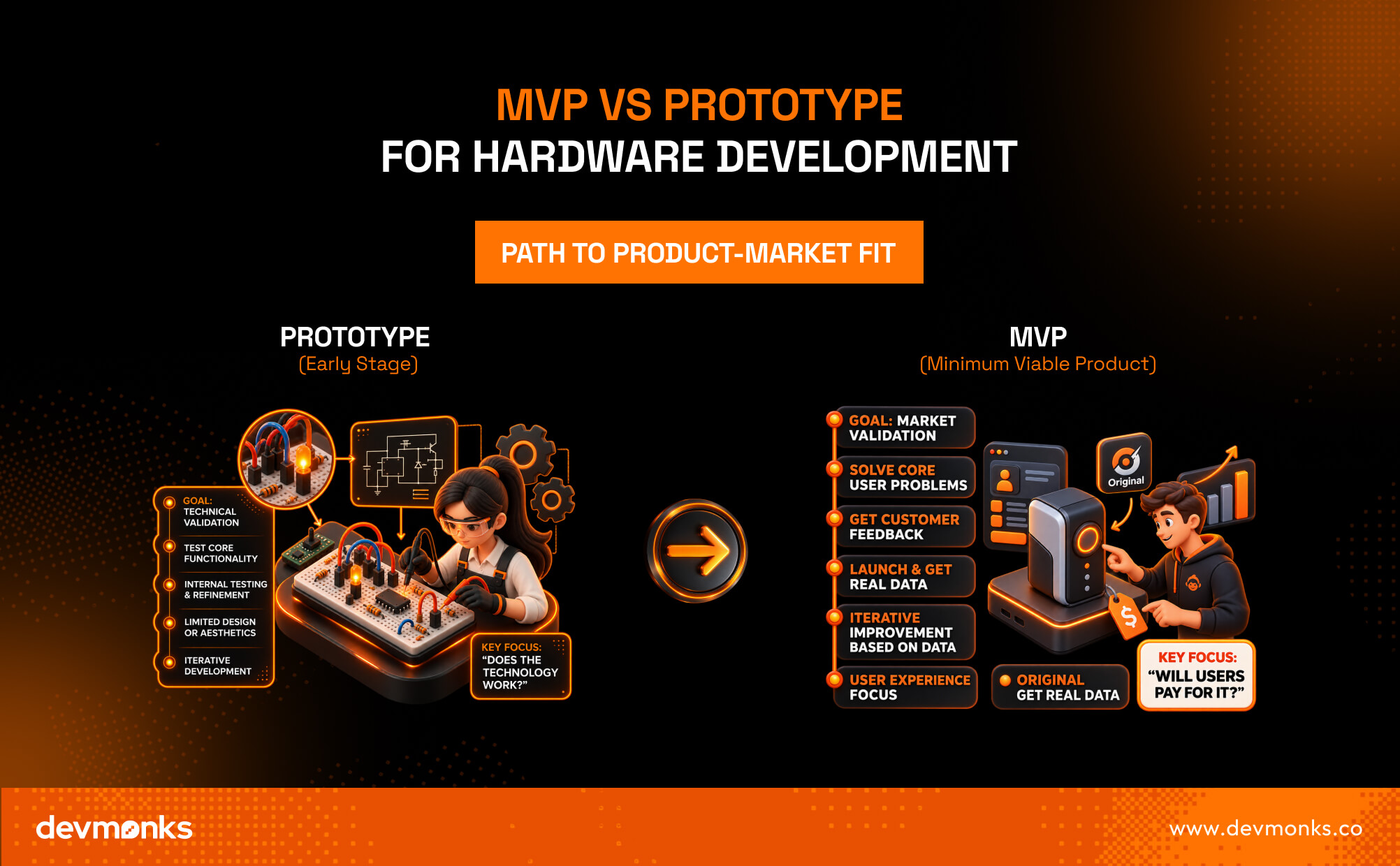
A hardware prototype and a hardware MVP serve different stages of product development. A prototype is mainly built to prove that the technology and design can work.
A hardware MVP is built to prove that a functional product can deliver value to real users. The differences become clearer when you compare their purpose, components, testing, and production readiness.
Prototype vs MVP: The Difference in Development Services
Prototype development services focus on proving the technology, while MVP services focus on building and validating a usable product.
Hardware Prototype Development Services
Prototype services help test technical ideas and identify engineering issues early. Common services include:
- Concept engineering: Turn the idea into a testable technical concept.
- Component selection: Choose suitable sensors, processors, modules, and electronics.
- Rapid prototyping: Build early versions for technical testing.
- Breadboard development: Test circuits without a finalized PCB.
- PCB prototyping: Create early PCBs to verify circuit functionality.
- Mechanical prototyping: Test dimensions, mechanisms, materials, and fit.
- 3D printing: Create quick enclosures, brackets, and mechanical parts.
- Basic firmware: Develop firmware for prototype operation and testing.
- Functional testing: Verify core hardware and software functions.
Hardware MVP Development Services
MVP services turn the validated concept into a functional product for real-world testing. They typically include:
- System architecture: Define how electronics, firmware, and mechanics work together.
- Custom PCB development: Design a functional PCB for MVP requirements.
- Firmware development: Build stable firmware for core functionality.
- Mechanical engineering: Develop components for repeated use.
- Enclosure development: Create a usable, protective enclosure.
- BOM optimization: Refine components for cost, availability, and production.
- Integrated testing: Test hardware, firmware, and mechanics together.
- Reliability testing: Check performance under expected conditions.
- User and pilot testing: Gather feedback from selected users.
- DFM preparation: Prepare the design for efficient manufacturing.
How Hardware MVP Development Differs Technically From Prototyping
Hardware prototyping proves the technology works, while MVP development turns that concept into an integrated, reliable, and production-oriented product.
Electronics and PCB Design
A prototype may use development boards, breakout modules, and temporary wiring. An MVP typically moves toward a custom or integrated PCB design for better reliability, fewer connections, and easier manufacturing.
Firmware Development
Prototype firmware usually tests specific functions. An MVP needs stable firmware that supports the core workflow, handles errors, manages device states, and enables communication across the embedded system.
Mechanical Design and Enclosure
MVP mechanical design considers ergonomics, durability, thermal management, connector placement, component access, and everyday usability. The enclosure must support real product use, not just hold components.
BOM and Component Selection
The BOM becomes more important as production approaches. Teams evaluate cost, availability, lifecycle, lead times, alternatives, and supply-chain risks to avoid costly redesigns.
Testing and Reliability
Prototype testing proves functionality in controlled conditions. MVP testing includes realistic operating conditions, integrated testing, reliability checks, and pilot use. This provides stronger engineering validation before wider deployment.
Hardware Prototype vs MVP: Cost and Timeline Differences
A hardware prototype usually needs fewer engineering hours, while an MVP requires more time and investment because it must support real-world use and validation.
Why Hardware MVPs Usually Cost More Than Prototypes
A hardware MVP involves more engineering work across the product development process. Costs can increase because of:
- Multiple engineering disciplines
- Greater system integration
- Custom electronics and PCB design
- More mature firmware
- Mechanical refinement and enclosure development
- Reliability and integrated testing
- Technical documentation
- BOM and component optimization
What Determines Hardware Prototype Cost?
Prototype cost depends mainly on the scope and number of iterations. Key factors include:
- Product complexity
- Number of components
- Prototype quantity
- PCB complexity
- Mechanical requirements
- Number of design iterations
What Determines Hardware MVP Cost?
MVP costs expand as the product moves beyond technical validation. The scope may include system integration, reliable firmware, custom electronics, mechanical refinement, user testing, production-oriented design, and DFM preparation.
The required engineering hours, component choices, testing depth, and number of iterations all affect the final hardware product development cost. For this reason, there is no reliable universal price for a hardware MVP.
When Should You Build a Hardware Prototype First?
Build a hardware prototype first when technical uncertainty or design risk makes an MVP premature.
When Technical Feasibility Is Uncertain
Use a prototype when you need to prove whether the technology, components, or hardware architecture will work. It helps identify technical risks before deeper development.
When You Need to Test Form or Function
Prototypes help test dimensions, ergonomics, sensor placement, mechanical movement, heat, connectors, and component integration before finalizing the design.
When You Expect Major Design Changes
If major changes are likely, flexible prototypes let teams test different components and designs without committing to production-oriented engineering. This reduces costly rework later.
When Should You Build a Hardware MVP?
Build a hardware MVP when the core technology is proven, and you need real users to validate the product.
When the Core Technology Is Proven
Move to an MVP once key technical risks are resolved and the product can deliver its core functionality reliably.
When You Need Real User Feedback
An MVP puts the product in the hands of early users for customer feedback, field testing, and product validation. Their experience helps identify improvements before wider launch.
When You Need a Functional Investor or Pilot Demo
A hardware MVP can provide a working product for investor presentations, pilot customers, and controlled field or lab testing. It demonstrates more than a technical concept and helps validate the product in realistic conditions.
Prototype to MVP: The Hardware Development Process
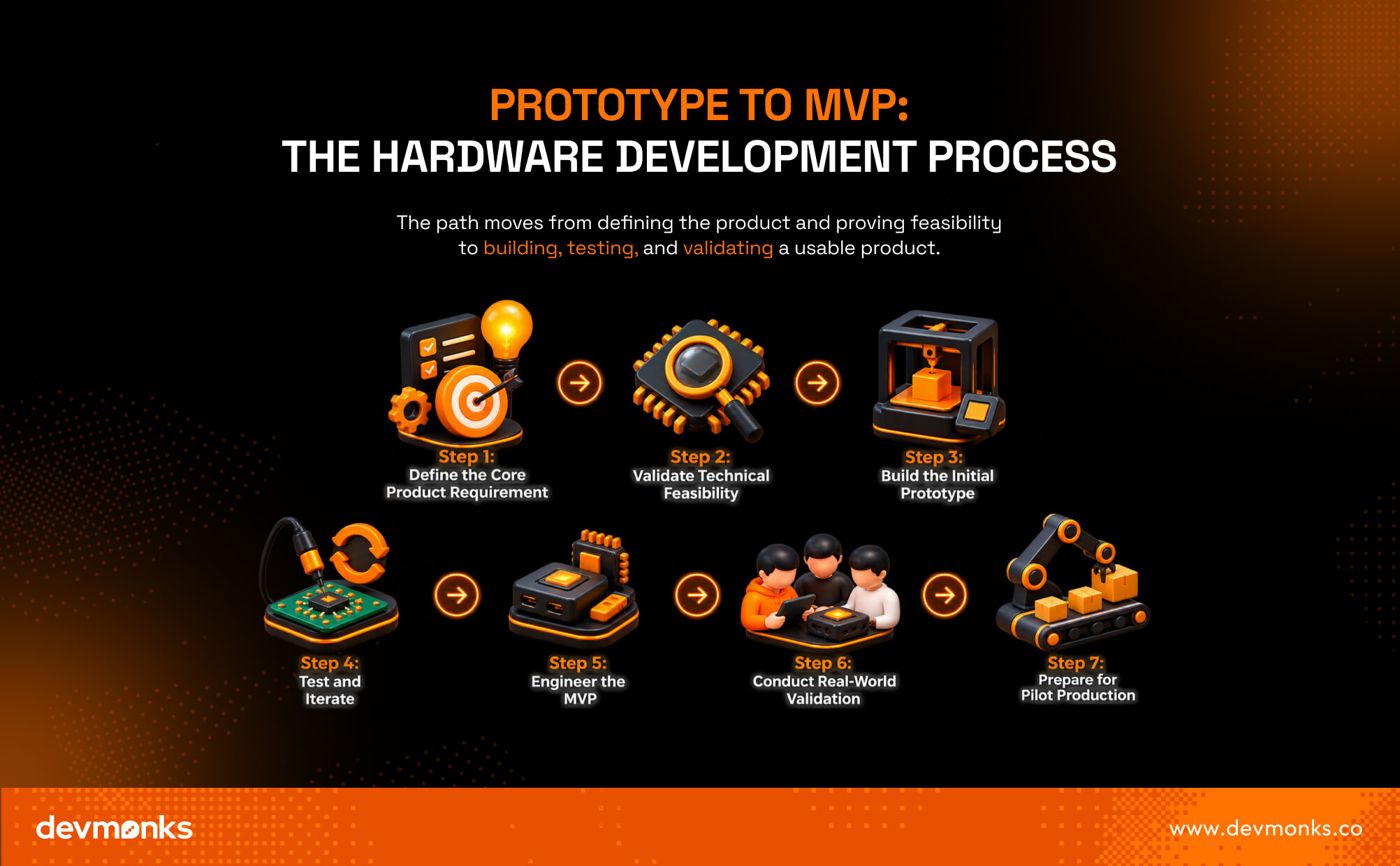
The path from prototype to MVP moves from defining the product and proving feasibility to building, testing, and validating a usable product.
Step 1: Define the Core Product Requirement
Identify the target user, core problem, essential features, and key technical requirements. This gives the hardware product development process a clear direction.
Step 2: Validate Technical Feasibility
Use a PoC or early experiments to test critical technologies, components, and system assumptions before investing in full development.
Step 3: Build the Initial Prototype
Create a hardware prototype using suitable development boards, electronics, mechanical parts, and basic firmware to prove the core concept.
Step 4: Test and Iterate
Test the prototype, identify failures, and refine the design. Repeat engineering iterations until major technical risks are resolved.
Step 5: Engineer the MVP
Develop the hardware MVP with integrated electronics, functional firmware, refined mechanics, enclosure, optimized BOM, and stronger reliability.
Step 6: Conduct Real-World Validation
Put the MVP through field testing with selected users or pilot customers. Collect feedback and improve the product based on actual use.
Step 7: Prepare for Pilot Production
Finalize documentation, manufacturing requirements, and DFM improvements before moving into pilot production.
Do You Need a PoC Before a Hardware Prototype or MVP?
A Proof of Concept (PoC) is useful when you need to confirm technical feasibility before investing in a full prototype.
However, not every hardware project needs a separate PoC. The right starting point depends on how much technical uncertainty exists.
PoC vs Prototype vs MVP
The three stages answer different questions:
- PoC → Can the technology work? Tests a critical technical assumption.
- Prototype → Can we build and refine the product? Combines components to test design and functionality.
- MVP → Will the working product deliver value to real users? Tests the product with early users for real-world validation.
In simple terms, a PoC proves the technology, a Hardware Prototype proves the design, and a Hardware MVP validates the product.
Common Mistakes When Choosing Between Prototype and MVP
Choosing the wrong development stage can increase development risk, cause scope creep, and create unnecessary costs. Avoid these common mistakes:
- Calling a breadboard demo an MVP: A basic demonstration does not necessarily deliver a complete user experience.
- Building an MVP before validating technical feasibility: Resolve major technical risks before investing in full product development.
- Overengineering the prototype: Do not spend heavily on production-level components before proving the concept.
- Adding too many MVP features: Keep the MVP focused on essential functionality and product validation.
- Ignoring component availability: Check supply, lead times, lifecycle, and alternatives early.
- Skipping firmware planning: Firmware affects hardware architecture and should be considered from the start.
- Treating a prototype as production-ready: A working prototype still needs reliability and manufacturing preparation.
- Ignoring manufacturing constraints: Consider DFM, assembly, sourcing, and production requirements before scaling.
How to Choose the Right Hardware Development Service
Choose prototype services for technical validation and hardware MVP services when you need a user-ready product for real-world validation.
Choose Prototype Development Services If...
- Your technology is still uncertain.
- You need to test physical design or functionality.
- You expect significant design iterations.
- You need engineering proof before further investment.
Choose Hardware MVP Development Services If...
- Core functionality has been proven.
- You need real-user testing or customer feedback.
- You need a functional investor demo.
- You are preparing for pilot deployment.
- You need integrated hardware, firmware, and software.
Questions to Ask a Hardware Development Company
Before choosing a development partner, ask:
- Do you handle electronics and mechanical engineering?
- Do you develop firmware?
- Can you provide custom PCB design?
- How do you optimize the BOM?
- Do you support DFM and pilot manufacturing?
- Can you provide testing documentation?
- How many prototype iterations are included?
For teams seeking end-to-end engineering support, Dev Monks is a reliable development agency for turning validated hardware concepts into functional, market-ready products.
FAQs
Is a hardware MVP production-ready?
Not necessarily. A hardware MVP is built for real-world validation, not full-scale manufacturing. It may still require further reliability testing, design refinement, certification, DFM, and production optimization before commercial launch.
Can a prototype use off-the-shelf components?
Yes. Prototypes often use development boards, sensors, modules, and other off-the-shelf components to test functionality quickly. This approach reduces early development effort and makes it easier to change components during technical validation.
Does a hardware MVP need a custom PCB?
Not always. An MVP can use development boards if they meet the product requirements. However, a custom PCB may improve integration, reliability, size, cost, and production readiness when the product moves beyond early testing.


Frequently Asked Questions
Does a hardware MVP need a custom PCB?

Not always. An MVP can use development boards if they meet the product requirements. However, a custom PCB may improve integration, reliability, size, cost, and production readiness when the product moves beyond early testing.
Can a prototype use off-the-shelf components?
Yes. Prototypes often use development boards, sensors, modules, and other off-the-shelf components to test functionality quickly. This approach reduces early development effort and makes it easier to change components during technical validation.
Is a hardware MVP production-ready?
Not necessarily. A hardware MVP is built for real-world validation, not full-scale manufacturing. It may still require further reliability testing, design refinement, certification, DFM, and production optimization before commercial launch.
How can I discuss an AI MVP with Dev Monks?
Book a strategy call with your use case, existing systems, and project priorities. The team can help define an initial scope and the dependencies that need to be addressed.
Does using AI replace engineering review?
Dev Monks uses AI-assisted workflows with human-guided decisions. Product requirements, engineering choices, and testing remain part of the development process.
What AI development services does Dev Monks offer?
Dev Monks offers agentic AI solutions, custom language-model solutions, workflow automation, and RAG development. Its broader services include SaaS engineering, MVP development, backend integrations, and web and mobile applications.
Is Dev Monks an official OpenAI Select Partner?
Yes. Dev Monks is now an official OpenAI Select Partner within the OpenAI Partner Network.
How long does it usually take to complete a project?
We combine AI-driven workflows with product-first engineering to provide MVP development services for startups and enterprises. Our approach balances speed, reliability, and usability while keeping teams involved. We deliver production-ready, scalable solutions, not just prototypes or demos.
What makes Dev Monks different from other development companies?
We combine AI-driven workflows with product-first engineering to provide MVP development services for startups and enterprises. Our approach balances speed, reliability, and usability while keeping teams involved. We deliver production-ready, scalable solutions, not just prototypes or demos.
How Involved Will My Team be During Development?
We combine AI-driven workflows with product-first engineering to provide MVP development services for startups and enterprises. Our approach balances speed, reliability, and usability while keeping teams involved. We deliver production-ready, scalable solutions, not just prototypes or demos.
How involved will my team be during development?
We combine AI-driven workflows with product-first engineering to provide MVP development services for startups and enterprises. Our approach balances speed, reliability, and usability while keeping teams involved. We deliver production-ready, scalable solutions, not just prototypes or demos.
Do you develop both web and mobile applications?
We combine AI-driven workflows with product-first engineering to provide MVP development services for startups and enterprises. Our approach balances speed, reliability, and usability while keeping teams involved. We deliver production-ready, scalable solutions, not just prototypes or demos.
How can Dev Monks help my startup launch faster
We combine AI-driven workflows with product-first engineering to provide MVP development services for startups and enterprises. Our approach balances speed, reliability, and usability while keeping teams involved. We deliver production-ready, scalable solutions, not just prototypes or demos.