How to Develop an MVP: Complete 10-Step Guide


4 min to read

[ key takeways ]
- MVP development helps validate ideas before investing in full-scale product development.
- A successful MVP focuses on solving one core customer problem.
- Startups use MVPs to reduce risks, costs, and development time.
- Feature prioritization helps teams build valuable MVPs faster.
- User feedback guides MVP improvements and long-term product success.

Developing an MVP starts with identifying a problem, building essential features, testing the idea with real users, and improving the product based on feedback.
A Minimum Viable Product (MVP) is the first working version of a product that helps businesses validate demand before investing heavily in full-scale development.
Understanding how to develop an MVP helps startups reduce costs, avoid unnecessary features, and create products that match customer needs.
Whether you are launching a new app or testing a business idea, a clear MVP strategy can improve your chances of success. Keep reading to explore the complete MVP development process.
What Is an MVP (Minimum Viable Product)?
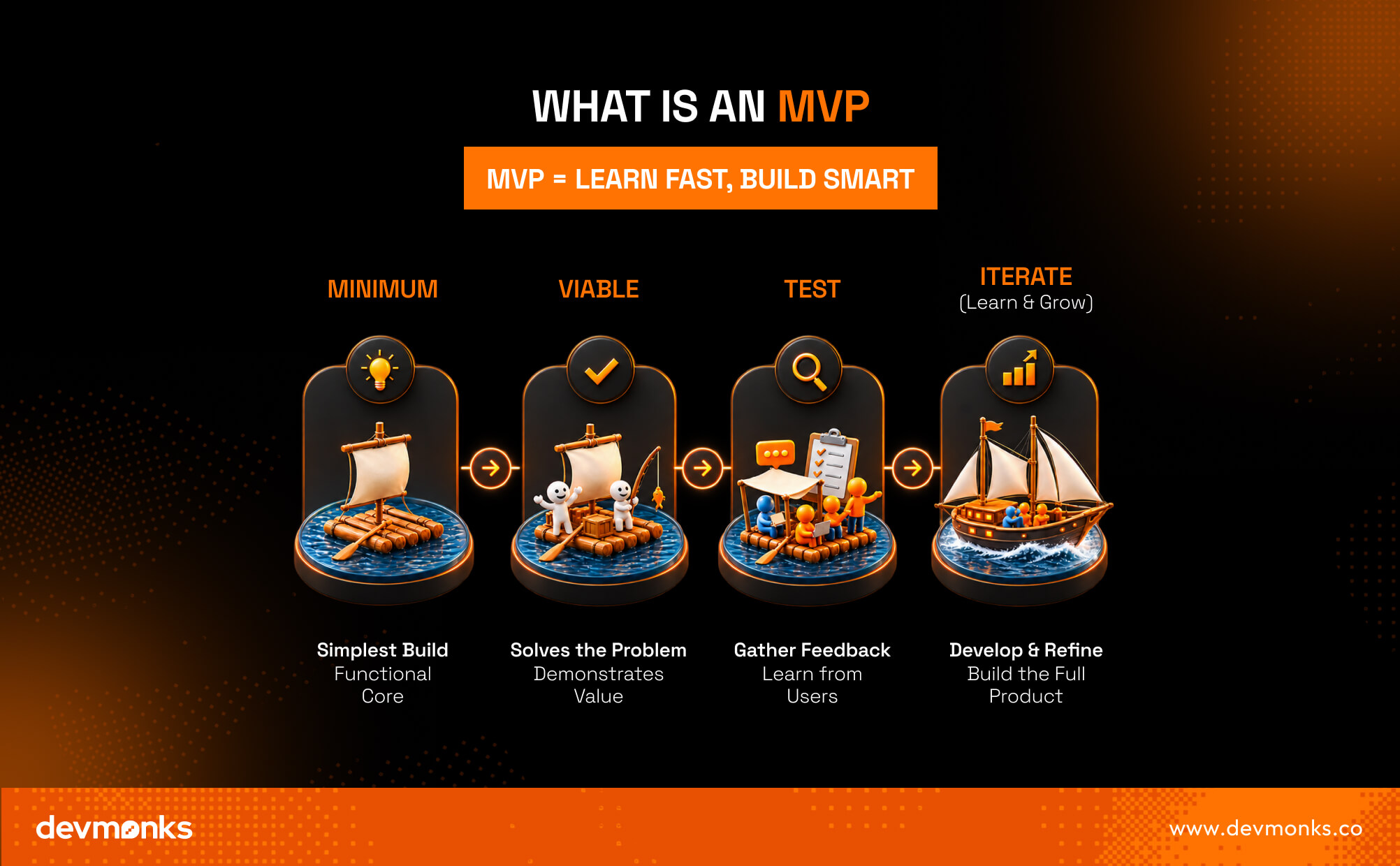
A Minimum Viable Product (MVP) is the simplest working version of a product that solves one real problem for users. It includes only the essential features needed to deliver value and collect feedback.
Instead of building a complete product, a startup launches an MVP first to test demand, improve the idea, and make better decisions.
This approach, popularized by the Lean Startup methodology, focuses on product validation before investing heavily in product development.
The meaning of MVP is building the first product version that helps businesses learn from real users. Unlike a fully developed MVP software product, an MVP is designed to test assumptions and guide future improvements.
Choosing the right development agency plays a crucial role in turning an MVP idea into a market-ready product.
Dev Monks helps startups build scalable MVP solutions with expert development support, which ensures faster validation and a strong foundation for future growth.
Why Startups Build MVPs
The Lean Startup approach encourages businesses to validate a product idea before investing significant time and money. An MVP reduces risk, supports market validation, and helps teams improve the product faster through real customer feedback.
Understanding the basics of application development helps businesses create MVPs with the right features, technology choices, and user experience strategies from the beginning.
MVP vs Prototype vs Proof of Concept
Why MVP Development Matters
MVP development helps businesses test ideas before making a large investment. Instead of building a full product, a startup launches a simple version to validate a business idea, collect customer feedback, and improve it based on real user needs.
This approach helps reduce development risk, speeds up decision-making, and moves businesses closer to Product Market Fit. By learning from early users, companies can build products that people actually want.
Validate Market Demand
An MVP lets businesses test demand before investing heavily. Feedback from early users shows what works, what doesn't, and which features customers truly value.
Reduce Development Cost
Building only the essential functionality saves time and money. Teams avoid spending resources on unnecessary features and focus on solving the main problem first.
Reach Market Faster
An MVP shortens development time by releasing a working product with core features. Faster launches help businesses gather feedback sooner and improve the product through quick release cycles.
Attract Investors
A product with active users and positive traction is more appealing to investors. Real customer feedback, growing engagement, and early market validation show that the business has potential, making fundraising easier and increasing investor confidence.
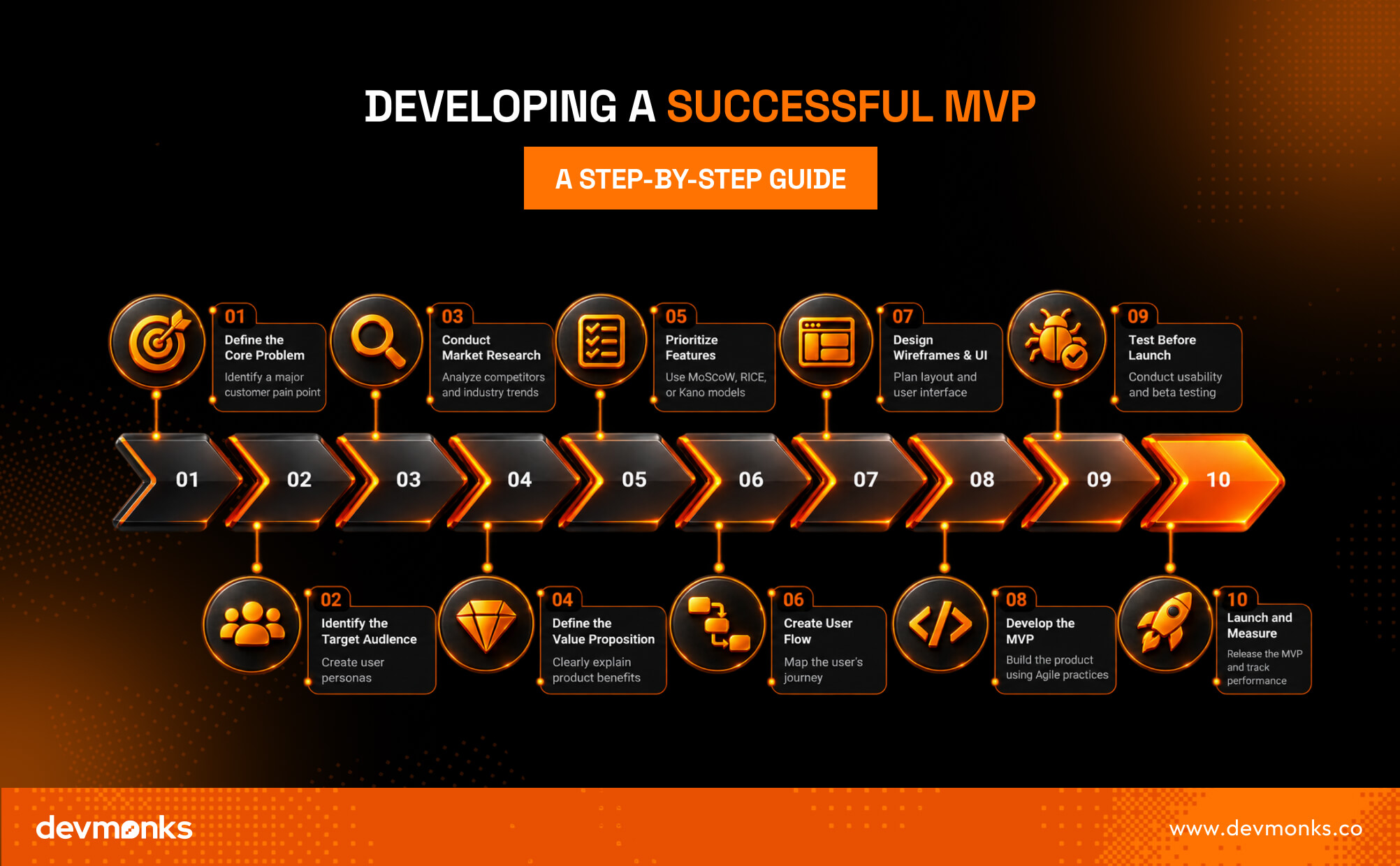
Step-by-Step Process to Develop an MVP
A successful MVP process is about building the right product, not just building it quickly. Following a structured software development lifecycle also keeps the development process organized and aligned with business goals.
Step 1: Define the Core Problem
The first step is identifying one major customer pain point. Talk to potential users, study their challenges, and understand what problem they need solved. A successful build MVP strategy focuses on solving one problem really well instead of trying to solve everything.
Step 2: Identify the Target Audience
Next, know who your product is for. Create user personas based on age, goals, behaviors, and challenges. Good user research helps you design features that match real customer needs.
Step 3: Conduct Market Research
You must study your competitors to see what they offer and where they fall short. Analyze industry trends and conduct customer interviews to understand user expectations. This research helps you find opportunities to stand out.
Step 4: Define the Value Proposition
Clearly explain why customers should choose your product over other options. Your value proposition should communicate the main benefit in one simple message and show how your solution solves the user's problem better.
Step 5: Prioritize Features
After that, prioritize the features you should have. Not every feature belongs in an MVP. Use the MoSCoW Method to separate must-have and nice-to-have features.
The RICE Framework helps rank ideas based on reach, impact, confidence, and effort, while the Kano Model identifies features that create the greatest customer satisfaction. Effective feature prioritization keeps the MVP simple and focused.
Step 6: Create User Flow
Map the user's journey before designing screens. A clear user flow shows how people move through the product and helps remove unnecessary steps that could create confusion.
Step 7: Design Wireframes & UI
After creating the user flow, go on to designing the wireframes and UI. Start with low-fidelity wireframes to plan the layout and user journey.
Then create high-fidelity designs with colors, branding, and interactions. A clean UI design makes the product easier and more enjoyable to use.
Step 8: Develop the MVP
The next step is to build the product using Agile Development practices. Many teams follow Scrum, dividing work into short sprints to release features, gather feedback, and improve the product continuously.
This approach makes development faster and more flexible.
Step 9: Test Before Launch
After developing, test the product carefully before release. Conduct usability testing to evaluate the user experience, perform QA to fix bugs, and run beta testing with real users to collect valuable feedback before the public launch.
Step 10: Launch and Measure
Finally, launch the MVP, monitor user behavior, and measure key performance indicators (KPIs). Tools like Google Analytics and Mixpanel help track user engagement, retention, and conversions.
Use these insights to update your Product Roadmap, improve the product, and continue building features that deliver real value.
Essential Features Every MVP Should Include
An MVP should focus on core functionality, not a long list of extras. The goal is to solve one problem with the essential features users need most.
First, write each User Story to understand what customers want to achieve. Then organize ideas in a Product Backlog and use feature prioritization to decide what belongs in the first release.
Keeping the MVP simple reduces development time, lowers costs, and makes it easier to collect meaningful user feedback.
Must-have Features
- Features that solve the main customer problem
- Simple and intuitive user interface
- User registration or login (if required)
- Basic security and data protection
- Feedback or contact option for users
Nice-to-have Features
- Personalized recommendations
- Social sharing options
- Advanced search and filters
- Push notifications
- Dark mode or theme customization
Features to Avoid
- Complex integrations in the first release
- Rarely used premium features
- Too many customization options
- Advanced analytics dashboards
- Features added without user demand
- Anything that does not support the product's primary goal
MVP Development Methodologies
Choosing the right development approach helps teams build an MVP faster and with less risk. Most businesses use proven frameworks that support iterative development, encourage continuous feedback, and improve decision-making.
Whether you're planning an agile MVP or validating a new idea, these methodologies make sprint planning and product improvement more effective.
Lean Startup
The Lean Startup approach focuses on building, measuring, and learning. Teams launch a simple product, gather user feedback, and improve it based on real market data instead of assumptions.
Agile Development
Agile breaks development into small, manageable stages. Teams release updates frequently, collect feedback, and make continuous improvements throughout the project.
Scrum Framework
Scrum is a popular Agile framework that organizes work into short sprints. Regular planning meetings, reviews, and daily collaboration help teams deliver features quickly while adapting to changing user needs.
Design Sprint
A Design Sprint is a structured process used to validate ideas before development begins.
In just a few days, teams define the problem, create solutions, build a prototype, and test it with users. This helps reduce uncertainty and ensures the MVP starts with the right direction.
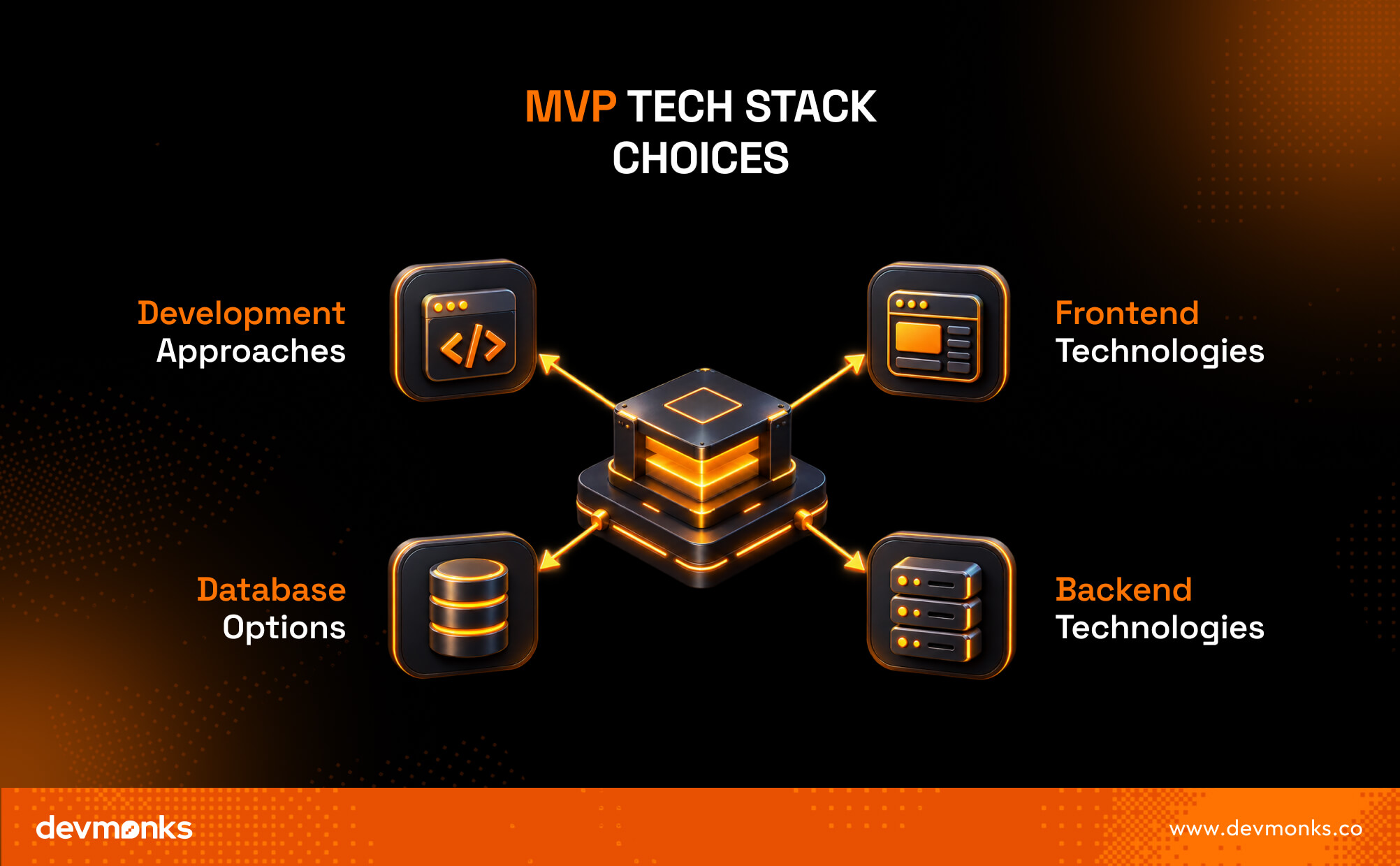
Choosing the Right Tech Stack for MVP Development
The right MVP tech stack depends on your budget, timeline, and future growth plans. Choose technologies that help you launch quickly while allowing the product to scale as your user base grows.
A balanced frontend and backend setup also makes development faster and maintenance easier.
Frontend Technologies
React is a popular choice for web applications because it is fast, flexible, and easy to scale. Flutter is ideal for building cross-platform mobile apps from a single codebase.
Backend Technologies
Node.js is a reliable backend framework for developing fast, real-time applications. It works well with modern APIs and supports rapid MVP development.
Database Options
Firebase provides a cloud database, authentication, and hosting, which makes it an excellent choice for MVPs that need quick development and simple management.
No-code vs Custom Development
No-code platforms help validate ideas quickly with minimal cost. Custom development offers greater flexibility, performance, and scalability for products with long-term growth plans.
For businesses looking to build a scalable MVP with the right technology choices, partnering with an experienced development agency can simplify the process.
Dev Monks helps startups select suitable tech stacks and develop high-performing MVP solutions customized to their business goals and future growth.
MVP Development Timeline
The exact development timeline depends on your product's complexity, team size, and feature requirements. However, most MVPs can be planned, built, and launched within 8 to 16 weeks.
- Planning & research: 1–2 weeks to define goals, validate the idea, and understand user needs.
- UI/UX design: 1–2 weeks to create user flows, wireframes, and interface designs.
- Development: 4–8 weeks to build the core features and integrate essential functionality.
- Testing: 1–2 weeks for QA, usability testing, and bug fixes.
- Launch: A few days to deploy the MVP, monitor performance, and collect user feedback for future improvements.
MVP Development Cost
The MVP cost depends on the product's complexity, development team, and location. A simple MVP with basic features generally costs $5,000–$15,000.
A medium MVP with user accounts, integrations, and custom functionality may range from $15,000–$50,000. A complex MVP with advanced features, AI, or real-time systems can exceed $50,000–$150,000+.
Hiring a Freelancer is often more affordable, while a Development Agency provides a complete team and faster execution.
Don't forget hidden costs such as UI/UX design, third-party tools, cloud hosting, maintenance, security updates, and ongoing product improvements after launch.
Common MVP Development Mistakes
Many businesses make MVP mistakes that increase costs, delay launches, and reduce the chances of success. Avoiding these common startup mistakes can help you build a better product and learn faster.
- Adding too many features: Trying to build everything at once makes the MVP expensive and slows development.
- Skipping validation: Building without testing the idea can result in a product that nobody wants.
- Ignoring user feedback: Early users provide valuable insights. Failing to act on their feedback limits product improvement.
- Poor user experience (UX): Even a simple MVP should be easy to use. A confusing interface can drive users away.
- Weak analytics: Without tracking user behavior and key metrics, it's difficult to understand what works and what needs improvement after launch.
Real MVP Examples
Many successful companies started with simple MVPs that solved one problem before expanding. These examples show how testing ideas early can lead to long-term growth.
Airbnb
Airbnb began as a basic website where the founders rented out air mattresses in their apartment to validate demand for short-term home rentals.
Dropbox
Instead of building a complete product, Dropbox launched with a simple demo video. It explained how the service worked and helped validate user interest before full development.
Uber
Uber started as a basic app that let users book rides from a small group of drivers in one city. After proving demand, it expanded to new markets and services.
Spotify
Spotify launched with a simple music streaming platform focused on fast, legal access to songs. Once users responded positively, it added more features, content, and global availability.
How to Measure MVP Success
After launching your MVP, track the right product metrics to understand user behavior and identify areas for improvement. Tools like Google Analytics, Mixpanel, and Amplitude make it easier to monitor performance.
- User engagement: Measure how often users interact with your product and its core features.
- Retention rate: Track how many users return after their first visit.
- Churn: Monitor the percentage of users who stop using your product.
- Conversion: Measure how many users complete key actions, such as signing up or making a purchase.
- Customer feedback: Collect user insights to guide future updates and improve the product.
When Should You Move Beyond an MVP?
It's time to move beyond your MVP when you see clear signs that the product is ready to grow. Key indicators include:
- Achieve Product-Market Fit (PMF): Users consistently find value in your product and actively use it.
- Stable Retention Rate: Customers continue returning and using the product over time.
- Steady Revenue Growth: Sales and recurring revenue show that the business model is working.
- Secure Funding: Investor support provides the resources needed to expand the product and team.
- Strong Customer Feedback: Users request improvements and additional features instead of questioning the core idea.
- Scalable Infrastructure: Your technology and team are ready to handle more users and future growth.
Once an MVP validates your idea and gains user traction, the next step is improving features, performance, and scalability.
Many growing businesses move toward customized software development for scaleups to build solutions that support long-term expansion.
AI-Assisted MVP Development
AI tools can speed up MVP development by reducing repetitive work and helping teams build faster. For example, ChatGPT can generate user stories, brainstorm features, and create documentation.
GitHub Copilot helps developers write code faster by suggesting functions and completing repetitive code. Cursor supports AI-powered coding, debugging, and code explanations, improving developer productivity.
Designers can also use AI to create wireframes and content drafts, while testers can generate test cases more efficiently.
However, AI cannot replace product validation. Real user feedback, market testing, and customer insights are still essential for building an MVP that solves the right problem.
MVP Development Checklist
Use this checklist to make sure your MVP is ready for launch:
- Clearly define the core problem your product solves.
- Identify your target audience and create user personas.
- Validate the idea through market research and customer interviews.
- Prioritize only the must-have features.
- Create user flows, wireframes, and UI designs.
- Build and test the MVP using an Agile approach.
- Fix bugs through QA and beta testing.
- Set up analytics to track key metrics after launch.
- Prepare a launch plan and collect user feedback.
- Update your product roadmap based on real customer insights and data.
FAQs
What Comes After an MVP?
After an MVP, the focus shifts to improving the product using real user feedback and data. Teams add valuable features, optimize performance, fix usability issues, and work toward achieving product-market fit before scaling the product for a larger audience.
Can No-Code Tools Build an MVP?
Yes, no-code tools can build an MVP for many business ideas. They help launch products quickly and at a lower cost. However, custom development is often a better choice when you need advanced features, scalability, or complex integrations.
What's the Difference Between an MVP and a Prototype?
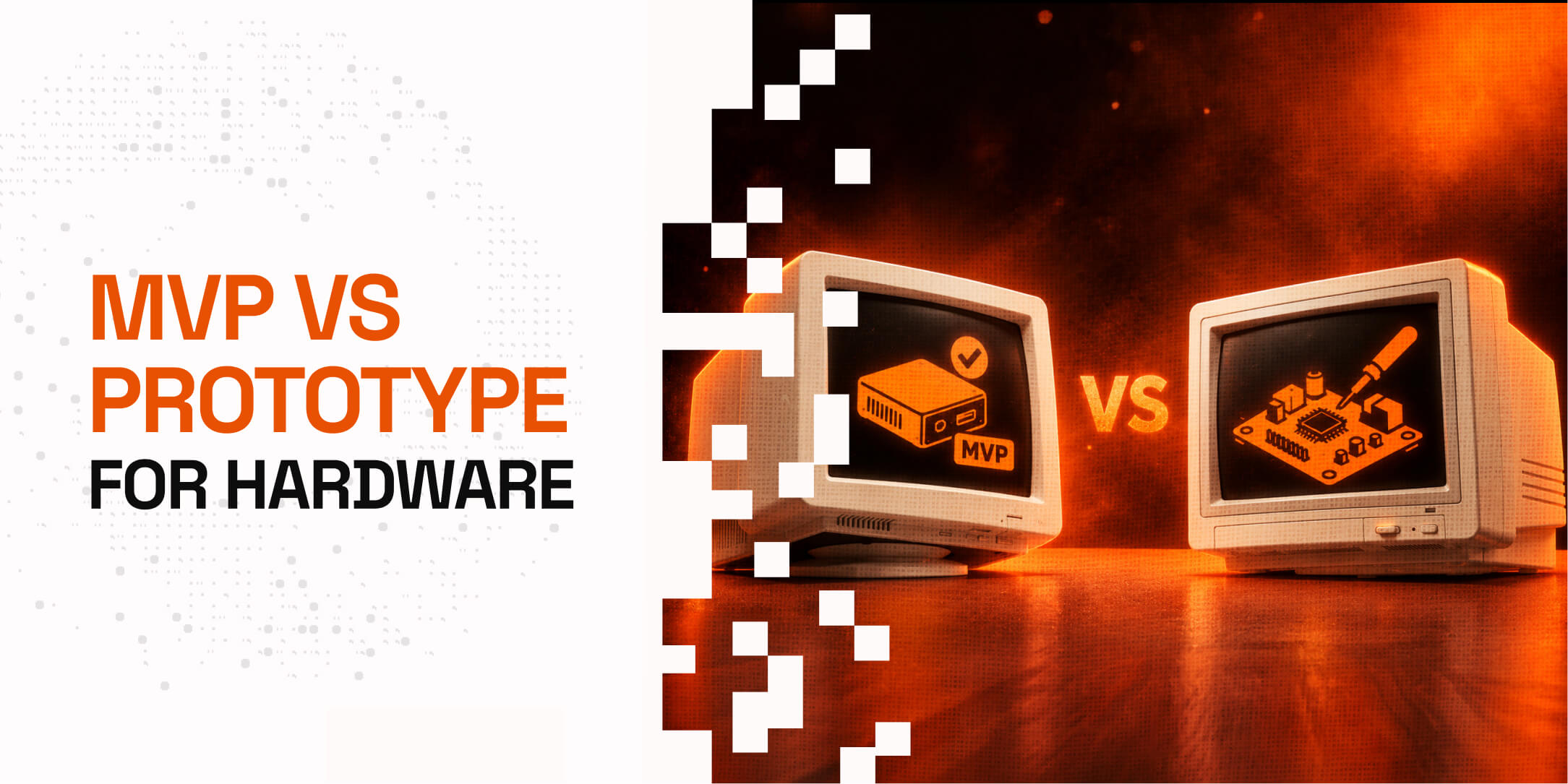
A prototype demonstrates how a product will look or function but is not intended for real users. An MVP is a working product with core features that is launched to customers to validate demand, collect feedback, and guide future development.
End Note
Building an MVP helps businesses test ideas, reduce risks, and create products based on real user needs.
By focusing on core features, collecting feedback, and improving continuously, startups can build solutions that have a higher chance of success. Start small, validate your idea, and use every insight to create a product your customers truly value.


Frequently Asked Questions
Does a hardware MVP need a custom PCB?

Not always. An MVP can use development boards if they meet the product requirements. However, a custom PCB may improve integration, reliability, size, cost, and production readiness when the product moves beyond early testing.
Can a prototype use off-the-shelf components?
Yes. Prototypes often use development boards, sensors, modules, and other off-the-shelf components to test functionality quickly. This approach reduces early development effort and makes it easier to change components during technical validation.
Is a hardware MVP production-ready?
Not necessarily. A hardware MVP is built for real-world validation, not full-scale manufacturing. It may still require further reliability testing, design refinement, certification, DFM, and production optimization before commercial launch.
How can I discuss an AI MVP with Dev Monks?
Book a strategy call with your use case, existing systems, and project priorities. The team can help define an initial scope and the dependencies that need to be addressed.
Does using AI replace engineering review?
Dev Monks uses AI-assisted workflows with human-guided decisions. Product requirements, engineering choices, and testing remain part of the development process.
What AI development services does Dev Monks offer?
Dev Monks offers agentic AI solutions, custom language-model solutions, workflow automation, and RAG development. Its broader services include SaaS engineering, MVP development, backend integrations, and web and mobile applications.
Is Dev Monks an official OpenAI Select Partner?
Yes. Dev Monks is now an official OpenAI Select Partner within the OpenAI Partner Network.
How long does it usually take to complete a project?
We combine AI-driven workflows with product-first engineering to provide MVP development services for startups and enterprises. Our approach balances speed, reliability, and usability while keeping teams involved. We deliver production-ready, scalable solutions, not just prototypes or demos.
What makes Dev Monks different from other development companies?
We combine AI-driven workflows with product-first engineering to provide MVP development services for startups and enterprises. Our approach balances speed, reliability, and usability while keeping teams involved. We deliver production-ready, scalable solutions, not just prototypes or demos.
How Involved Will My Team be During Development?
We combine AI-driven workflows with product-first engineering to provide MVP development services for startups and enterprises. Our approach balances speed, reliability, and usability while keeping teams involved. We deliver production-ready, scalable solutions, not just prototypes or demos.
How involved will my team be during development?
We combine AI-driven workflows with product-first engineering to provide MVP development services for startups and enterprises. Our approach balances speed, reliability, and usability while keeping teams involved. We deliver production-ready, scalable solutions, not just prototypes or demos.
Do you develop both web and mobile applications?
We combine AI-driven workflows with product-first engineering to provide MVP development services for startups and enterprises. Our approach balances speed, reliability, and usability while keeping teams involved. We deliver production-ready, scalable solutions, not just prototypes or demos.
How can Dev Monks help my startup launch faster
We combine AI-driven workflows with product-first engineering to provide MVP development services for startups and enterprises. Our approach balances speed, reliability, and usability while keeping teams involved. We deliver production-ready, scalable solutions, not just prototypes or demos.