How to Develop AI Applications in 2026: Complete 9-Step Guide
.png)

.svg)
[ key takeways ]
- Define clear business goals before choosing AI models or development tools.
- High-quality data directly improves AI accuracy, reliability, and long-term performance.
- Select technologies based on your application's features, scalability, and budget.
- Test, monitor, and refine AI applications continuously after deployment.
- Partner with experienced developers to build secure, scalable AI applications.
.svg)
To develop an AI application, define the problem you want to solve, collect and prepare quality data, choose the right AI model, build and test the application, deploy it, and continuously improve it using real-world feedback.
Each step plays a key role in creating an AI solution that is accurate, scalable, and reliable.
Understanding this process helps you avoid costly mistakes, choose the right technologies, and build AI software that delivers real business value.
In this article, you'll learn every stage of AI application development, from planning and model selection to deployment, best practices, costs, and future trends.
What Is an AI Application?
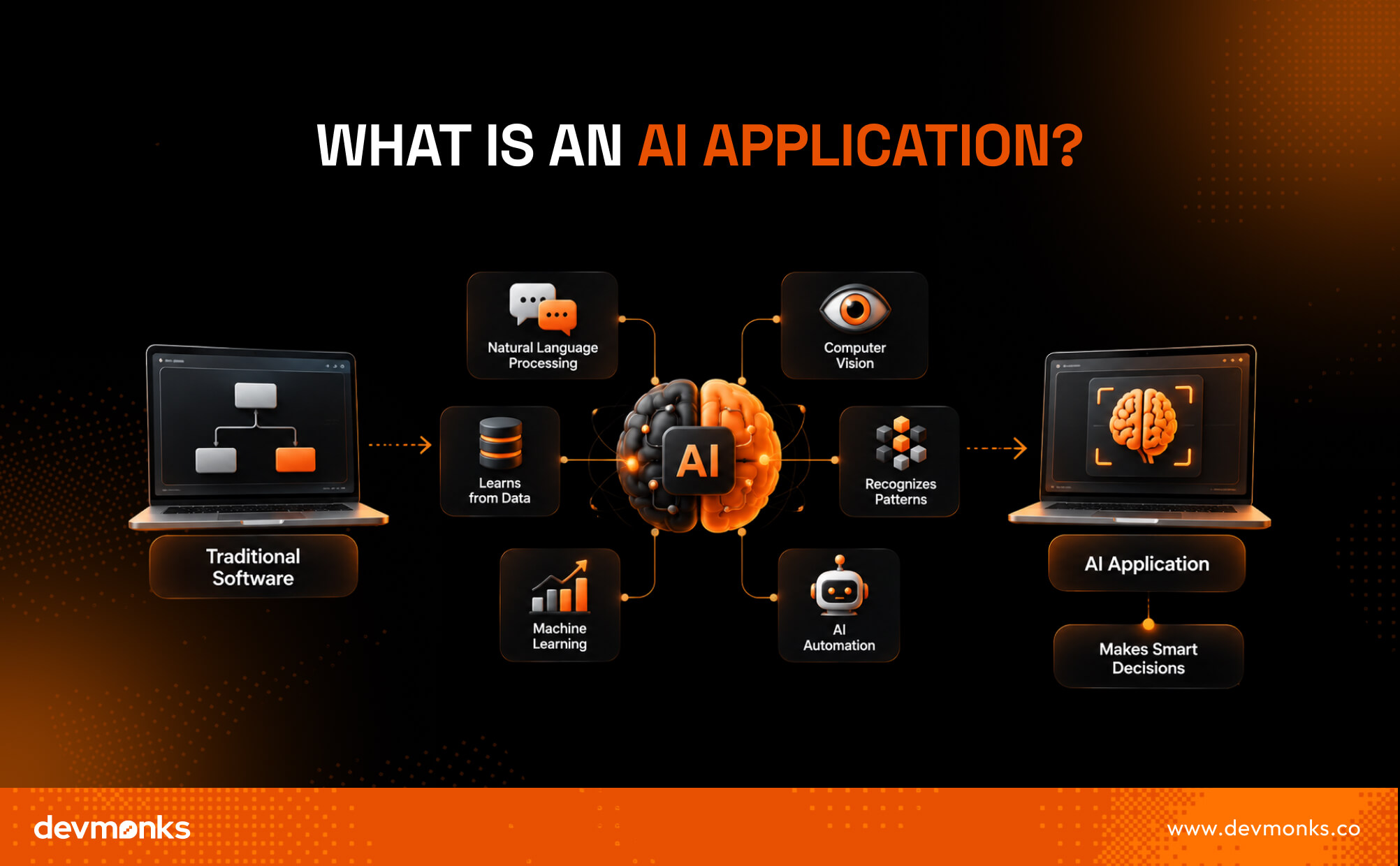
An AI application is software that uses Artificial Intelligence to perform tasks that normally require human thinking.
Unlike traditional software, which follows fixed rules, AI-powered software can learn from data, recognize patterns, and improve its performance over time. This makes AI-driven apps more flexible and capable of handling complex tasks.
AI application development is a specialized branch of application development that combines traditional software engineering with artificial intelligence to build smarter, data-driven solutions.
Many AI systems use Machine Learning, Deep Learning, and NLP (Natural Language Processing) to understand text, images, speech, and user behavior.
Technologies such as OpenAI and Google DeepMind have made modern intelligent applications more accurate and useful.
Today, businesses use AI software for chatbots, recommendations, fraud detection, content generation, and intelligent automation, helping users complete tasks faster and more efficiently.
If you're planning to develop an AI application, working with an experienced development agency like Dev Monks can help you build a secure, scalable, and high-performing solution.
Types of AI Applications You Can Build
AI can solve different business problems. The right application depends on your goals, industry, and users. Modern AI models make it possible to build everything from smart assistants to advanced analytics platforms.
Generative AI Applications
Generative AI applications create text, images, code, and other content using large language models.
Businesses use them to automate content creation, customer support, coding assistance, document generation, and other creative or productivity tasks.
Predictive AI Applications
Predictive AI uses predictive analytics to forecast trends and user behavior. Businesses use a recommendation engine to suggest products, movies, or content based on customer preferences.
Computer Vision Applications
Computer Vision helps software understand images and videos. Common uses include AI image recognition, OCR, object detection, and quality inspection.
Frameworks like TensorFlow and hardware from NVIDIA power many of these solutions.
Conversational AI Applications
Conversational AI includes every AI chatbot, AI assistant, and AI agent that understands natural language.
Industry-Specific AI Applications
AI is transforming healthcare, finance, retail, manufacturing, education, and SaaS with smarter automation, faster decisions, and personalized user experiences.
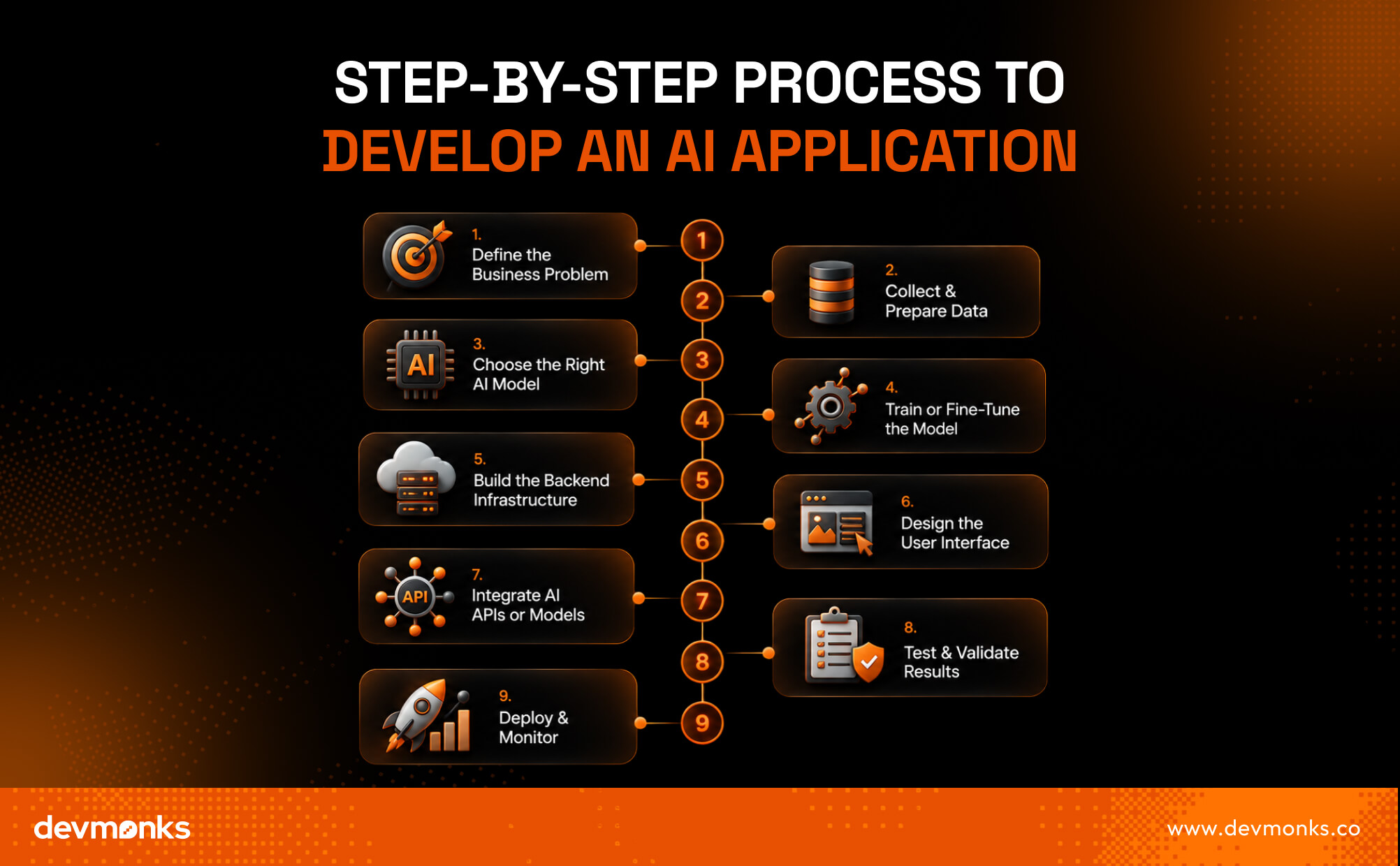
Step-by-Step Process to Develop an AI Application
Building an AI application involves more than choosing a model and writing code. You need a clear plan, quality data, the right technology, and continuous improvements after launch.
Step 1: Define the Business Problem
The first step is identifying the problem you want AI to solve. Ask what users need, what tasks can be automated, and how success will be measured.
Clear goals help you choose the right AI solution instead of adding AI where it is not needed. This step also defines your overall AI workflow and project scope.
Step 2: Collect and Prepare Data
After defining the problem, collect data from trusted sources, remove duplicates, fix errors, and label it correctly. Clean and organized datasets help improve accuracy and reduce bias during model training.
Step 3: Choose the Right AI Model
Different problems require different models. Generative AI often uses models available through the OpenAI API or Hugging Face. For image recognition, frameworks like TensorFlow and PyTorch are popular choices.
Step 4: Train or Fine-Tune the Model
You can either train a model from scratch or use fine-tuning to adapt an existing model to your business data.
Fine-tuning is often faster, more affordable, and delivers better results for specific use cases. During model training, monitor accuracy, precision, and other performance metrics to ensure the model learns correctly.
Step 5: Build the Backend Infrastructure
Your backend handles data processing, user requests, and AI operations. It should be secure, scalable, and able to process requests efficiently.
Many businesses use AWS, Azure, or Google Cloud to host AI applications because these platforms provide reliable infrastructure and built-in AI services.
Step 6: Design the User Interface
Next, design a clean and intuitive interface that makes AI features easy to access. Focus on simple navigation, fast responses, and clear feedback so users can interact with the application naturally.
Step 7: Integrate AI APIs or Models
Connect your application to the selected AI model through APIs or by hosting the model on your own infrastructure.
During this stage, configure prompts, manage requests, handle responses, and optimize inference speed so users receive fast and accurate results.
Step 8: Test and Validate Results
Before launch, test the application with real-world scenarios. Check the AI's accuracy, speed, security, and reliability. Validate outputs with different datasets and user groups to identify errors, reduce bias, and improve overall performance before production.
Step 9: Deploy and Monitor the Application
The final step is deployment. After release, continuously monitor performance, collect user feedback, and track AI accuracy. Update datasets, retrain or fine-tune models when needed, and improve the application over time.
AI is never truly finished, rather, it becomes more effective through ongoing monitoring and continuous optimization.
If your business lacks in-house AI expertise, partnering with an experienced AI development agency like Dev Monk can simplify the entire development process, from strategy and model selection to deployment and ongoing support.
Choosing the Right AI Technology Stack
The right AI tech stack depends on your application's features, performance needs, and budget. Choosing the right tools from the beginning makes development faster and future updates easier.
Programming Languages
Python is the most popular choice for AI because of its rich ecosystem. JavaScript is commonly used for web-based AI applications, while Java is preferred for many enterprise systems.
AI Frameworks
Frameworks like TensorFlow and PyTorch simplify AI model development. LangChain and LlamaIndex are popular LLM frameworks for building AI assistants that connect to external data.
Databases
A vector database such as Pinecone or Weaviate stores embeddings and enables fast vector search. SQL and NoSQL databases manage application and user data.
Cloud Infrastructure
AWS, Google Cloud, and Azure provide scalable infrastructure for training, deployment, and monitoring AI applications.
APIs and AI Services
Developers can integrate models through OpenAI, Anthropic Claude, and Gemini inference APIs.
AI Models Used in Modern Applications
The best AI model depends on what your application needs to do. Different models are designed for different tasks, from generating text to recognizing images and speech.
Large Language Models (LLMs)
LLMs such as GPT-4, Claude, Gemini, and Llama are powerful language models built on transformer architecture. These foundation models are ideal for chatbots, content generation, coding assistants, and document analysis.
Machine Learning Models
Traditional machine learning models work well for prediction, classification, fraud detection, and recommendation systems using structured data.
Deep Learning Models
Deep Learning uses neural network architectures to solve complex problems involving text, images, and audio.
Computer Vision Models
Computer vision models identify objects, faces, and text in images. They are widely used for image recognition and quality inspection.
Speech Recognition Models
Speech recognition models convert spoken language into text and understand voice commands. They power voice assistants, transcription tools, call center automation, and hands-free applications.
Data Requirements for AI Application Development
The success of an AI application depends on the quality of its data. Accurate, complete, and well-organized data helps AI models learn faster and produce more reliable results. A strong training dataset also reduces errors and improves overall performance.
Structured vs. Unstructured Data
AI applications can learn from structured data, such as spreadsheets and databases, as well as unstructured data like text, images, videos, and audio.
Data Collection
Gather enough training samples from reliable and relevant sources to ensure the model learns effectively.
Data Cleaning
Data preprocessing removes duplicates, fixes missing values, and corrects inconsistencies. Feature engineering also helps improve model performance.
Labeling Data
Annotation adds meaningful labels to raw data, allowing AI models to recognize patterns and make accurate predictions.
Privacy and Compliance
Protect user data by following regulations like GDPR and HIPAA. Strong data quality standards and privacy practices help build secure, trustworthy AI applications.
Building AI Applications with APIs vs Custom Models
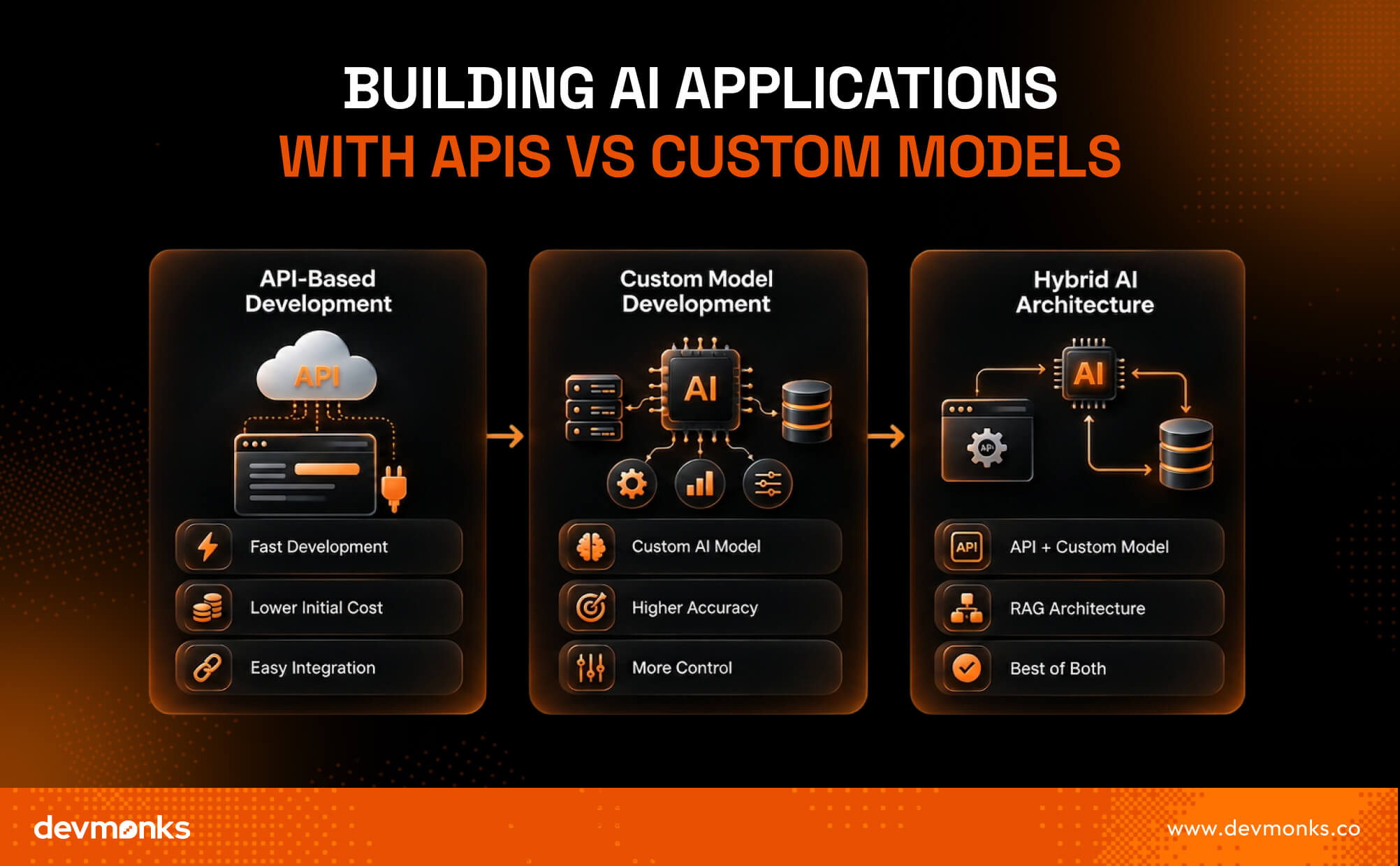
Businesses can build AI applications using ready-made APIs, custom AI models, or a combination of both. The right approach depends on your budget, performance needs, and project goals.
API-Based Development
API-based development is the fastest way to launch an AI application. Services like the OpenAI API and Anthropic API provide access to powerful foundation models without the need to build your own infrastructure.
With proper API integration, prompt engineering, and platforms like Hugging Face, developers can quickly create AI-powered features.
Custom Model Development
Custom models are trained or fine-tuned for specific business needs. They offer greater control, improved accuracy, and better performance for specialized tasks, but require more time, expertise, and computing resources.
Businesses with unique workflows often choose custom software development to build AI applications that match their specific requirements and integrate seamlessly with existing systems.
Hybrid AI Architecture
A hybrid approach combines APIs with custom models to balance speed and flexibility.
Many businesses use RAG architecture to connect foundation models with private knowledge bases, delivering more accurate, context-aware responses while keeping information up to date.
Challenges in AI Application Development
Developing AI applications comes with technical and ethical challenges that can affect performance, reliability, and user trust. Addressing these issues early leads to better long-term results.
Data Quality
Poor or incomplete data reduces model accuracy and leads to unreliable predictions.
AI Hallucinations
AI models can generate incorrect information. Hallucination mitigation techniques, such as better prompts and reliable data sources, help improve response quality.
Bias
Biased training data can produce unfair results. Following AI ethics and responsible AI practices helps create more balanced systems.
Model Drift
Over time, changing data can reduce model performance, which makes regular updates essential.
Scalability
Growing user demand can increase latency, which requires scalable infrastructure.
Security
Protect AI applications by following OWASP guidelines and complying with GDPR to keep user data secure.
Best Practices for Developing AI Applications
Following proven best practices helps you build AI applications that are accurate, scalable, and easy to maintain.
- Keep humans in the loop: Allow human review for important decisions to improve accuracy and reduce errors.
- Monitor performance continuously: Track AI outputs, response times, and accuracy after deployment.
- Use version control: Maintain different versions of models, datasets, and prompts for easier updates and rollbacks.
- Improve prompt engineering: Write clear, well-structured prompts to generate more reliable responses.
- Implement RAG: Connect AI models to trusted knowledge sources to deliver more accurate and up-to-date answers.
- Test thoroughly: Validate the application with real-world scenarios before every release.
- Focus on explainability: Help users understand how AI reaches its decisions.
- Create feedback loops: Collect user feedback and use it to continuously improve the AI model over time.
AI Application Development Cost and Timeline
The cost and timeline of AI application development depend on the project's complexity, features, and technology choices. Simple applications can be built in weeks, while enterprise solutions often take several months.
- MVP: A basic AI application usually takes 2–4 months to design, develop, test, and launch.
- Enterprise AI: Large-scale AI platforms with custom features and integrations typically require 6–12 months or longer.
- API pricing: Costs vary based on API provider, usage volume, and the AI model you choose.
- Infrastructure: Cloud hosting, storage, and computing resources affect ongoing expenses.
- Team size: Larger teams can speed up development but increase project costs.
- Maintenance: Regular updates, monitoring, model improvements, and security patches add to long-term costs.
Real-World AI Application Examples
AI is already helping businesses improve efficiency, reduce costs, and deliver better customer experiences across many industries. Here are some common real-world examples:
- Healthcare diagnosis: AI helps doctors analyze medical images, detect diseases earlier, and support faster clinical decisions.
- AI customer support: Chatbots and virtual assistants answer customer questions 24/7, which reduces wait times and improves satisfaction.
- Fraud detection: Banks and fintech companies use AI to identify unusual transactions and prevent fraudulent activities in real time.
- AI coding assistants: Developers use AI tools to write code, fix bugs, generate documentation, and speed up software development.
- Personalized ecommerce: Online stores recommend products based on browsing history, purchases, and customer preferences.
- Predictive maintenance: Manufacturers monitor equipment with AI to predict failures, reduce downtime, and schedule maintenance before costly breakdowns.
Future Trends in AI Application Development
AI is evolving rapidly, and new technologies are making applications smarter, faster, and more autonomous. Businesses that adopt these innovations early can gain a strong competitive advantage.
- AI Agents: Intelligent agents can plan tasks, make decisions, and complete multi-step workflows with minimal human input.
- Multimodal AI: Future AI applications will understand and generate text, images, audio, and video within a single system.
- Edge AI: Running AI directly on devices reduces latency, improves privacy, and enables real-time processing.
- Autonomous Workflows: AI will automate complex business processes with little manual intervention.
- AI Copilots: AI assistants will help users work faster by providing real-time guidance and recommendations.
- Small Language Models: Lightweight AI models deliver faster performance with lower computing costs.
- Agentic AI: AI systems will independently plan, reason, and execute tasks to achieve defined goals.
FAQs
How do AI apps make money?
AI apps generate revenue through subscription plans, one-time purchases, in-app purchases, advertisements, API usage fees, enterprise licensing, and premium features. Some businesses also offer custom AI solutions, consultation, or usage-based pricing for commercial customers.
Can I build an AI app without machine learning experience?
Yes. Many AI platforms and APIs allow developers to build AI applications without deep machine learning knowledge. However, understanding AI fundamentals, data handling, and prompt engineering helps you create more reliable, accurate, and scalable AI solutions.
Which programming language is best for AI application development?
Python is the most popular programming language for AI application development because of its extensive libraries and frameworks. JavaScript is excellent for AI-powered web applications, while Java is commonly used for enterprise AI systems that require high performance and scalability.
End Note
Developing an AI application requires careful planning, quality data, the right technology stack, and continuous improvement after launch.
Whether you're building a simple AI assistant or an enterprise solution, following a structured development process will increase your chances of success.
Start with a clear business goal, focus on user needs, and partner with an experienced AI development team to turn your idea into a reliable, scalable application.
.png)
.svg)
Frequently Asked Questions
How long does it usually take to complete a project?

We combine AI-driven workflows with product-first engineering to provide MVP development services for startups and enterprises. Our approach balances speed, reliability, and usability while keeping teams involved. We deliver production-ready, scalable solutions, not just prototypes or demos.
What makes Dev Monks different from other development companies?
We combine AI-driven workflows with product-first engineering to provide MVP development services for startups and enterprises. Our approach balances speed, reliability, and usability while keeping teams involved. We deliver production-ready, scalable solutions, not just prototypes or demos.
How Involved Will My Team be During Development?
We combine AI-driven workflows with product-first engineering to provide MVP development services for startups and enterprises. Our approach balances speed, reliability, and usability while keeping teams involved. We deliver production-ready, scalable solutions, not just prototypes or demos.
How involved will my team be during development?
We combine AI-driven workflows with product-first engineering to provide MVP development services for startups and enterprises. Our approach balances speed, reliability, and usability while keeping teams involved. We deliver production-ready, scalable solutions, not just prototypes or demos.
Do you develop both web and mobile applications?
We combine AI-driven workflows with product-first engineering to provide MVP development services for startups and enterprises. Our approach balances speed, reliability, and usability while keeping teams involved. We deliver production-ready, scalable solutions, not just prototypes or demos.
How can Dev Monks help my startup launch faster
We combine AI-driven workflows with product-first engineering to provide MVP development services for startups and enterprises. Our approach balances speed, reliability, and usability while keeping teams involved. We deliver production-ready, scalable solutions, not just prototypes or demos.